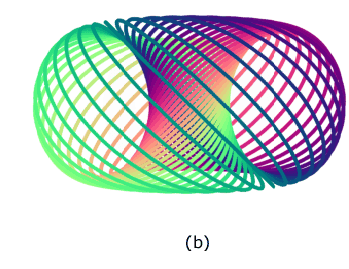
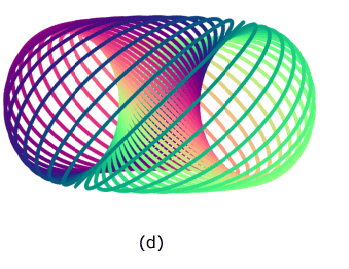
So I think I have an answer to my original question which was the title of this thread,
Hopf Fibration, torus with fibers, do it 2 ways?
I think that the answer to my question is yes and there are 2 fibrations that cannot be rotated into each other? To understand this requires only some simple assumptions about Hopf Fibrations which I think to be true.
Imagine a very large 3-sphere and the set of fibers of its fibration. Pick a point of this 3-sphere and consider a fiber that goes through this point. Now with the point and the fiber we can define a 2-sphere that goes through the point, is perpendicular to the fiber, and divides the 3-sphere in two equal halves? Our fiber actually goes through this 2-sphere at 2 antipodal points and is perpendicular at both points? Now surround this fiber with with a small torus of radius r such that the fiber is perfectly centered in the center of the torus. This torus is in fact the union of 2 inequivalent sets of fibers, typical fibers shown in yellow and blue of the projection of our torus below? Ignore the green and light blue lines below.
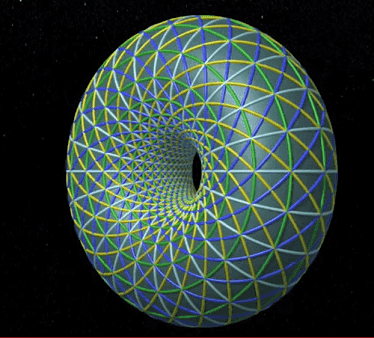
If we were in the 3-sphere we would not see the image above but see a "straight" fibered torus. Keep that picture in your head, what you would actually see because under a rotation of the 3-sphere what you see does not change, the 3-sphere and its fibrations rotate "rigidly"? The two fibrations are inequivalent and can not be rotated into one another?
Please point out where I may have made questionable assumptions.
Thanks.
Image captured from,