How can I determine Rth in Thevenin with a transconductance source?

  • Thread starter Thread starter qwertyuiop
  • Start date Start date
  • Tags Tags
    Thevenin
Click For Summary

Discussion Overview

The discussion revolves around determining the Thevenin resistance (Rth) in a circuit that includes a transconductance source. Participants explore the application of Thevenin's theorem, nodal analysis, and the implications of negative resistance in this context.

Discussion Character

  • Technical explanation
  • Debate/contested
  • Mathematical reasoning

Main Points Raised

  • One participant describes using Thevenin's theorem and nodal analysis to find Rth, questioning the correctness of their approach.
  • Another participant raises a question about the nature of the components involved, specifically whether they are all resistors given the units in kila-ohms.
  • There are corrections regarding the formulation of equations used in the analysis, with one participant pointing out a mistake in the expression involving the dependent source.
  • A participant expresses confusion about the sign of a term in their equation, leading to a discussion about the definition of current directions in nodal analysis.
  • Concerns are raised about the possibility of obtaining a negative Rth, with one participant stating their calculated value as -1363 ohms and questioning its validity.
  • Another participant explains that the negative Rth arises from the characteristics of the transconductance source and provides a mathematical expression to illustrate the conditions under which Rth can be negative.

Areas of Agreement / Disagreement

Participants do not reach a consensus on the implications of a negative Rth, with some accepting it as a valid outcome due to the circuit's configuration, while others express uncertainty about its physical meaning.

Contextual Notes

The discussion includes various assumptions about the definitions of currents and the behavior of dependent sources, which may affect the interpretation of results. The calculations and reasoning presented depend on the specific circuit configuration and the definitions chosen by participants.

qwertyuiop
Messages
7
Reaction score
0
Member advised to use the homework template for posts in the homework sections of PF.
This is the question
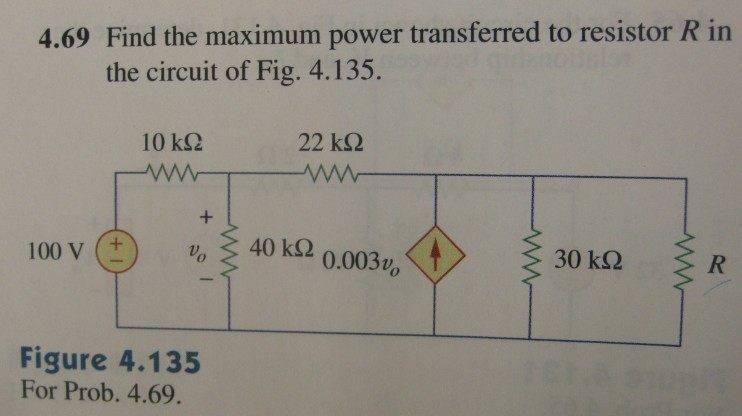
negative-thevenin-resistance-jpg.jpg

First,I use thevenin theorem,when I close the voltage source, i apply nodal analysis to find rth,is my answer correct?
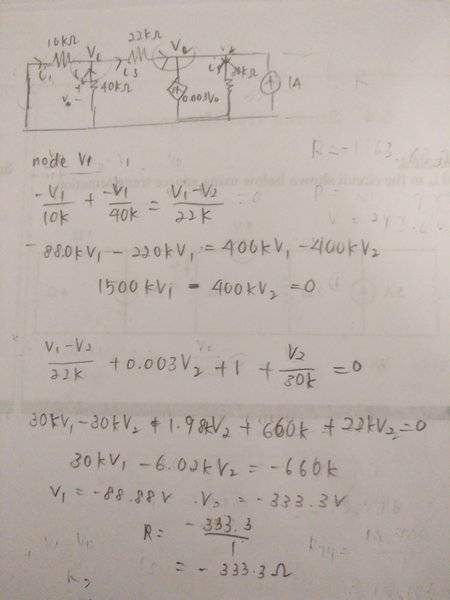
IMG20170523084138.jpg
 
Last edited by a moderator:
Physics news on Phys.org
Just a question but aren't those all resistors if the units are kila-ohms?
 
Futurestar33 said:
Just a question but aren't those all resistors if the units are kila-ohms?
I don't understand what you mean
 
Dependent source 0.003vo should, with your nomenclature, be written 0.003V1
 
  • Like
Likes   Reactions: qwertyuiop
Note: we are not able to see what's at your facebook link, if it's applicable
 
NascentOxygen said:
Note: we are not able to see what's at your facebook link, if it's applicable
Moderator's note: I've restructured the original post to make the relevant images visible, and removed the facebook link as it was not accessible. @qwertyuiop is advised to upload relevant content rather than link to a facebook page.
 
Halfway down the page of your calculations you have:

(V1-V2)/22k + 0.003 V2 +1 + V2/30k = 0

This should be:

(V1-V2)/22k + 0.003 V1 +1 - V2/30k = 0

Which should then become:

30 V1 - 30 V2 + 1980 V1 + 660000 - 22 V2 = 0

Which becomes:

2010 V1 - 52 V2 = -660000
 
  • Like
Likes   Reactions: qwertyuiop
NascentOxygen said:
Dependent source 0.003vo should, with your nomenclature, be written 0.003V1
Thank you for you helping,now i know my mistake
 
gneill said:
Moderator's note: I've restructured the original post to make the relevant images visible, and removed the facebook link as it was not accessible. @qwertyuiop is advised to upload relevant content rather than link to a facebook page.
Thank you
 
  • #10
The Electrician said:
Halfway down the page of your calculations you have:

(V1-V2)/22k + 0.003 V2 +1 + V2/30k = 0

This should be:

(V1-V2)/22k + 0.003 V1 +1 - V2/30k = 0

Which should then become:

30 V1 - 30 V2 + 1980 V1 + 660000 - 22 V2 = 0

Which becomes:

2010 V1 - 52 V2 = -660000
Thank you for your help.
I don't understand why - V2/30k ?
 
  • #11
qwertyuiop said:
Thank you for your help.
I don't understand why - V2/30k ?

Because you have chosen to define currents into a node as positive. The other choice people make is to define current out of a node as positive. But whichever you choose, you must be consistent.

The expression V2/30k gives the current out of the node, so its sign must be negative.
 
  • Like
Likes   Reactions: qwertyuiop
  • #12
The Electrician said:
Because you have chosen to define currents into a node as positive. The other choice people make is to define current out of a node as positive. But whichever you choose, you must be consistent.

The expression V2/30k gives the current out of the node, so its sign must be negative.
ok, thank you for your help. In this circuit, I find the rth = -1363ohm. Is possible rth is negative? why?
 
Last edited:
  • #13
qwertyuiop said:
ok, thank you for your help. In this circuit, I find the rth = -1363ohm. Is possible rth is negative? why?

The dependent source in this circuit is a transconductance source. The value 0.003 is the transconductance. Substitute a variable x for the value 0.003 and solve the circuit for Rth. You will get this expression: Rth = 3.75/(.00025-x). You can see that if x is greater than .00025, Rth will be negative; since .003 is greater than .00025, we get a negative value for Rth.

The circuit of this thread is an example of a circuit with an active element connected in such a way as to generate a negative resistance. There are other well known circuits that can do this, for example: https://en.wikipedia.org/wiki/Negative_impedance_converter
 
  • #14
The Electrician said:
The dependent source in this circuit is a transconductance source. The value 0.003 is the transconductance. Substitute a variable x for the value 0.003 and solve the circuit for Rth. You will get this expression: Rth = 3.75/(.00025-x). You can see that if x is greater than .00025, Rth will be negative; since .003 is greater than .00025, we get a negative value for Rth.

The circuit of this thread is an example of a circuit with an active element connected in such a way as to generate a negative resistance. There are other well known circuits that can do this, for example: https://en.wikipedia.org/wiki/Negative_impedance_converter

Thank you
 

Similar threads

  • · Replies 1 ·
Replies
1
Views
2K
  • · Replies 12 ·
Replies
12
Views
4K
  • · Replies 7 ·
Replies
7
Views
3K
  • · Replies 42 ·
2
Replies
42
Views
7K
  • · Replies 5 ·
Replies
5
Views
2K
  • · Replies 10 ·
Replies
10
Views
3K
  • · Replies 10 ·
Replies
10
Views
4K
  • · Replies 5 ·
Replies
5
Views
2K
  • · Replies 3 ·
Replies
3
Views
2K
  • · Replies 4 ·
Replies
4
Views
6K