High School How can I model a density function of a compressible fluid?

Click For Summary
To model the density of a compressible liquid in a cylinder under hydrostatic conditions, one can use the relationship between pressure and elevation, described by the equation dP/dz = -ρg. The density function can be approximated using the formula ρ = ρ0[1 + β(P - P0)], where ρ0 is the density at a reference pressure P0, and β is the bulk compressibility. By integrating the pressure equation, P = PB e^(-ρ0 g β z) + [P0 - 1/β](1 - e^(-ρ0 g β z)), the pressure at any elevation can be determined. This approach allows for calculating both the average pressure and average density throughout the cylinder. The discussion emphasizes the importance of understanding hydrostatic principles for accurate modeling.
Se Adolf
Messages
1
Reaction score
0
I have a cylinder of some dimensions. I have a compressible liquid inside. Assuming a constant temperature, no atmosphere, no convection currents within, because it is in a cylinder, there will be no variations in density horizontally (the fluid will have time to settle). Now because there is gravity, the liquid will be pulled down and because the volume of water on top increases as depth increases, the fluid will be more dense at the bottom than at the top. So I pick for example two densities: 0.5 and 1 with 0.5 at the very top of the cylinder and 1 at the very base of it. Something as follows:

https://ibb.co/DCWmTZH

https://ibb.co/DCWmTZH < Sloppy Diagram of what I mean
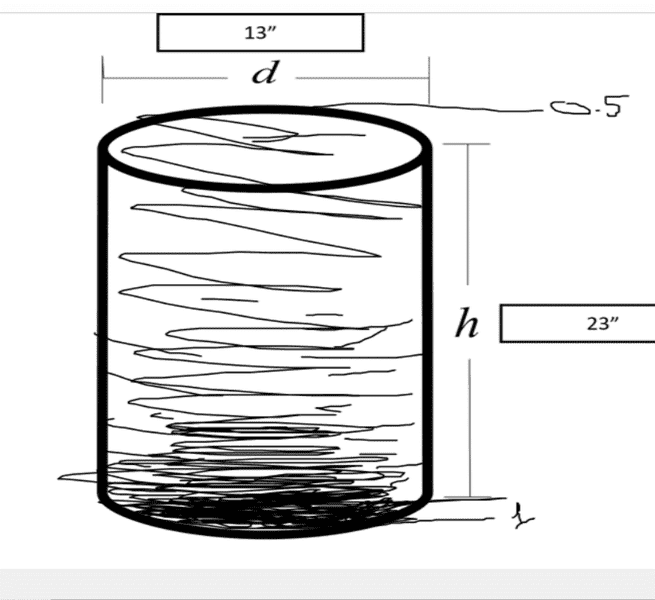
Picture1.png


So my question is how can I model this? How can I get some kind of density function out of this? Please go easy on me, I don't really do physics, this is for a Mathematics investigation. Thank you in advance for help, I'm kinda desperate at this point :P.
 

Attachments

  • Picture1.png
    Picture1.png
    23.2 KB · Views: 473
Last edited by a moderator:
Physics news on Phys.org
Hello Se Adolf, :welcome:

Perhaps you can find some inspiration in the derivation of the barometric formula ?
 
For a liquid, the density can be approximated by $$\rho=\rho_0[1+\beta (P-P_0)]$$where ##\rho_0## is the liquid density at pressure ##P_0##, P is the local pressure in the liquid, and ##\beta## is the bulk compressibility of the liquid.

The liquid in the cylinder is under hydrostatic conditions, so the pressure is related to elevation z above the bottom of the cylinder by $$\frac{dP}{dz}=-\rho g$$If we combine these two equations, we obtain: $$\frac{dP}{dz}=-\rho_0 g[1+\beta (P-P_0)]$$If we solve this equation for the pressure P as a function of the elevation z, we obtain:
$$P=P_Be^{-\rho_{0} g \beta z}+\left[P_0-\frac{1}{\beta}\right](1-e^{-\rho_{0} g \beta z})$$
where ##P_B## is the pressure at the base of the cylinder z = 0.

Once the pressure at the base is specified, we can determine the pressure at any elevation in the cylinder. We can also integrate this equation over the height of the cylinder to get the average pressure, and also the average liquid density.
 
Thread 'What is the pressure of trapped air inside this tube?'
As you can see from the picture, i have an uneven U-shaped tube, sealed at the short end. I fill the tube with water and i seal it. So the short side is filled with water and the long side ends up containg water and trapped air. Now the tube is sealed on both sides and i turn it in such a way that the traped air moves at the short side. Are my claims about pressure in senarios A & B correct? What is the pressure for all points in senario C? (My question is basically coming from watching...

Similar threads

  • · Replies 3 ·
Replies
3
Views
3K
  • · Replies 6 ·
Replies
6
Views
2K
  • · Replies 6 ·
Replies
6
Views
1K
Replies
20
Views
6K
  • · Replies 14 ·
Replies
14
Views
2K
  • · Replies 45 ·
2
Replies
45
Views
6K
  • · Replies 17 ·
Replies
17
Views
5K
  • · Replies 1 ·
Replies
1
Views
3K
  • · Replies 48 ·
2
Replies
48
Views
5K
  • · Replies 2 ·
Replies
2
Views
1K
