How Do Length-Adjustable Gas Springs Work?

Click For Summary

Discussion Overview

The discussion centers around the functioning of length-adjustable gas springs, particularly in office chairs. Participants explore the mechanics of these gas springs, their locking mechanisms, and the implications of their design on performance and user experience.

Discussion Character

  • Exploratory
  • Technical explanation
  • Debate/contested

Main Points Raised

  • One participant suggests that length-adjustable gas springs operate as closed systems, proposing that closing the piston orifice would alter their force profile to resemble that of a mechanical spring.
  • Another participant speculates that there may be a coil spring in the gas spring's design, questioning the existence of a piston orifice and suggesting an external valve-controlled channel for gas flow.
  • A participant provides a rough calculation of the force and pressure involved in a gas spring, expressing concern about the potential dangers of venting the gas when adjusting the chair.
  • One participant references an external source, explaining that gas springs in office chairs are designed to allow gentle height adjustments without needing significant force from the user.
  • Another participant challenges the explanation from the external source, arguing that the locking mechanism must involve more than just friction and that the gas spring itself contributes to the spring-like behavior when locked.
  • A participant shares a link to a specific product, indicating interest in a particular design of locking gas springs.
  • One participant expresses appreciation for a diagram found in the discussion, noting that while their initial understanding was correct, the design presented is more elegant and raises questions about spring stiffness at different locking positions.

Areas of Agreement / Disagreement

Participants express differing views on the mechanics of gas springs, particularly regarding the locking mechanism and the role of gas pressure versus mechanical components. No consensus is reached on the exact workings of these systems.

Contextual Notes

Participants acknowledge various assumptions about the design and functionality of gas springs, including the potential for different spring stiffness at various locking positions and the implications of gas pressure on performance. Some calculations and hypotheses remain unverified.

Tazerfish
Messages
157
Reaction score
39
I was uncertain wether to put this in the general physics forum, but I decided against it.

How do length adjustable gas springs(like for example in office chairs)work ?
I know how gas springs work and i even have an idea how length adjustable ones could work.

Since you hear a "gas flowing sound" when when you pull the lever on the chair and since the whole apperatus is pressurized and so an airflow out of the spring would be irreversible, I assume there is no air exchange between the inside and outside.
It has to work as a closed system.
gas-spring-diagram.png


My Idea:
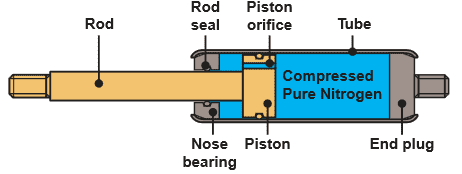
If you could close the piston orifice in the upper picture, the gas spring would stop having a roughly constant force to extension profile and would behave like a normal mechanical spring(following an approximately linear curve with its equillibrium position on the locking position)
The gas springs could additionally apply forces much higher than in their "free" states.
That behaviour is necessary in chairs.You want the chair to be able to hold you up in its locked position but move down with you when you try to adjust the height.
There are however a few problems with this.
The spring hardness would be higher if you "locked" the spring in one of the more extreme (very short or long) positions due to the smaller volumes that get encompassed on one of the sides.
 
Engineering news on Phys.org
I just tried bouncing on my chair at various set heights. It feels like there is a coil spring in the righthand chamber of your drawing that is never fully compressed. I suspect the piston orifice doesn't exist and there is an external, valve controlled, channel that connects the two chambers when you pull the lever.

Maybe someone else here knows how they are actually built (or has been foolish enough to try opening one).
 
Tom.G said:
I just tried bouncing on my chair at various set heights. It feels like there is a coil spring in the righthand chamber of your drawing that is never fully compressed. I suspect the piston orifice doesn't exist and there is an external, valve controlled, channel that connects the two chambers when you pull the lever.

Maybe someone else here knows how they are actually built (or has been foolish enough to try opening one).
That sounds scary. I did a little back of the envelope calculation.
I assume the gas spring in my chair has about 300 Newtons of force in the free mode.(I can just barely push it down with one foot on it)
And the rod diameter is 2.5 cm give or take a millimeter.So the necessary pressure to supply such a force on that small an area is roughly 5 atm
or 4800 hPa. How in the world would you vent that ?(I know there is a cap on the bottom of the spring but I don't want to imagine what happens when you pull it :eek:

I also thought about and "external gas channel".It could work like this. Then the "spring hardness" would be smaller because of the larger volumes and would vary less with the "extension of locking".
1.png

PS:I am quite sure there is no spring in there, it just feels like it.

I found this picture on the internet. Maybe you can figure it out ?
879623374_251.jpg

2.png
 
From http://www.explainthatstuff.com/gassprings.html:
For a gas-lift office chair, you need the spring to provide a little bit more force than the weight of the seat. In most chairs, the spring doesn't actually support the person's weight. Instead, it typically has a lever attached that grips and locks at a certain height, preventing the seat from moving up or down any further. The spring is simply designed to let the seat move up and down gently without your having to supply much force.
 
jack action said:
That is nice and all but I am specifically interested in how the locking works.
It probably is still the gas spring which holds you up, not some secondary mechanism.
The "gripping and locking" sounds weird. That wouldn't explain the springlike and "bouncy" behavior of the locked spring.
There clearly is an equilibrium position around which you get restoring forces.The locking is not just frictional!
And "you need the spring to provide a little bit more force than the weight..." is not how the designers of my chair did it.
A small child would have no way of shortening the gas spring in my chair. The extra force in its free state is easily a third or even half my weight.(about 60 kg)

I assume that isn't just a flaw of design. The higher pressure inside the gas spring would produce a higher spring hardness in its locked state if the locking works anything like I suspect.
 
Wow, I really appreciate that you found that diagram.:smile:
I at least got the basic principle right, but their design is somewhat more elegant.
I really like how the "venting" is done.It makes me appreciate my chair every time I hear the sound it makes when adjusting the height. :)
But it looks like this design would have the problem I came up with:
The spring stiffness would not be the same for all locking positions.
I tried bouncing on the chair a few times at different heights and that behavior seems to actually happen.
Maybe I am just imagining things o0)

Thanks again
 

Similar threads

Replies
4
Views
2K
  • · Replies 9 ·
Replies
9
Views
3K
  • · Replies 5 ·
Replies
5
Views
2K
  • · Replies 5 ·
Replies
5
Views
4K
  • · Replies 4 ·
Replies
4
Views
4K
  • · Replies 9 ·
Replies
9
Views
2K
  • · Replies 5 ·
Replies
5
Views
3K
  • · Replies 4 ·
Replies
4
Views
5K
  • · Replies 8 ·
Replies
8
Views
3K
  • · Replies 33 ·
2
Replies
33
Views
4K