How Do You Calculate Strain Energy in Beams Using Integral Equations?

Click For Summary

Discussion Overview

The discussion revolves around calculating strain energy in beams using integral equations, specifically focusing on the bending moment and its representation in the integral form. Participants explore the application of the integral equation to derive strain energy, addressing specific questions related to the bending moment function and its integration over the length of the beam.

Discussion Character

  • Technical explanation, Mathematical reasoning, Debate/contested

Main Points Raised

  • Some participants suggest that the strain energy can be calculated by taking '2EI' out of the integral and integrating the square of the bending moment, M^2.
  • Others clarify that the strain energy is represented by the integral U = ∫(M^2(s)/(2EI)) ds, emphasizing that if EI is constant, it can be factored out of the integral.
  • A participant presents a calculation yielding a strain energy of 26.315 kJ, which contrasts with a provided solution of 8.772 kJ, noting that the latter is a third of their result.
  • Another participant points out that M(s) is not constant over the length of the beam and discusses the importance of the bending moment diagrams in calculating strain energy.
  • There is a request for clarification on the phrase 'squared term by term,' leading to a discussion about squaring the ordinates of the bending moment diagram for integration.
  • A participant mentions that for a second beam, dividing their previous result by 3 yields the correct solution, indicating a potential pattern or relationship in the calculations.

Areas of Agreement / Disagreement

Participants express differing views on the correct approach to calculating strain energy, with some agreeing on the need to square the bending moment function while others challenge the initial assumptions and calculations. The discussion remains unresolved regarding the correct method and results.

Contextual Notes

Participants note that the bending moment varies along the length of the beam, which affects the integration process. There are also references to specific beam loading conditions and the need for symbolic expressions for M(s) to evaluate the integral accurately.

smr101
Messages
72
Reaction score
0
I can't work out the strain energy using the integral equation here, question (b)(i).

I've got the bending moment for the first beam as 400kN.

E and I are given, I'm guessing you can take '2EI' out of the integral and just integrate the M^2, is that correct?
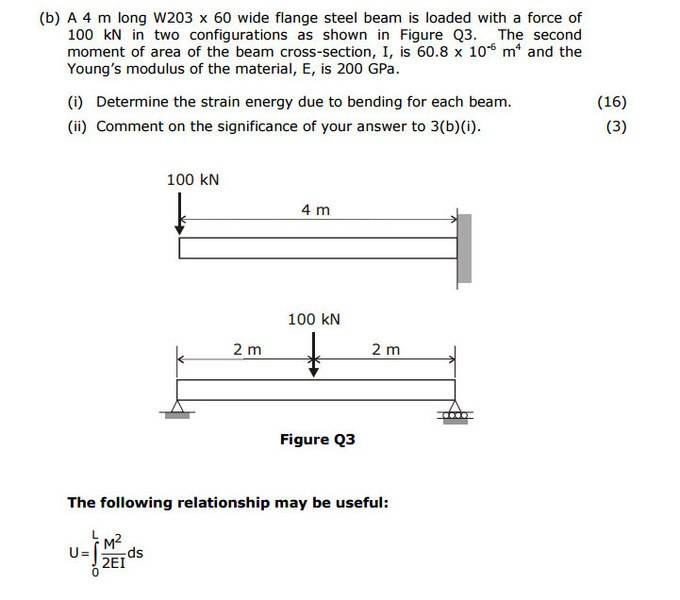
OcWeW.jpg
 
Physics news on Phys.org
smr101 said:
I can't work out the strain energy using the integral equation here, question (b)(i).

I've got the bending moment for the first beam as 400kN.

E and I are given, I'm guessing you can take '2EI' out of the integral and just integrate the M^2, is that correct?
OcWeW.jpg

To calculate the strain energy of the beams, you need to know the function of M w.r.t. the length coordinate of each beam, which is s here.

So the strain energy is more accurately represented by the following integral:

##U=\int_0^L \frac {M^2(s)}{2EI} \, ds##

If EI is a constant value over the length of the beam, it can be moved before the integral sign, like any other constant.
 
SteamKing said:
To calculate the strain energy of the beams, you need to know the function of M w.r.t. the length coordinate of each beam, which is s here.

So the strain energy is more accurately represented by the following integral:

##U=\int_0^L \frac {M^2(s)}{2EI} \, ds##

If EI is a constant value over the length of the beam, it can be moved before the integral sign, like any other constant.

This is what I thought would be the case, I did the following:

2EIU = M^2*s

U = 400,000^2 * 4 / (2 * 200x10^9 * 60.8x10^-6)

= 26.315 kJ

The solution states the answer is 8.772 kJ.

Which strangely enough is exactly a third of the answer I got it...
 
smr101 said:
This is what I thought would be the case, I did the following:

2EIU = M^2*s

U = 400,000^2 * 4 / (2 * 200x10^9 * 60.8x10^-6)

= 26.315 kJ

The solution states the answer is 8.772 kJ.

Which strangely enough is exactly a third of the answer I got it...

In each beam case, M(s) ≠ constant over the length of the beam.

Remember drawing shear and bending moment diagrams for beams with various loadings? The integral of the strain energy in bending is the area under those bending moment curves squared term-by-term, then divided by 2EI. That's the calculation you are supposed to do here.
 
SteamKing said:
In each beam case, M(s) ≠ constant over the length of the beam.

Remember drawing shear and bending moment diagrams for beams with various loadings? The integral of the strain energy in bending is the area under those bending moment curves squared term-by-term, then divided by 2EI. That's the calculation you are supposed to do here.

I'm not understand what you mean by 'squared term by term'. What terms?

Again, I've noticed for the second beam doing what I did in my last post and dividing by 3 gives the correct solution.
 
smr101 said:
I'm not understand what you mean by 'squared term by term'. What terms?
I meant point-by-point.
The bending moment curve for a cantilever beam loaded at the end is this:

cantilever1.JPG

In order to evaluate the integral
##U=\int_0^L \frac {M^2(s)}{2EI} \, ds##
you must square the ordinates of the bending moment diagram.

Since the ordinates of this bending moment diagram vary linearly with the coordinate s, which runs along the length of the beam, you can find a symbolic expression for M(s) as a function of s and then square that expression and evaluate the integral for U.
Again, I've noticed for the second beam doing what I did in my last post and dividing by 3 gives the correct solution.

The bending moment diagram for the second beam is similar to the one below:

2000px-Shear_Moment_Diagram.svg.png

Just as in the case of the cantilever beam, you can find a symbolic expression for M(s) for the simply-supported beam and use the square that expression for M(s) to evaluate the integral which gives U. In this case, it might be easier to split the integration interval 0 ≤ s ≤ L into two parts.
 
  • Like
Likes   Reactions: smr101

Similar threads

  • · Replies 3 ·
Replies
3
Views
7K
Replies
13
Views
23K
Replies
3
Views
3K
  • · Replies 15 ·
Replies
15
Views
6K
Replies
62
Views
24K
  • · Replies 1 ·
Replies
1
Views
2K
  • · Replies 9 ·
Replies
9
Views
4K
  • · Replies 2 ·
Replies
2
Views
2K
  • · Replies 6 ·
Replies
6
Views
2K
Replies
1
Views
5K