How Does the Angle at P1 Change Over Time Until the Object Falls?

2 replies · 2K views · last reply
AI_Messiah
Messages
5
Reaction score
0
TL;DR
I have provided an illustration so that anyone who understands enough about rigid body physics can understand what I mean.
So I have 2 Points P1 and P2. P2 is the center of mass which has an X and Y coordinate. P1 is where I think that it will fall over from and only has an X location.
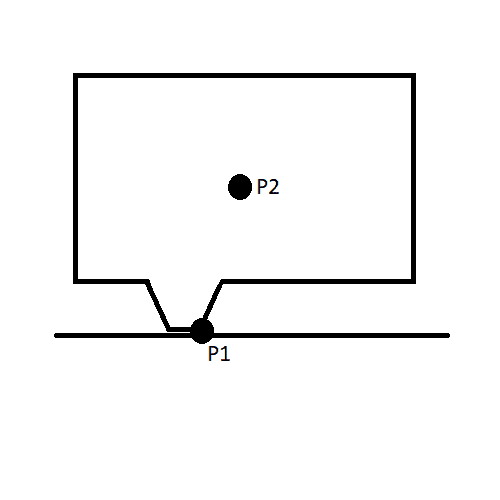
Diagram of a rigid body resting on a horizontal floor line, with a notch in its bottom edge touching the floor at point P1 and its center of mass marked as P2 inside the body.

Now what I want is to find a way to get how far the angle at P1 will change in relation to where these points are within a given amount of time until the edge on the far right bottom hits the floor and this object may or may not have a velocity when I am making the calculation.
 
AI_Messiah said:
Summary:: I have provided an illustration so that anyone who understands enough about rigid body physics can understand what I mean.

So I have 2 Points P1 and P2. P2 is the center of mass which has an X and Y coordinate. P1 is where I think that it will fall over from and only has an X location.

View attachment 297108
Now what I want is to find a way to get how far the angle at P1 will change in relation to where these points are within a given amount of time until the edge on the far right bottom hits the floor and this object may or may not have a velocity when I am making the calculation.
So as @Dale says, you just sum the moments on your Free Body Diagram (FBD) that you draw for the mechanical system. Do you know how to do that yet? Is this related to your other thread start here at PF?

https://www.physicsforums.com/threads/rigid-body-physics-machine-learning-environment.1012171/