How to activate a relay using a phototransistor

  • Thread starter Thread starter Sauce6378
  • Start date Start date
  • Tags Tags
    Relay
Click For Summary

Discussion Overview

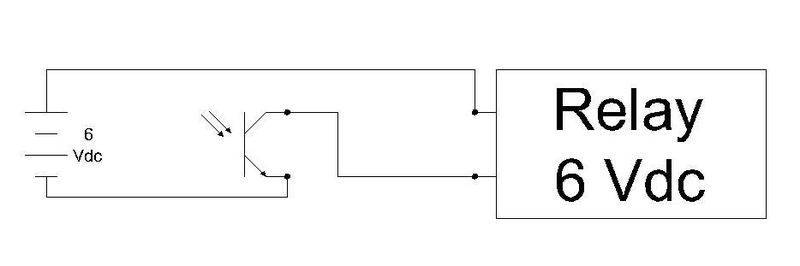
The discussion revolves around the activation of a relay using a phototransistor as an input to a programmable logic controller (PLC). Participants explore the challenges and potential solutions related to current requirements and circuit design.

Discussion Character

  • Technical explanation
  • Debate/contested
  • Experimental/applied

Main Points Raised

  • One participant notes that the relay does not energize when the phototransistor is conducting, seeking clarification on the issue.
  • Another participant suggests that the relay requires a significant current to operate, which the phototransistor cannot provide due to its resistance, even in bright light.
  • A proposed solution involves using an amplifier circuit and possibly increasing the voltage to 9 volts, along with a series resistor of around 1000 ohms with the phototransistor.
  • Participants discuss the use of specific transistors, such as TIP31 or BD139, for the amplification circuit.
  • A later reply introduces a method to reverse the action of the relay, detailing a circuit design and resistor values needed to achieve the desired operation based on the phototransistor's state.
  • There is mention of determining the correct resistor values experimentally to ensure the relay activates properly.

Areas of Agreement / Disagreement

Participants express differing views on the necessary circuit design and component values, indicating that multiple competing approaches exist without a consensus on the best solution.

Contextual Notes

Participants reference specific circuit designs and resistor values but do not provide definitive calculations or outcomes, leaving some assumptions and dependencies on experimental results unresolved.

Who May Find This Useful

This discussion may be useful for individuals interested in electronics, particularly those working with phototransistors and relay circuits in automation or control systems.

Sauce6378
Messages
3
Reaction score
0
I am trying to use some 6 volt phototransistor sensors as inputs to a plc. Can someone tell me how come the relay will not energize when the phototransistor is conducting? Thank You
RELAY2.jpg
 
Engineering news on Phys.org
The relay needs quite a large current to make it work and the phototransistor has too much resistance, even in bright light, to let that much current flow.

So, you need an amplifier like this:

http://dl.dropbox.com/u/4222062/Relay%20driver%203.JPG

Although you might need a bit more than 6 volts (maybe 9 volts) and you might need a resistor in series with the phototransistor (maybe 1000 ohms). But it might work well enough as shown.

The transistor can be a small power transistor like a TIP31 or a BD139.
 
Last edited by a moderator:
Thank You So Much! Sauce
 
Thanks for the personal mail.

To reverse the action, you would need to use a circuit like this:
http://dl.dropbox.com/u/4222062/Relay%20driver%204.JPG

To find out the right values for the resistors, R1 and R2 you will need to find out the value of base resistor that gives enough collector current to pull the relay in.

Suppose you found that 4700 ohms instead of R1 and R2 would make the relay pull in.
(You would do this without the phototransistor.)
Then you could make R1 and R2 both 2.2K.
R1 should equal R2 and the two should add up in value to the total resistance you found would turn the transistor on.

If the phototransistor is on, (in bright light) then the junction of R1 and R2 will be low causing the transistor to turn off and the relay to drop out.
When the phototransistor is off (ie in darkness) the relay will pull in because the transistor will get normal base current.
 
Last edited by a moderator:
Thanks Again! Sauce
 

Similar threads

  • · Replies 25 ·
Replies
25
Views
3K
  • · Replies 4 ·
Replies
4
Views
2K
Replies
12
Views
4K
  • · Replies 31 ·
2
Replies
31
Views
5K
  • · Replies 6 ·
Replies
6
Views
3K
  • · Replies 17 ·
Replies
17
Views
3K
Replies
37
Views
7K
  • · Replies 3 ·
Replies
3
Views
1K
Replies
21
Views
23K
Replies
3
Views
2K