How to Calculate Power Dissipation in Resistors?

Click For Summary
SUMMARY

This discussion focuses on calculating power dissipation in resistors R1, R2, and R3 using the formula P = I²R. The currents provided are I1 = 0.8409 A, I2 = -0.4545 A, and I3 = 0.39 A. The correct calculations yield power dissipation values of 0.7071 W for R1, 0.41314 W for R2, and 0.4563 W for R3. The key takeaway is to multiply the square of the current by the resistance, rather than dividing, to obtain accurate power dissipation results.

PREREQUISITES
  • Understanding of Ohm's Law
  • Familiarity with power dissipation formulas
  • Basic knowledge of electrical circuits
  • Ability to perform calculations with resistances and currents
NEXT STEPS
  • Study the derivation of the power dissipation formula P = I²R
  • Learn about series and parallel resistor configurations
  • Explore the implications of negative current values in circuit analysis
  • Investigate the use of simulation tools for circuit analysis
USEFUL FOR

Electrical engineers, students studying circuit theory, and hobbyists interested in understanding power dissipation in resistors.

charger9198
Messages
60
Reaction score
0
Calculate the power dissipated in R1, R2 and R


[/b]
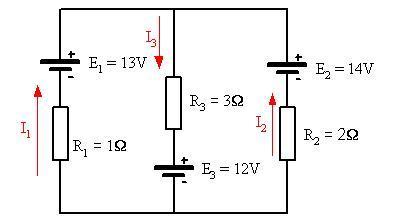
Fig1.jpg


Previously i worked out the Current I1, I2 and I3 so i planned to use this to calculate the power dissipated;

For current i got;

I1= 0.8409 A
I2= -0.4545 A
I3= 0.39 A

I used I^2/R to get the following answers

R1 = 0.8409^2 / 1 = 0.7071 W
R2 = -0.4545^2 / 2 = -0.4131 W
R3 = 0.39^2 / 3 = 0.4563 W
 
Physics news on Phys.org
Think about these I*V=watts V=I*R
 
charger9198 said:
R1 = 0.8409^2 / 1 = 0.7071 W
R2 = -0.4545^2 / 2 = -0.4131 W
R3 = 0.39^2 / 3 = 0.4563 W

A negative real number squared gives a positive result!
 
Of course...

R1 = 0.8409^2 / 1 = 0.7071 W
R2 = -0.4545^2 / 2 = 0.2066 W
R3 = 0.39^2 / 3 = 0.4563 W

Am i on the right lines with this?
 
You were right first time I should have checked but your notation fooled me / usually means divide * is multiply.
 
First, the power is p = V2/R or p = I2R. Since you are using currents and resistances the second equation applies here. So you should be MULTIPLYING the square of the currents by the resistance values, not dividing as you've indicated. Recheck the results with this in mind.
 
so

p=(I^2)R

thus

(0.8409^2)*1 = 0.70711 W
(-0.4545^2)*2 = 0.41314 W
(0.39^2)*3 = 0.4563 W

Hopefully that's it!
 
charger9198 said:
so

p=(I^2)R

thus

(0.8409^2)*1 = 0.70711 W
(-0.4545^2)*2 = 0.41314 W
(0.39^2)*3 = 0.4563 W

Hopefully that's it!

Yes, that looks good for the given resistances and currents.
 
Thanks for your help
 
  • #10
charger, can you show me how you worked out those currents?
 
  • #11
stemurdo said:
charger, can you show me how you worked out those currents?
Discussion of this circuit in this thread.
 

Similar threads

Replies
22
Views
4K
  • · Replies 26 ·
Replies
26
Views
3K
  • · Replies 3 ·
Replies
3
Views
2K
  • · Replies 3 ·
Replies
3
Views
2K
  • · Replies 7 ·
Replies
7
Views
1K
  • · Replies 7 ·
Replies
7
Views
2K
Replies
8
Views
2K
Replies
51
Views
17K
  • · Replies 8 ·
Replies
8
Views
2K
  • · Replies 4 ·
Replies
4
Views
2K