How to calculate what a voltmeter measures with multiple resistors?

Click For Summary
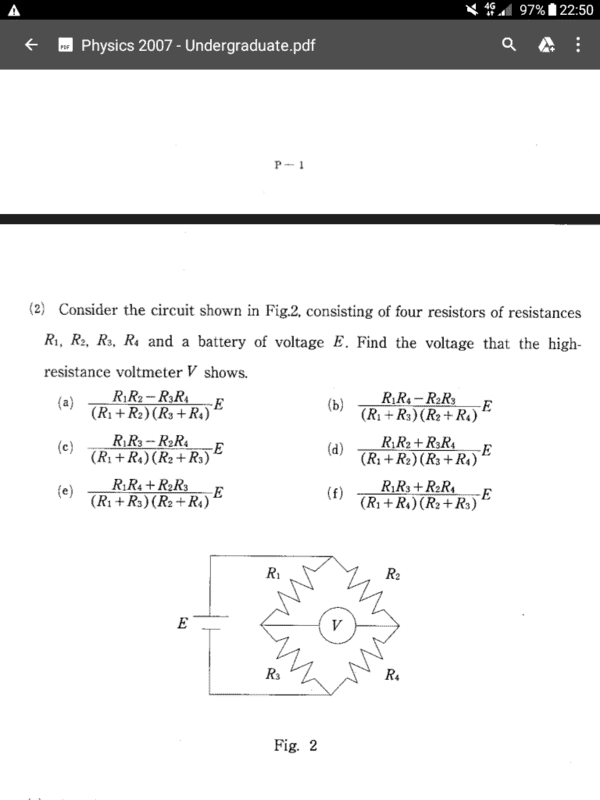
To calculate what a voltmeter measures with multiple resistors, it's suggested to simplify the circuit by removing the voltmeter and analyzing the remaining resistors. This approach reveals two voltage dividers, which can aid in understanding the voltage distribution. Redrawing the circuit with resistors R1 and R3 aligned vertically, and R2 and R4 in parallel, can clarify the relationships between the components. Participants are encouraged to share their calculations or attempts to facilitate better guidance. Engaging with the problem actively is crucial for effective learning and understanding.
Rasias
Messages
1
Reaction score
0
Homework Statement
Calculate what the voltmeter measures
Relevant Equations
Req=R1+R2+...+Rn
I tried to solve it by removing the voltmeter and simplifying it to just one resistor, then calculate the individual volts and then the deltaV, but still didn't found the answer, can you guys help me?
Screenshot_2019-04-06-22-50-03.png
 
Physics news on Phys.org
If you take out the voltmeter for the moment, do you see that you have two voltage dividers? Does that help?
 
Rasias said:
still didn't found the answer,
Per forum rules, please post your attempt.
 
What if you redraw the circuit? Redraw, without the voltmeter, and with R1 & R3 in a straight vertical line, and parallel to that, R2 & R4 in a straight vertical line. The new drawing should be equivalent to the original (ignoring the lack of the voltmeter). Now, as @lewando said, do you see that you have two voltage dividers? If you want help understanding how leaving the voltmeter out (for analysis purposes) can be valid, just ask for another hint.
 
haruspex said:
Per forum rules, please post your attempt.
This is not haruspex being excessively fussy -- Physics Forums scolds us if we do not require you to make an attempt. And it will help your learning process. (In fact, I might be scolded for the tip I gave you earlier.)
 
The book claims the answer is that all the magnitudes are the same because "the gravitational force on the penguin is the same". I'm having trouble understanding this. I thought the buoyant force was equal to the weight of the fluid displaced. Weight depends on mass which depends on density. Therefore, due to the differing densities the buoyant force will be different in each case? Is this incorrect?

Similar threads

Replies
8
Views
2K
  • · Replies 7 ·
Replies
7
Views
2K
  • · Replies 3 ·
Replies
3
Views
2K
  • · Replies 25 ·
Replies
25
Views
3K
  • · Replies 11 ·
Replies
11
Views
3K
  • · Replies 3 ·
Replies
3
Views
6K
  • · Replies 1 ·
Replies
1
Views
3K
  • · Replies 4 ·
Replies
4
Views
2K
  • · Replies 8 ·
Replies
8
Views
7K
  • · Replies 10 ·
Replies
10
Views
3K