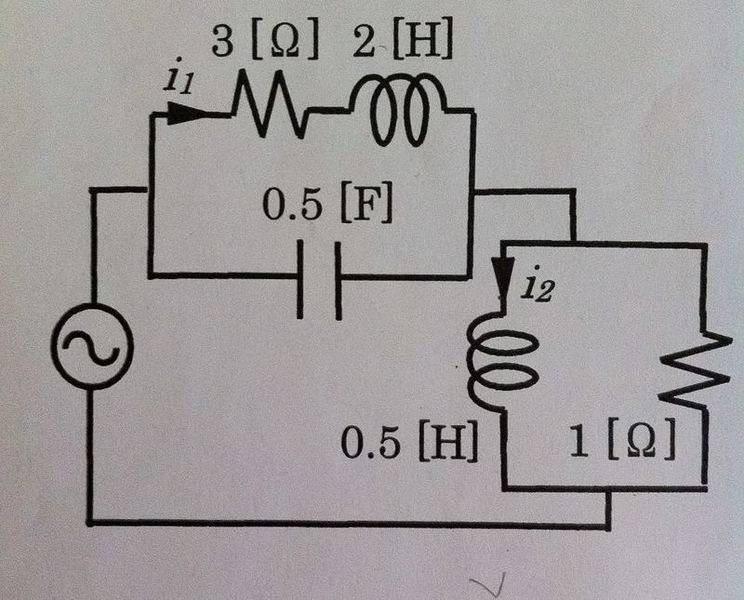
Discussion Overview
The discussion revolves around finding the current i2(t) and the effective current consumption in an AC circuit, given the current i1(t) = (√2)*sin(2t) A. Participants explore methods for calculating currents in AC RLC circuits, addressing both theoretical and practical aspects of circuit analysis.
Discussion Character
- Exploratory
- Technical explanation
- Debate/contested
- Mathematical reasoning
Main Points Raised
- Some participants suggest finding the impedance of each component and using complex plane additions for AC circuits.
- Others question the frequency and peak amplitude of the given current i1, indicating the importance of these parameters in calculations.
- Several participants express uncertainty about the method of dividing currents in parallel circuits, with examples provided to illustrate potential errors in reasoning.
- Some participants propose using the current division principle to calculate individual currents through resistors in parallel.
- A participant raises a question about the transition from sinusoidal to cosinusoidal representation of the current and its implications for calculations.
- There are corrections regarding the reactance of inductors and the need to accurately calculate total impedance in the circuit.
Areas of Agreement / Disagreement
Participants exhibit a mix of agreement and disagreement on methods for calculating currents and the interpretation of circuit components. There is no consensus on the best approach, and multiple competing views remain regarding the calculations and representations used.
Contextual Notes
Some participants highlight limitations in the assumptions made about circuit components and the need for clarity on definitions, particularly regarding impedance and current division in parallel circuits.