- 6,052
- 3,166
It's not free charge and besides the conductor is neutral in charge. If div E were not zero it would build up somewhere.Charles Link said:Inside the conductor there is plenty of charge present.
Please study my posts 86 and 87 in detail. I don't have a conclusive answer yet, but I think I am headed in the right direction there.rude man said:It's not free charge and besides the conductor is neutral in charge. If div E were not zero it would build up somewhere.
Right now we are just considering ## E_m ##. I don't know that we can say ## \nabla \cdot E_m =0 ##, but I don't think we need to have that for your method to work. The ## E_m ## starts in the material, and points in one direction, and stops there. It is not a continuous loop like the ## B ## field of a magnet or solenoid. ## \\ ## To add to this, ## E_s ## in the inductor is non-zero, and we will find ## \nabla \cdot E_s ## is non-zero in places. Since ## \nabla \cdot E=\nabla \cdot (E_s+E_m)=0 ##, clearly ## \nabla \cdot E_m ## is non-zero.rude man said:On top of that, we are assuming an ideal conductor so E = 0 so div E = 0 inside the conductor.
No problem with #86.Charles Link said:Please study my posts 86 and 87 in detail. I don't have a conclusive answer yet, but I think I am headed in the right direction there.
Why would you think div Em not equal to zero? There are no net charges in the wire and that's where Em exists.Charles Link said:Right now we are just considering ## E_m ##. I don't know that we can say ## \nabla \cdot E_m =0 ##, but I don't think we need to have that for your method to work.
Please see my additions to the last post (95), including a couple later additions. ## \\ ## To add to this, your method basically is to treat any EMF's with an ## E_m ##, and to assume there is inherent in the circuit an ## E_s ## that behaves very predictably, as summarized at the bottom of post 89. I do think the method has considerable merit.rude man said:No problem with #86.
Ditto #87.
In fact, no problem with your conclusions even though I'm dubious about your rationale.
Why would you think div Em not equal to zero? There are no net charges in the wire and that's where Em exists.
.
OK, so for convenience I will write down the statements and number them for easy reference:rude man said:Yes, absolutely that is where we now still disagree.
The Es field is the consequence of the chemical reaction (the Em field) pushing + charge to the + electrode and - charge to the - electrode. Equilibrium is reached when Es = -Em.
Charles Link said:Just to summarize for the inductor, inside there is an ## E_{induced} ##. We have ## \int E_{induced} \cdot dl=\mathcal{E} ##. In order to get a finite current in the inductor, we must have an ## E_s=-E_{induced} ## in the inductor. Because for the whole loop ## \oint E_s \cdot dl=0 ##, outside the inductor we have ## \int E_s\cdot dl=\mathcal{E} ## to match the ## \int E_s \cdot dl=-\mathcal{E} ## inside the inductor. It really is very straightforward.
rude man said:I think you are basically misintepreting the equation ## \bf E_m = - \bf E_s ##.
That equation does not mean that Es is just a negative Em.
[EDIT: I retyped the LaTeX, which somehow got distorted. I hope it's not a bug in the forums software?]rude man said:What you are still not recognizing is that Em≠0Em≠0. It is in fact the field that accounts for the battery emf.
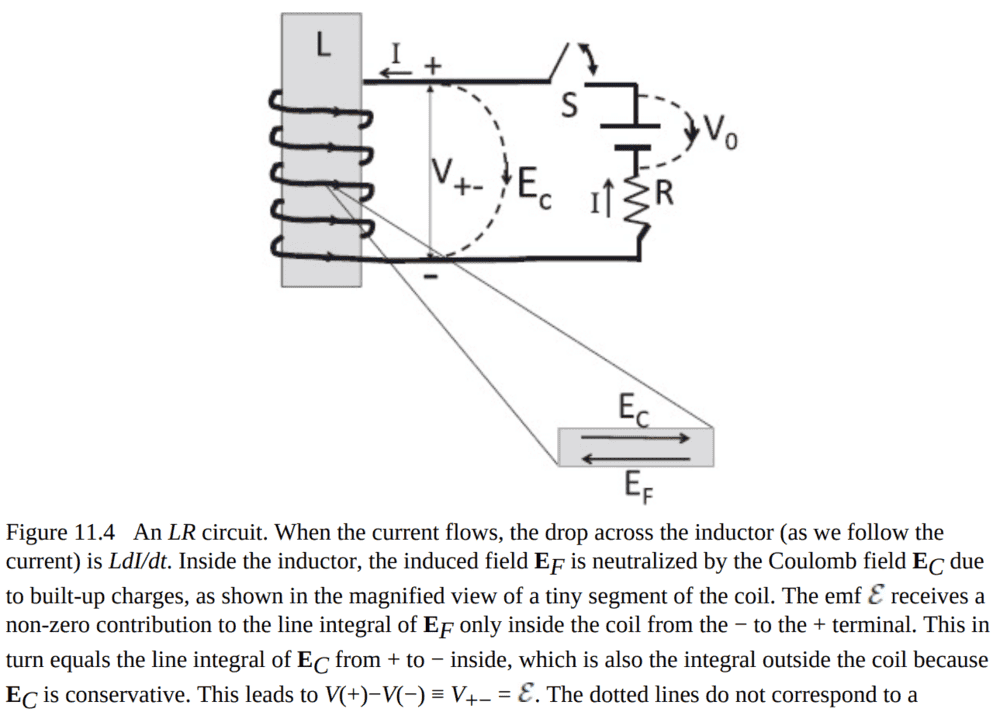
Source: Fundamentals of Physics II, R. Shankar
vanhees71 said:Well, treatments like this made me sick, when I first learned about AC circuits in high school. Of course Feynman Lect. II is much better.
I am not interpreting anything. I am just doing math. This is a purely mathematical exercise. You accept 98.3 and 98.5, so 98.9 follows strictly by math, regardless of how you interpret it. Similarly with the rest. This is a mathematical exercise.rude man said:I think you are basically misintepreting the equation ## \bf E_m = - \bf E_s ##.
I have no objection to this nor any of your other statements about interpretations. Similarly, for a person standing at rest the downward gravitational force and the upward normal force “are equal in magnitude and opposite in direction but they have totally different sources and exist independently of one another”. And they can be mathematically described by vectors with all of the corresponding vector operationsrude man said:They are equal in magnitude and opposite in direction but they have totally different sources and exist independently of one another, on top of one another.
Dale said:I have no objection to this nor any of your other statements about interpretations. Similarly, for a person standing at rest the downward gravitational force and the upward normal force “are equal in magnitude and opposite in direction but they have totally different sources and exist independently of one another”. And they can be mathematically described by vectors with all of the corresponding vector operations
Please point out specifically which step in my proof is inaccurate.Charles Link said:In any case, some of the mathematics that is being presented to criticize it, IMO, is inaccurate.
The comment was directed to the ## E_m ## being labeled as conservative by @etotheipi .Dale said:Please point out specifically which step in my proof is inaccurate.
That is exactly my point. Your two forces can be written N = mg yet they have as you say " totally different sources and exist independently of one another". In this spirit we write ## \bf E_s = -\bf E_m ##. So where is the problem?Dale said:I have no objection to this nor any of your other statements about interpretations. Similarly, for a person standing at rest the downward gravitational force and the upward normal force “are equal in magnitude and opposite in direction but they have totally different sources and exist independently of one another”. And they can be mathematically described by vectors with all of the corresponding vector operations
Well, (98.2) didn’t come from me. That was from @rude man. It is clear that he will need to discard at least one of those equations in (98.1-6), but I am not sure which he will choose.Charles Link said:@Dale Please see the addition to the above post, that 98.2 is, IMO, incorrect. See also my posts 86 and 87.
The proof in post 98 demonstrates the problem conclusively. The equations that you propose are in fact inconsistent with each other. They cannot all be true.rude man said:In this spirit we write Es=−Em. So where is the problem?
Mathematics may not be his strongest suit. I think he may have made a mathematical error or two in the course of the discussion, but that should not negate the merit of this methodology.Dale said:Well, (98.2) didn’t come from me. That was from @rude man. It is clear that he will need to discard at least one of those equations in 98.1-6, but I am not sure which he will choose.
As far as I can tell his methodology is a Helmholtz decomposition of the E field, although he uses non standard terminology. That is fine and does have some uses. I do not object to it in general. I am specifically objecting to his treatment of a battery. It is mathematically inconsistent.Charles Link said:Mathematics may not be his strongest suit. I think he may have made a mathematical error or two in the course of the discussion, but that should not negate the merit of this methodology.
rude man said:He does not violate ## \oint \bf E =0 ## if ## \bf E ## is conservative (or zero) as Feynman does in his lecture notes (vol II chapt 22).
 . The presence of the time varying magnetic field inside the lumped inductor means that you can no longer constrain the line integral to be zero.
Do you just ignore my post #106?rude man said:That is exactly my point. Your two forces can be written N = mg yet they have as you say " totally different sources and exist independently of one another". In this spirit we write ## \bf E_s = -\bf E_m ##. So where is the problem?
I question whether the Helmholtz decomposition works for this case. I can't put my finger conclusively on why it seems to go wrong, but all indications are that it doesn't work. Meanwhile, the separation into ## E_m ## and ## E_s ## is very straightforward, and the ## E_s ## behaves in a very predictable manner.Dale said:As far as I can tell his methodology is a Helmholtz decomposition of the E field, although he uses non standard terminology. That is fine and does have some uses. I do not object to it in general. I am specifically objecting to his treatment of a battery. It is mathematically inconsistent.
When someone uses a standard method incorrectly, then a criticism of the result does not imply a criticism of the standard method. Helmholtz decomposition is fine, but does not produce the result he claims for a battery.
 .
.Well, it certainly isn’t as straightforward as it seems since the straightforward analysis for a battery leads to an inconsistent set of equations.Charles Link said:Meanwhile, the separation into Em and Es is very straightforward, and the Es behaves in a very predictable manner.