How to select the PLL parameters
- Thread starter anstxfw
- Start date
-
- Tags
- Parameters
Click For Summary
Selecting the appropriate PLL parameters, particularly for the low pass filter components C18, R5, and R6, is critical for achieving stable voltage output in the circuit. Changing C18 from 0.1uF to 10uF causes the PLL to fail to lock, resulting in a constant 5V output. The discussion highlights the impact of external noise, specifically 50Hz interference, on the PLL's performance, suggesting the need for filtering solutions. Grounding issues are also noted, where connecting the machine to earth stabilizes the PLL, indicating that grounding can significantly affect circuit behavior. The conversation emphasizes the importance of understanding the loop filter's role and the need for careful component selection to balance stability and response time.

Engineering news on Phys.org
jim hardy
Science Advisor
Homework Helper
Dearly Missed
- 9,832
- 4,898
It's not straightforward because you're dealing with a closed loop
here's the best introduction to PLL's that i know of
https://ia801608.us.archive.org/30/...s_5800304/1972_Signetics_PLL_Applications.pdf
around page 38 they give some equations for their NE560 series of PLL's
but most valuable is their explanation of what the terms in the equations mean.
here's the best introduction to PLL's that i know of
https://ia801608.us.archive.org/30/...s_5800304/1972_Signetics_PLL_Applications.pdf
around page 38 they give some equations for their NE560 series of PLL's
but most valuable is their explanation of what the terms in the equations mean.
anstxfw
- 12
- 0
First,I illustrate the application of this circuit,as shown in Figure 1.It is called capacitive liquid level
detection.When the needle touches the liquid level,the capacitance value will become larger.So using phase locked loop
to detect the change of capacitance.My schematic diagram is shown in Figure 2.Network named signal is connected to the
needle.Normally,the voltage of TP1 is 2.5v,if the neddle touches the liquid level,the voltage of TP1 will change,as
shown in Figure 3.However, When the needles are filled with ionized water, the voltage will become unstable,as shown
in Figure 4.The frequency of the TP1 point voltage is 50Hz.It will affect the judgement of the waveform.Now I have two
solutions,one is change the low pass filter parameter of PLL,so it can filter out the interference of 50hz, but to
consider the timeliness of change.Another is to add a notch filter.where to put the notch filter,I want to put it in
the output of OP U4,so the signal is passed through the notch filter before it is passed to MCU.
Now my question is that which will be better,and how to make it.If you have some advice,I will appreciate it very
much.Thank you very much.
detection.When the needle touches the liquid level,the capacitance value will become larger.So using phase locked loop
to detect the change of capacitance.My schematic diagram is shown in Figure 2.Network named signal is connected to the
needle.Normally,the voltage of TP1 is 2.5v,if the neddle touches the liquid level,the voltage of TP1 will change,as
shown in Figure 3.However, When the needles are filled with ionized water, the voltage will become unstable,as shown
in Figure 4.The frequency of the TP1 point voltage is 50Hz.It will affect the judgement of the waveform.Now I have two
solutions,one is change the low pass filter parameter of PLL,so it can filter out the interference of 50hz, but to
consider the timeliness of change.Another is to add a notch filter.where to put the notch filter,I want to put it in
the output of OP U4,so the signal is passed through the notch filter before it is passed to MCU.
Now my question is that which will be better,and how to make it.If you have some advice,I will appreciate it very
much.Thank you very much.
Attachments

analogdesign
Science Advisor
- 1,150
- 370
Jim,
The old Signetics app note is great, but I really think the best free resource for PLL design is the book PLL Performance, Simulation, and Design by National Semiconductor (now TI). It is comprehensive, easy to understand, and goes step-by-step with easy to understand explanations and design procedures. It was my go-to book when I designed an integrated PLL a few years ago.
http://www.ti.com/tool/pll_book
The old Signetics app note is great, but I really think the best free resource for PLL design is the book PLL Performance, Simulation, and Design by National Semiconductor (now TI). It is comprehensive, easy to understand, and goes step-by-step with easy to understand explanations and design procedures. It was my go-to book when I designed an integrated PLL a few years ago.
http://www.ti.com/tool/pll_book
jim hardy
Science Advisor
Homework Helper
Dearly Missed
- 9,832
- 4,898
analogdesign said:It is comprehensive, easy to understand, and goes step-by-step with easy to understand explanations and design procedures. It was my go-to book when I designed an integrated PLL a few years ago.
At first glance it looks excellent ! Thank you analogdesign,
i'll make the transition from sail to steam yet...
saved a copy.
old jim
jim hardy
Science Advisor
Homework Helper
Dearly Missed
- 9,832
- 4,898
anstxfw said:If I change C18 from 0.1uF to 10uF, PLL cann't lock phase,the VCOin is always 5V,How to select C18/R5/R6 of the filter.
Well slowing the loop filter reduces capture range.
I don't quite understand what you are up to.
Are you shifting the pll center frequency and trying to lock that to output of whatever is (U1 divided by U3) ?
Averagesupernova
Science Advisor
Gold Member
- 4,835
- 1,509
I would assume he allows the capacitance to change which in turn detunes the oscillator in which case the PLL compensates to bring it back on frequency. Watching the VCO voltage is tells just what the capacitance is doing. I know some about PLL but there is plenty I do not know also. I know that the loop filter is a critical little bugger. I would say control system theory (PID and such) will get you where you want to be with PLL. A wise engineer once told me that to troubleshoot a PLL often it is desirable to break the loop. Concerning your 50 hertz noise, is it an oscillation within the loop or is it external? Are you in a part of the world that uses 50 hertz instead of 60 hertz for power?
anstxfw
- 12
- 0
jim hardy said:Well slowing the loop filter reduces capture range.
View attachment 106144
I don't quite understand what you are up to.
Are you shifting the pll center frequency and trying to lock that to output of whatever is (U1 divided by U3) ?
I just want the VCOin to be DC Voltage. I don't understand why this voltage could fluctuate? (PS:my AC power is 50 HZ).
jim hardy
Science Advisor
Homework Helper
Dearly Missed
- 9,832
- 4,898
I feel not very well informed.
What is the frequency you are trying to lock to, i think at HEF4024 Q3 ?
Is fig 3 a scope trace when pll can lock, 0.1uf, and fig 4 when it fails to lock, 10 uf ? What are sweep speeds ?
Could be you're picking up 50 hz at pins C1A and C1B from your probe. It looks from figure 1 rather like an antenna. I think those pins both need DC isolation and 50 hz isolation(if you can get it) from signal common.
First thing i'd do is set scope trigger to LINE, if trace stands still then your 50 hz is power line frequency not loop natural frequency. I suspect strongly that's what you'll find.
Next i'd try hooking my probe up like this so it's got some Z in series at low frequency
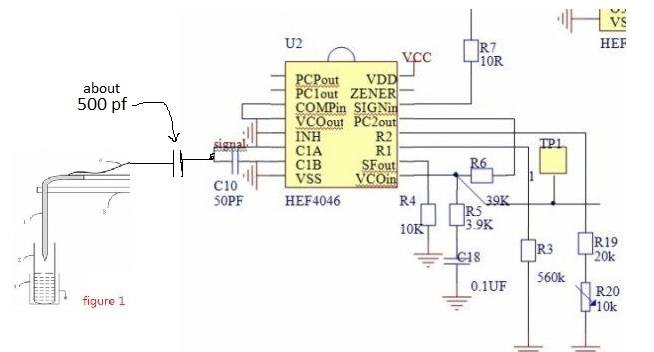
500 pf at 50hz is 6 megohms, what is it at your operating frequency ?
Next thing i'd try is, since your frequency setting resistors R3 and R19 go to signal common and so does your probe capacitance, try connecting your probe to them in turn.
Got to push at this thing and figure out how it behaves.
What is the frequency you are trying to lock to, i think at HEF4024 Q3 ?
Is fig 3 a scope trace when pll can lock, 0.1uf, and fig 4 when it fails to lock, 10 uf ? What are sweep speeds ?
anstxfw said:I don't understand why this voltage could fluctuate? (PS:my AC power is 50 HZ).
Could be you're picking up 50 hz at pins C1A and C1B from your probe. It looks from figure 1 rather like an antenna. I think those pins both need DC isolation and 50 hz isolation(if you can get it) from signal common.
First thing i'd do is set scope trigger to LINE, if trace stands still then your 50 hz is power line frequency not loop natural frequency. I suspect strongly that's what you'll find.
Next i'd try hooking my probe up like this so it's got some Z in series at low frequency
500 pf at 50hz is 6 megohms, what is it at your operating frequency ?
Next thing i'd try is, since your frequency setting resistors R3 and R19 go to signal common and so does your probe capacitance, try connecting your probe to them in turn.
Got to push at this thing and figure out how it behaves.
anstxfw
- 12
- 0
Jim Hardy,Thank you so much.
I'm trying to lock to HEF4024 Q3,the frequency is 375khz. But if the needles are filled with ionized water,the PLL can not lock, as shown in figure. It is strange that if I put the ground of the machine to the earth(the real ground),no any changes,the PLL can lock again,put it off the earth,unlock again.
I will connect a capacitor between needles and C10 on your suggestion.Right now I don't have 500pf,is it ok to use 200pf?And you said that"Next thing i'd try is, since your frequency setting resistors R3 and R19 go to signal common and so does your probe capacitance, try connecting your probe to them in turn". I can't see your point.Is the probe capacitance to be C10?what's the meaning of "in turn".
I'm trying to lock to HEF4024 Q3,the frequency is 375khz. But if the needles are filled with ionized water,the PLL can not lock, as shown in figure. It is strange that if I put the ground of the machine to the earth(the real ground),no any changes,the PLL can lock again,put it off the earth,unlock again.
I will connect a capacitor between needles and C10 on your suggestion.Right now I don't have 500pf,is it ok to use 200pf?And you said that"Next thing i'd try is, since your frequency setting resistors R3 and R19 go to signal common and so does your probe capacitance, try connecting your probe to them in turn". I can't see your point.Is the probe capacitance to be C10?what's the meaning of "in turn".
Attachments

jim hardy
Science Advisor
Homework Helper
Dearly Missed
- 9,832
- 4,898
anstxfw said:It is strange that if I put the ground of the machine to the earth(the real ground),no any changes,the PLL can lock again,put it off the earth,unlock again.
Any voltage between them is injected right into your PLL's C1A ,if i read correctly the image attached to post #1.
Might be that 'earthing' the signal common on circuit board removes any voltage between it and the beaker of deionized water.
Of course, we're looking for cause-effect.anstxfw said:I don't have 500pf,is it ok to use 200pf?
Hmmm wait a second here, you said ionized water not de-ionized. I'm guilty of inattention to detail.
De-ionized water is nonconductive and has dielectric constant perhaps 80. I don't know what is ionized water, but surely it's conductive .
So when you said 'capacitive' i jumped to the conclusion you were sensing very pure water. That's why i suggested series capacitance.
If that's not so, your probe when wetted may experience more change in resistance than in capacitance.
Furthermore i'd wager it makes a few tens or hundreds of millivolts DC by galvanic action.
No, for this experiment it's to alter the value of R3 or R19&R20anstxfw said:I can't see your point.Is the probe capacitance to be C10?
Water that's not deionized is pretty conductive.
If your probe when wetted sees more resistance change than capacitance change, it'd make sense to let it affect the frequency setting resistor instead of the frequency setting capacitor, wouldn't it ?
First connect probe at pin R1 so that when wetted it decreases resistance from that pin to common, as if value of R3 were changedanstxfw said:what's the meaning of "in turn".
then try it at pin R2 as if changing R19&R20 .I think you'll have to connect those two "grounds" in my altered sketch above.
"Ground" is a much abused term. Usually it means 'signal common' or 'zero volt reference point' as in right part of your drawing . It means "earth" only if physically connected to earth, which clearly in an airplane or rocket it's not.
Is your beaker connected to Earth by a wire or metal counter top ? Is your "signal common" connected to Earth through the oscilloscope probe ? Is there any voltage between them?
Keep us posted?
Last edited:
NascentOxygen
Staff Emeritus
Science Advisor
Homework Helper
- 9,249
- 1,080
Is that sensor plate coated with plastic insulation? If not, it will be sensitive to R as well as C. Is it a pin or a plate?anstxfw said:When the needles are filled with ionized water,
Is your connection of the sensor plate directly to the IC pin correct? This evades any filtering;
Last edited:
anstxfw
- 12
- 0
Thank you a lot.Figure 5.1 shows the neddle connects to the circuit and the tube. The gnd of circuit is connected to
the gnd of machine.
Today I try to change C18(the low pass filter cap) from 0.1uf to 1uf.The waveform of VCOin can be stable,as shown in
Figure 5.2,the figure 5.2 shows that the waveform of VCOin before and after touching the liquid level.But the response time will be longer.This will cause the needle to overshoot at the level of the liquid.Now solved a problem and lead to another problem.I am going to crash.
Thank you again, Jim.
the gnd of machine.
Today I try to change C18(the low pass filter cap) from 0.1uf to 1uf.The waveform of VCOin can be stable,as shown in
Figure 5.2,the figure 5.2 shows that the waveform of VCOin before and after touching the liquid level.But the response time will be longer.This will cause the needle to overshoot at the level of the liquid.Now solved a problem and lead to another problem.I am going to crash.
Thank you again, Jim.
Attachments

anstxfw
- 12
- 0
it may be better to connect the sensor across the timing capacitor C18,you mean connect the neddle to the C18? what is the sensor?NascentOxygen said:Is that sensor plate coated with plastic insulation? If not, it will be sensitive to R as well as C. Is it a pin or a plate?
Is your connection of the sensor plate directly to the IC pin correct? This evades any filtering; it may be better to connect the sensor across the timing capacitor C18.
NascentOxygen
Staff Emeritus
Science Advisor
Homework Helper
- 9,249
- 1,080
Sorry, I misinterpreted your diagram.anstxfw said:it may be better to connect the sensor across the timing capacitor C18,you mean connect the neddle to the C18? what is the sensor?
I can't identify where your needle connects into the PLL. But I'm wondering why you are using [apparently] a needle and not a plate to come into contact with the liquid's surface?
jim hardy
Science Advisor
Homework Helper
Dearly Missed
- 9,832
- 4,898
anstxfw said:Figure 5.2,the figure 5.2 shows that the waveform of VCOin before and after touching the liquid level.But the response time will be longer.This will cause the needle to overshoot at the level of the liquid.Now solved a problem and lead to another problem.I am going to crash.
Looks to me like you've solved your problem. It appears to never lose lock ?
Fig 5.3 also locks . I am unable to read what is the time per division on your 'scope
but there's no more line frequency.
That "hash" at VCO in is at your operating frequency hundreds of khz?
If you measure at capacitor C18, other side of R5, you'll see DC without the hash. Then you'll be able to reduce C18 for faster loop response.
I would try a 0.01uf C18, too. It's only 1 ohm at your frequency. That'll speed up the loop, and you can begin exploring those closed loop equations.
I hope you'll try wiring your needle to R3 and R19 , just to see what happens.
anstxfw
- 12
- 0
no,i don't solve my problem.using 0.1uf (C18) ,the VCOin can not be stable, the frequency of the hash is 50HZ,you can watch the figure 4 at 3# where I posted.If using 1uf,the VCOin have no hash,but the rising time will be 5 times before. It is unacceptable.Looks to me like you've solved your problem. It appears to never lose lock ? Fig 5.3 also locks . I am unable to read what is the time per division on your 'scope
It looks like Figure a,attached in the annex.If you measure at capacitor C18, other side of R5, you'll see DC without the hash. Then you'll be able to reduce C18 for faster loop response.
To change the circuit will have a little bit of trouble,so I want to know why to do this?I hope you'll try wiring your needle to R3 and R19 , just to see what happens.

jim hardy
Science Advisor
Homework Helper
Dearly Missed
- 9,832
- 4,898
anstxfw said:no,i don't solve my problem.using 0.1uf (C18) ,the VCOin can not be stable, the frequency of the hash is 50HZ,
Well then , what's figure 5.3 attached to post 13 ? It says C18=0.1 uf and there's no 50hz.
i am confused.
anstxfw
- 12
- 0
Sorry about that,because i put the ground of the machine to the earth.
jim hardy
Science Advisor
Homework Helper
Dearly Missed
- 9,832
- 4,898
anstxfw said:Sorry about that,because i put the ground of the machine to the earth.
Looks to me like that solved it.
anstxfw
- 12
- 0
If the power supply systems of some customers don't connect to the earth,it can be an problem.So i must solve it without the earth.
How to improve the response time, if the use of 1uF capacitors(C18).
How to improve the response time, if the use of 1uF capacitors(C18).
jim hardy
Science Advisor
Homework Helper
Dearly Missed
- 9,832
- 4,898
i think that means you'll have to decouple your beaker from Earth and connect it instead to signal common. See post 11.anstxfw said:If the power supply systems of some customers don't connect to the earth,it can be an problem.
To what did you connect your oscilloscope probe reference lead ? See post 21.
Did you try that small capacitor in series with the needle ?
anstxfw
- 12
- 0
I try 200pf,but the PLL can unlock.the VCOin is 5V.jim hardy said:Did you try that small capacitor in series with the needle ?
And Impolite to ask a question,why to Series a capacitor,i don't understand.
Last edited:
jim hardy
Science Advisor
Homework Helper
Dearly Missed
- 9,832
- 4,898
no, an honest question is never impolite.anstxfw said:And Impolite to ask a question,why to Series a capacitor,i don't understand.
The series capacitor presents a high impedance to DC and line frequency currents so they won't affect your PLL.
Hmmm . It unlocks ? Have you a 'scope trace of that ?anstxfw said:I try 200pf,but the PLL can unlock.the VCOin is 5V.
anstxfw
- 12
- 0
hi,Jim.Thank you for your help.I solved my problem.I just put a wire into the cleaning barrel,which filled with ionized water.And the wire connected to the GND of the machine.The voltage of VCOin can be stable. I think the wire bypass the interference.
Thank you again.
If you visit to China, I am glad to be your guide.
Best wishes to you !
Thank you again.
If you visit to China, I am glad to be your guide.
Best wishes to you !
jim hardy
Science Advisor
Homework Helper
Dearly Missed
- 9,832
- 4,898
I think you're exactly right !anstxfw said:I think the wire bypass the interference
Congratulations, and
And thank you for that kind offer.
old jim
Last edited:
Similar threads
- Replies
- 26
- Views
- 6K
- Replies
- 3
- Views
- 2K
- Replies
- 2
- Views
- 1K
- · Replies 1 ·
- Replies
- 1
- Views
- 7K
- · Replies 7 ·
- Replies
- 7
- Views
- 4K
- · Replies 16 ·
- Replies
- 16
- Views
- 2K
- Replies
- 2
- Views
- 2K
- · Replies 46 ·
- Replies
- 46
- Views
- 5K
- · Replies 7 ·
- Replies
- 7
- Views
- 3K
- Replies
- 38
- Views
- 6K