How to Solve an Optimization Problem for Carrying a Ladder Around a Corner?

  • Thread starter Thread starter muna580
  • Start date Start date
  • Tags Tags
    Optimization
Click For Summary
SUMMARY

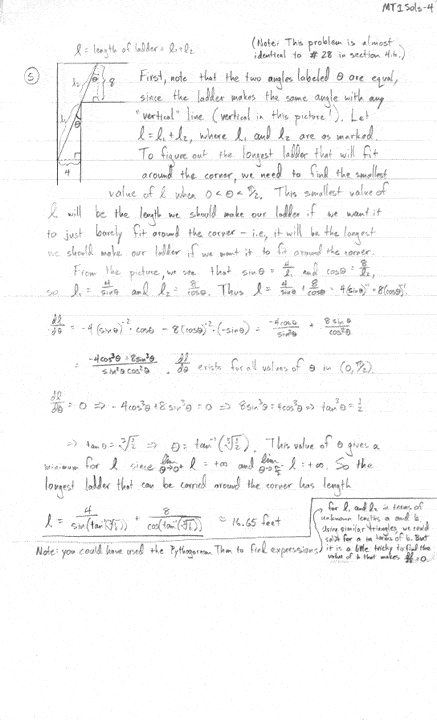
The optimization problem involves determining the maximum length of a ladder that can be carried around a right-angled corner formed by two hallways, one 4 feet wide and the other 8 feet wide. The solution utilizes trigonometric relationships where sin(θ) = 4/l1 and cos(θ) = 8/l2, leading to the equation l1 + l2 = l, where l is the length of the ladder. The problem requires understanding of geometric principles and trigonometric functions to derive the maximum ladder length effectively.

PREREQUISITES
  • Understanding of basic trigonometry, specifically sine and cosine functions.
  • Familiarity with optimization problems in geometry.
  • Knowledge of right-angled triangles and their properties.
  • Ability to manipulate algebraic equations involving multiple variables.
NEXT STEPS
  • Study the derivation of trigonometric identities related to right-angled triangles.
  • Explore optimization techniques in calculus, focusing on constrained optimization.
  • Learn about geometric interpretations of trigonometric functions.
  • Investigate similar optimization problems involving geometric constraints.
USEFUL FOR

Mathematicians, engineering students, and anyone interested in solving geometric optimization problems, particularly those involving trigonometry and algebra.

muna580
I have this optimization problem, with the solution, but I don't really understand how to do this. Can someone please explain it to me? I mean, I the solution, I got totally lost when he started working out the problem after that long paragraph. Where did he get the first equation from?

One hallway (which is 4 feet wide) meets another hallway (which is 8 feet wide) in a right-angled corner. What is the length of the longest ladder which can be carried horizontally around the corner? Give an exact answer, assuming the ladder has no width.
00mt1sols-4.gif
 
Physics news on Phys.org
I don't understand what more you want. Do you see why sin(\theta)= \frac{4}{l_1}? Do you see why cos(\theta)= \frac{8}{l_2}? Do you see why l_1+ l_2= l?
 

Similar threads

Replies
10
Views
5K
Replies
2
Views
4K
  • · Replies 7 ·
Replies
7
Views
4K
Replies
2
Views
3K
  • · Replies 6 ·
Replies
6
Views
5K
Replies
1
Views
3K
  • · Replies 3 ·
Replies
3
Views
1K
  • · Replies 2 ·
Replies
2
Views
2K
Replies
2
Views
6K
Replies
1
Views
2K