Huygen's Principle doesn't necessarily imply the law of reflection

Click For Summary
SUMMARY

The discussion centers on Huygen's Principle and its implications for the law of reflection. It establishes that while Huygen's Principle allows for multiple orders of reflection, only the zeroth order is consistently observed in smooth reflectors due to the path difference requirements for constructive interference. The conversation highlights that diffraction gratings can produce higher order reflections, but these are sensitive to wavelength and not applicable to uniform reflectors. Ultimately, the zeroth order reflection is the only one that remains valid across all wavelengths.

PREREQUISITES
  • Understanding of Huygen's Principle in wave theory
  • Knowledge of constructive and destructive interference
  • Familiarity with diffraction gratings and their properties
  • Basic principles of wave optics and reflection
NEXT STEPS
  • Explore the mathematical derivation of Huygen's Principle
  • Study the behavior of light in diffraction gratings
  • Investigate the relationship between wavelength and reflection angles
  • Examine applications of Huygen's Principle in antenna theory
USEFUL FOR

Physicists, optical engineers, and students studying wave optics who seek to deepen their understanding of reflection phenomena and the implications of Huygen's Principle.

etotheipi
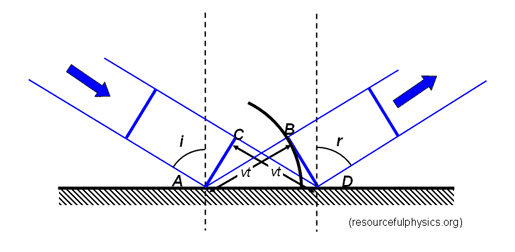
There are many diagrams like the following
1576424174582.png


which demonstrate that if A acts as a point source of wavelets, then we will have constructive interference in the case that ##i=r## as shown, as we can show with a little geometry that the path difference is zero.

However, surely this isn't the only option, since we can let the path difference between the two waves shown equal any multiple of ##\lambda## a consequently obtain many different orders. If we accept Huygens principle and apply it to a smooth reflector, we should obtain reflection across many different angles.

So why is it that only the zeroth order is included in the law of reflection?

Previously, I thought that we could only get the "scattering" required with a reflective diffraction grating, however Huygen's principle seems to imply that the diffraction grating principle is correct even for a smooth plane mirror - is this right?
 

Attachments

  • 1576424084675.png
    1576424084675.png
    10.1 KB · Views: 268
Science news on Phys.org
If we had just two rays, on the extremities of the incident beam, they would induce current in two places (like dipoles) on the reflector surface and give rise to multiple re-radiated lobes, in the manner of Young's Slits. But the incident beam is solid, so across the surface of the reflector we have a row of points which will re-radiate. The phasing of these is such as to create a parallel reflected beam in the direction i = r. The radiation in other directions tends to average to zero.
Notice, incidentally, that one cannot have a parallel beam with finite diameter except close to a source.
 
  • Like
Likes   Reactions: Ibix and etotheipi
tech99 said:
But the incident beam is solid, so across the surface of the reflector we have a row of points which will re-radiate.

Thank you, I forgot to consider this.

If the incident angle is ##i## and the reflected is ##r##, then for any two rays to interfere constructively we require $$d(\sin{i}-\sin{r})= n\lambda$$Now suppose two rays separated by a distance ##d## interfere constructively along their common first order, so that ##d(\sin{i}-\sin{r}) = \lambda##. The ray in between them at a distance ##\frac{d}{2}## will be such that its path difference from the two previous rays is $$\frac{d}{2}(\sin{i}-\sin{r}) = \frac{\lambda}{2}$$ and we will get destructive interference.

So the result is the only maximum is where ##i=r##. Is this right?
 
etotheipi said:
So why is it that only the zeroth order is included in the law of reflection?
Only the zeroth order works for all wavelengths. You can build reflectors called diffraction gratings that cause the higher order reflections you are describing. They do reflect at other angles, but are very sensitive to wavelength.
 
  • Like
Likes   Reactions: sophiecentaur
etotheipi said:
however Huygen's principle seems to imply that the diffraction grating principle is correct even for a smooth plane mirror - is this right?
Yes it is but, for a uniform reflector, the equivalent diffraction slits have zero spacing. The limit as the spacing goes to zero gives only the zeroth order beam. In any other direction the addition of all the Huygens sources gives zero.
Take any diffraction grating and see where the second order beam occurs. Then double the pitch of the grating lines and the second order beam will be greater (double, in fact, for a wide spaced grid). Repeat the process and the second order beam is deflected more. Carry on with that process and the second order beam will be deflected by more than the angle of the grating / mirror. So only the zeroth order beam will remain.
 
  • Like
Likes   Reactions: tech99 and etotheipi
Yes, a diffraction grating is an underfilled array, so we have side lobes.
 
  • Like
Likes   Reactions: sophiecentaur
tech99 said:
Yes, a diffraction grating is an underfilled array, so we have side lobes.
I just love it when people bring it all back to antenna theory.
 
  • Like
Likes   Reactions: vanhees71
sophiecentaur said:
I just love it when people bring it all back to antenna theory.
And on that theme, you have to remember that there will be a sin(x)/x distribution over the width of the reflected beam. You can't avoid that one.
 

Similar threads

  • · Replies 5 ·
Replies
5
Views
2K
  • · Replies 10 ·
Replies
10
Views
3K
  • · Replies 1 ·
Replies
1
Views
3K
  • · Replies 22 ·
Replies
22
Views
8K
  • · Replies 6 ·
Replies
6
Views
8K
  • · Replies 3 ·
Replies
3
Views
2K
  • · Replies 3 ·
Replies
3
Views
1K
  • · Replies 12 ·
Replies
12
Views
23K
  • · Replies 5 ·
Replies
5
Views
3K
  • · Replies 8 ·
Replies
8
Views
2K