Ideal transformer problem, angular frequency w

Click For Summary
The discussion revolves around solving a transformer problem, specifically focusing on parts 2 and 4. The user applies Kirchhoff's Voltage Law (KVL) to derive equations for mesh analysis and seeks clarification on calculating power and input impedance. They explore the relationship between voltage and current at resonance, realizing that the input impedance must be purely resistive at this point. The conversation highlights the importance of the turns ratio in determining how impedance is transformed across the transformer, with ongoing confusion about the role of inductances L1 and L2 in the final solution. Ultimately, the user is working towards a clearer understanding of how to express the impedance in terms of the turns ratio.
degs2k4
Messages
72
Reaction score
0
Hello,

I have some doubts in the following problem of a transformer, specially on parts 2 and 4.
I would be very grateful if someone could please give me any ideas specially about those parts...
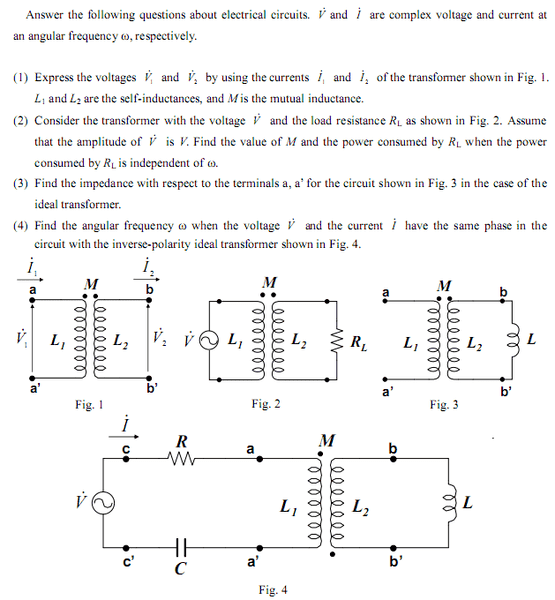
Homework Statement


15g8sap.png


The Attempt at a Solution


1)

Applying KVL in each mesh:
Mesh 1: V1 = jwL1I1 - jwMI2
Mesh 2: V2 = jwMI1 - jwL2I2

2)

power for RL?

First, apply KVL in each mesh:

Mesh 1 : V1 = jwL1I1 - jwMI2
Mesh 2 : 0 = jwMI1 - (jwL2 + RL) I2

get I2, and substitute it in the power function below:

P = V I2 = RL I2^2

Regarding M, I only know the formula of M = k sqrt(L1 L2).
I wonder if there is another way to get M...Any ideas ?

3) Z1?

V1 = Z1 I1
Z1 = V1 / I1

First, apply KVL in each mesh:

Mesh 1 : V1 = jwL1I1 - jwMI2
Mesh 2 : 0 = jwMI1 - (jwL2 + jwL) I2

get I2 from equation of Mesh 2, and substitute it in Mesh 1 equation.
After that, substitute V1 from Mesh 1 equation into the equation below:

Z1 = V1 / I2 =

So the result is:

Z1 = jwL1 + (w^2 M^2)/(jwL2 + jwL)

4) w?
I have absolutely no idea on how to do this part.
V and I in phase means : V = Vm cos(wt + 0), I = I am cos(wt + 0)
and an ideal trasnformer means that k =1 from the equation for M...
Any ideas for this part?

Thanks in advance!
 
Physics news on Phys.org
Hint on #4 -- What is the relationship between I and V at RLC resonance?
 
berkeman said:
Hint on #4 -- What is the relationship between I and V at RLC resonance?

Thank you very much for your reply.

After looking at a physics book, I undestood that:

1) at resonance, source voltage and current are in phase, which means:
V = Vm cos(wt + 0), I = I am cos(wt + 0)

2) at resonance, we can do: imaginary part of Zin (input impedance) = 0

since the problem meets 1) we do the following:

input impedance: Zin = R + j(wL + 1/wC)
Applying 2) : Im(Zin)=wL + 1/wC = 0
And extract w from the above equation...

The problem now is, I think that the above steps are for a simple RLC circuit, what would happen to a transfomer ?
 
Last edited:
Ok, I realized how to get the the input impedance for this part of the problem.

The input impedance must be Zin = Zn + Zp where:
Zn is the equivalent impedance of Resistance + Capacitor (R + 1/jwC)
Zp is a the equivalent impedance of the mutually coupled coils + coil L (as calculated in part 3 of the problem, but must re-calculate again since the polarities -dots- haven been changed)

Does this sound right?
 
You're on the right track. However, my initial guess is that the polarity dot reversal thing doesn't make any difference. The whole secondary is floating (no connections to the primary side), so I don't think the polarity makes any difference. The turns ratio, however, does come into the calculations...
 
berkeman said:
You're on the right track. However, my initial guess is that the polarity dot reversal thing doesn't make any difference. The whole secondary is floating (no connections to the primary side), so I don't think the polarity makes any difference. The turns ratio, however, does come into the calculations...

Thanks for your reply.

I have tried this part again and, as you said, the polarity change does not seem to make any difference in this part...

Steps:
(supposing I1 I2 as the currents for meshes 1 and 2)

Z1 = V1 / I1

KVL mesh 1: V1 = kwL1I1 + RI1 + I1/jwC + jwMI2

KVL mesh 2: jwMI1 + jwL2I2 + jwLI2 = 0

After some algebra, we get Z1 = R + jwL1 + 1/jwC + (w^2M^2)/(jwL2 + jwL)

In resonance, impedance is purely resistive so imaginary part is 0:

wL1 - 1/wC - (wM^2)/(L2 + L) = 0

After some manipulation I finally got: w = \frac{1}{\sqrt{C(L1-\frac{M^2}{L2+L})}}

Would it be right now?

Thanks.

(I think we could have also thought part 4 as an extension of part 3 where a resistor and capacitor have been added in series, whithout doing all the recalculation again, however I wanted to check the impact of the polarity change)
 
I don't think L1 or L2 should show up in the solution. If the transformer is doing its job, L1 and L2 just transform the load impedance L across the transformer by the square of the turns ratio. You can get the turns ratio from the ratio of L1 to L2.
 
berkeman said:
I don't think L1 or L2 should show up in the solution. If the transformer is doing its job, L1 and L2 just transform the load impedance L across the transformer by the square of the turns ratio. You can get the turns ratio from the ratio of L1 to L2.

Thanks for your reply but I think I don't understand it very well...

1) Why is my solution wrong ? Why L1 or L2 should not show up in the solution? I have a textbook where input impedance is calculated as I did...(impedance circuit 1 + reflected impedance from circuit 2)

2) Ideal transformer, Turns ratio N = N2/N2, V2/V1 = N2/N1 = I1/I2

According to Wikipedia: Ideal Transformer: The impedance in one circuit is transformed by the square of the turns ratio, For example, if an impedance ZL is attached across the terminals of the secondary coil, it appears to the primary circuit to have an impedance of ZL(N1/N2)^2. This relationship is reciprocal, so that the impedance ZL of the primary circuit appears to the secondary to be ZL(N2/N1)^2.

So... the impedance of the first circuit should be... Z1 = R + jwL1 + 1/jwC + jwL(N1/N2)^2 ?
The solution should be expressed in terms of N1 and N2?

I am sorry but is the first time I am studying this and everything sounds quite confusing...

Thanks again!
 

Similar threads

  • · Replies 7 ·
Replies
7
Views
3K
Replies
7
Views
2K
Replies
18
Views
2K
  • · Replies 31 ·
2
Replies
31
Views
4K
  • · Replies 5 ·
Replies
5
Views
2K
  • · Replies 2 ·
Replies
2
Views
3K
  • · Replies 3 ·
Replies
3
Views
3K
  • · Replies 26 ·
Replies
26
Views
3K
Replies
3
Views
7K
  • · Replies 11 ·
Replies
11
Views
5K