If gate (NMOS) is connected to Ground how is current able to flow

Click For Summary
SUMMARY

The discussion clarifies the operation of an NMOS transistor when its gate is connected to ground. For the NMOS to conduct, the gate-source voltage (Vgs) must exceed the threshold voltage (Vt), which is achieved when the source is at a negative potential (Vss). In this scenario, with Vdd at 10V and Vss at 0V, the gate voltage of 5V is sufficient to turn on the NMOS, allowing current to flow in the triode region. The confusion regarding the MOSFET type is addressed, confirming that the device in question is indeed an NMOS operating under specific conditions.

PREREQUISITES
  • Understanding of NMOS transistor operation
  • Knowledge of gate-source voltage (Vgs) and threshold voltage (Vt)
  • Familiarity with MOSFET circuit symbols and configurations
  • Basic concepts of triode and saturation regions in MOSFETs
NEXT STEPS
  • Study the MOSFET operation in triode and saturation regions
  • Learn about the impact of gate-source voltage on NMOS performance
  • Explore the MOS equation for NMOS transistors
  • Review circuit configurations involving NMOS and PMOS transistors
USEFUL FOR

Electrical engineering students, circuit designers, and anyone interested in understanding MOSFET operation and characteristics.

PalmTreeSD
Messages
1
Reaction score
0
I am confused about this example circuit (attached) where the Gate it connected to Ground.
I thought in order for current to flow in a MOSFET (i.e. NMOS) a positive gate voltage (Vg) AND Vds (drain to source voltage) needs to be applied. If Vg = 0, how is a channel created in order to allow current to flow in this circuit if this is not a depletion-type MOSFET?
I only have a guess as to how it is possible for current to be able to flow.

Thanks in advance
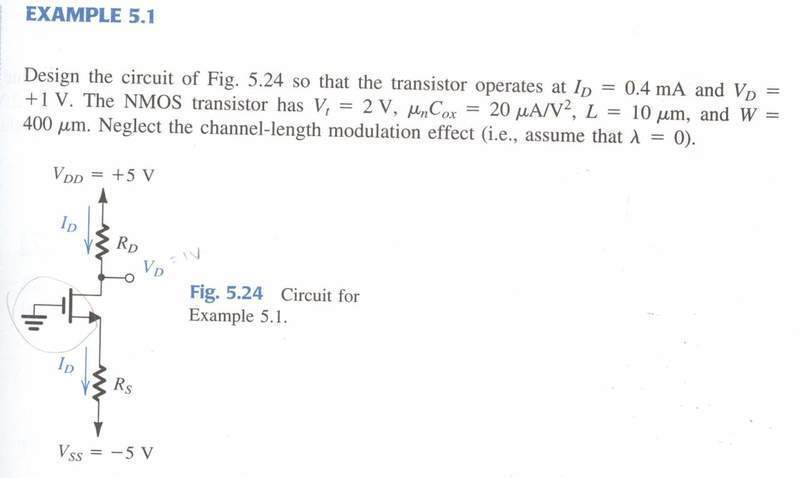
scan0007.jpg
 
Engineering news on Phys.org
Looks like a typo, the FET in your attached figure is a PMOS.
 
Err, I was about to link you to this wiki page

http://en.wikipedia.org/wiki/MOSFET#Circuit_symbols

when I realized the symbol in your assignment very much resembles what they call a N-channel MOSFET enh (no bulk) on that wiki page. I thought arrow pointing out always meant PMOS, but apparently not ... ?

(At least my advice is cheap.)
 
Why don't you add 5 volts to all three nodes--it will change nothing but voltage offsets, and see how it looks.
 
Um, the grounded gate is 5 volts positive as compared to Vss (-5v)
If you think of it as:
Vdd = 10v
Vgate = 5v
Vss = 0v
does that explain it better?

Paul, the 60 year old student
 
It is Ok. The transistor is NMOS and it is operating in triode region. For transistor to conduct in strong inversion, the condition is gate to source voltage has to be greater than threshold voltage. I said that it is in linear region because Vd < Vg - Vt. Now using the MOS equation is triode region, the problem can be solved.
 
It is because Vss is negative.. To turn on the nMOS, gate-source or gate-drain voltage must be more than the threshold. In this case, you have more than threshold voltage between the gate and Vss, therefore, nMOS turns on.
 
Last edited:

Similar threads

Replies
80
Views
5K
  • · Replies 42 ·
2
Replies
42
Views
5K
  • · Replies 19 ·
Replies
19
Views
6K
Replies
12
Views
2K
  • · Replies 26 ·
Replies
26
Views
3K
  • · Replies 12 ·
Replies
12
Views
4K
  • · Replies 4 ·
Replies
4
Views
2K
  • · Replies 1 ·
Replies
1
Views
3K
Replies
18
Views
6K
  • · Replies 4 ·
Replies
4
Views
4K