Integers as an Ordered Integral Domain .... Bloch Th. 1.4.6

Click For Summary
SUMMARY

The discussion centers on Ethan D. Bloch's Theorem 1.4.6 from "The Real Numbers and Real Analysis," which defines integers as an ordered integral domain satisfying the Well Ordering Principle. Participants seek clarification on the reasoning behind the assertion that a set of positive integers, denoted as S, is a subset of the natural numbers, denoted as &mathbb{N}. The consensus is that this conclusion is straightforward, as S consists solely of positive integers. However, the necessity of this assertion in the proof is debated, with some arguing it is redundant while others assert its importance for applying the well-ordering principle.

PREREQUISITES
  • Understanding of ordered integral domains
  • Familiarity with the Well Ordering Principle
  • Knowledge of Peano axioms and their implications
  • Basic concepts of set theory and subsets
NEXT STEPS
  • Study the implications of the Well Ordering Principle in ordered integral domains
  • Review the Peano axioms and their role in defining natural numbers
  • Examine the definitions and properties of ordered integral domains in detail
  • Analyze the structure and proofs presented in Bloch's "The Real Numbers and Real Analysis" for deeper insights
USEFUL FOR

Mathematics students, educators, and researchers interested in foundational concepts of number theory and the formal definitions of integers and natural numbers.

Math Amateur
Gold Member
MHB
Messages
3,920
Reaction score
48
I am reading Ethan D. Bloch's book: The Real Numbers and Real Analysis ...

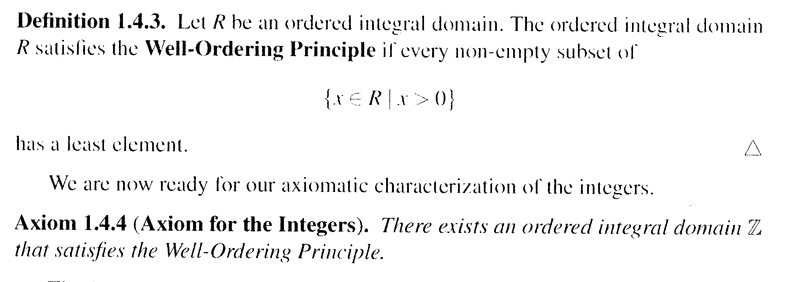
I am currently focused on Section 1.4: Entry 2: Axioms for the Integers ... In this section Bloch defines the integers as an ordered integral domain that satisfies the Well Ordering Principle ... rather than defining the integers via the natural numbers ...

I need help/clarification with an aspect of Theorem 1.4.6 ...

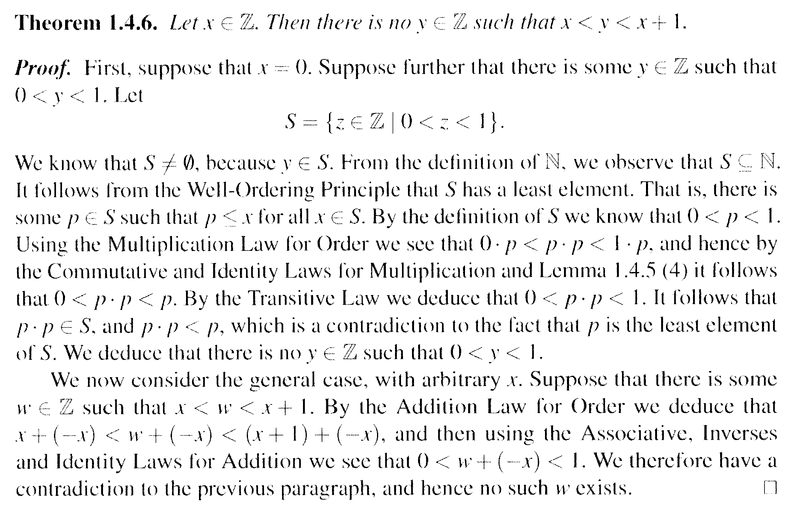
Theorem 1.4.6 and the start of the proof reads as follows:
?temp_hash=432383d02291abe058b7ea84c87f1574.png
In the above proof ... near the start of the proof, we read the following:

" ... ... From the definition of ##\mathbb{N}##, we observe that ##S \subseteq \mathbb{N}##. ... ..."Question: What exactly is the reasoning that allows us to conclude that ##S \subseteq \mathbb{N}## from the definition on ##\mathbb{N}## ... "The above theorem is in the section where Bloch defines the integers as an ordered integral domain that satisfies the Well Ordering Principle... ... as follows:
?temp_hash=432383d02291abe058b7ea84c87f1574.png

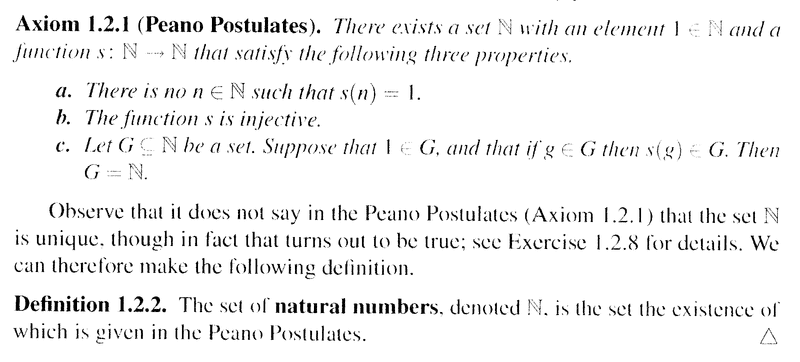
The definition of the natural numbers is mentioned above ... Bloch's definition is as follows ...
?temp_hash=432383d02291abe058b7ea84c87f1574.png
Hope someone can help,

Peter
 

Attachments

  • Bloch - Theorem 1.4.6 ... ....png
    Bloch - Theorem 1.4.6 ... ....png
    50.9 KB · Views: 618
  • Bloch - Axioms for Integers and Well Ordering ....png
    Bloch - Axioms for Integers and Well Ordering ....png
    17.2 KB · Views: 518
  • Bloch - Peano Postulates and Defn of the Natural Numbers ... ....png
    Bloch - Peano Postulates and Defn of the Natural Numbers ... ....png
    27.2 KB · Views: 512
Physics news on Phys.org
Maybe I shouldn't answer my own questions ... but maybe I am worrying too much over a trivial point ... ... maybe the reasoning is simply ... as follows ...since ##S## is a set made up of positive integers then it is a subset of ##\mathbb{N}## ... is it as simple as that ..?

My apologies if it is that simple ...

Peter
 
Math Amateur said:
Maybe I shouldn't answer my own questions ... but maybe I am worrying too much over a trivial point ... ... maybe the reasoning is simply ... as follows ...since ##S## is a set made up of positive integers then it is a subset of ##\mathbb{N}## ... is it as simple as that ..?

My apologies if it is that simple ...

Peter
As I read it, yes. However, I do not see immediately from the Peano axiom how the natural numbers are all positive, but this depends on the definition of the order as well. So somewhere between 1.2.1. and 1.4.6. the author should have shown (or defined), that natural numbers are positive.
 
  • Like
Likes   Reactions: Math Amateur
fresh_42 said:
As I read it, yes. However, I do not see immediately from the Peano axiom how the natural numbers are all positive, but this depends on the definition of the order as well. So somewhere between 1.2.1. and 1.4.6. the author should have shown (or defined), that natural numbers are positive.
Thanks fresh_42 ... indeed my problem was how to derive ##S \subseteq \mathbb{N}## ... but got confused (with Bloch's help ... :frown: ...)

To explain ...

Bloch investigates two approaches to defining/constructing the integers as he describes here ...

?temp_hash=1574f2bad2421b2b59fd08932580c001.png
In Section 1.4, where Theorem 1.4.6 occurs, Bloch is expounding the ordered integral domain approach to the integers ... so we should not go back to the Peano Postulates as I did - that is his approach number 1 ... under the second approach, the ordered integral domain approach, the Peano Postulates/Axioms become a theorem and are proved ...

Actually when we meet ##\mathbb{N}## in the proof of Theorem 1.4.6 Bloch has not defined ##\mathbb{N}## yet in this approach ... he does so after presenting Theorem 1.4.6 as follows:

?temp_hash=1574f2bad2421b2b59fd08932580c001.png


Interestingly as Evgeny Makarov has pointed out in the Math Help Forum, the claim ##S \subseteq \mathbb{N}## seems unnecessary for the rest of the proof ...

Peter
 

Attachments

  • Bloch - Section 1.4 Introduction ....png
    Bloch - Section 1.4 Introduction ....png
    67.8 KB · Views: 551
  • Bloch - Defn 1.4.7 ... ....png
    Bloch - Defn 1.4.7 ... ....png
    15.4 KB · Views: 603
Math Amateur said:
Interestingly as Evgeny Makarov has pointed out in the Math Help Forum, the claim S⊆NS⊆NS \subseteq \mathbb{N} seems unnecessary for the rest of the proof ...
It is not, because he needs ##p \in \mathbb{N}## provided by the well-ordering principle of ##S \subseteq \mathbb{N}.## Otherwise he wouldn't have the laws available, which he applies on ##p,## and which I assume were provided by the axioms (or derived statements) of the natural numbers.
 
Hi fresh_42,

Well ... I do not think that that is the case ...

Maybe I did not make clear the approach to the integers that was relevant to Theorem 1.4.6 ...

Bloch is, in Section 1.4, dealing with the approach to defining/constructing the integers via defining the integers as an ordered integral domain that satisfies the Well-Ordering Principle ... not the approach through the natural numbers (see my previous post above). In the ordered integral domain approach the natural numbers the natural numbers are 'found'/defined as an embedded set within the integers. The relevant definition for the natural numbers is given in Definition 1.4.7 - unfortunately presented after Theorem 1.4.6. The definition reads as follows:

?temp_hash=13b178a1469c8fd5933105233e9a00d8.png


Once we have defined the integers as an ordered integral domain we have the following properties to call on in Theorem 1.4.6 ... and these properties include those named in the proof of the Theorem ...

?temp_hash=13b178a1469c8fd5933105233e9a00d8.png


Peter
 

Attachments

  • Bloch - Defn 1.4.7 ... ....png
    Bloch - Defn 1.4.7 ... ....png
    15.4 KB · Views: 562
  • Bloch - Defn 1.4 - Ordered Integral Domain ....png
    Bloch - Defn 1.4 - Ordered Integral Domain ....png
    51.1 KB · Views: 763
One needs the well-ordering to get ##p \in S## (definition 1.4.3). Together with definition 1.4.7. this abbreviates to ##S \subseteq \mathbb{N}##. It is just another language as to say all elements of ##S## are positive. So whether you say all elements of ##S## are natural numbers or all elements of ##S## are positive, doesn't make a difference, it is the same. And which ever way you look at it, one of them is needed. So the language might be redundant, the fact is not.
 
Hi fresh_42 ... thanks for the post ...

Yes ... see the point you are making ...

Peter
 

Similar threads

Replies
4
Views
2K
  • · Replies 4 ·
Replies
4
Views
2K
Replies
4
Views
2K
  • · Replies 2 ·
Replies
2
Views
2K
  • · Replies 8 ·
Replies
8
Views
3K
  • · Replies 3 ·
Replies
3
Views
2K
Replies
2
Views
2K
  • · Replies 3 ·
Replies
3
Views
4K
  • · Replies 2 ·
Replies
2
Views
2K
  • · Replies 3 ·
Replies
3
Views
2K