Integration with a unit step function

Click For Summary
SUMMARY

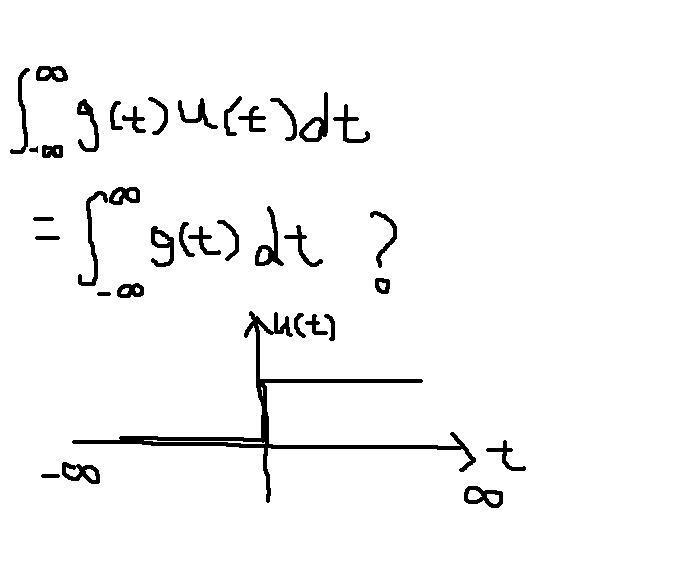
The discussion centers on the integration of a function with a unit step function, specifically the Heaviside step function, denoted as u(t). Participants clarify that u(t) equals 1 for t ≥ 0 and 0 for t < 0, leading to the conclusion that the integral from -∞ to ∞ of g(t) multiplied by u(t) simplifies to the integral from 0 to ∞ of g(t). This understanding is crucial for correctly applying the unit step function in definite integrals.

PREREQUISITES
  • Understanding of the Heaviside step function (u(t))
  • Knowledge of definite integrals in calculus
  • Familiarity with the properties of integrals involving piecewise functions
  • Basic concepts of mathematical notation and limits
NEXT STEPS
  • Study the properties of the Heaviside step function in detail
  • Learn about the application of unit step functions in signal processing
  • Explore integration techniques involving piecewise functions
  • Investigate the use of Laplace transforms with unit step functions
USEFUL FOR

Students and professionals in mathematics, engineering, and physics who are dealing with integration involving unit step functions, particularly in the context of signal processing and control systems.

killerfish
Messages
16
Reaction score
0
Hi,

i have a problem with integration a function with a unit step function.

Homework Statement


Given,

eafe.JPG


Refer to the image, i dun understand is that u(t) is equal to 1 from a definite integration from -\infty to \infty since u(t)=1 from -\infty to 0 and u(t)=0 from 0 to \infty.


Thanks.
 
Physics news on Phys.org
killerfish said:
Hi,

i have a problem with integration a function with a unit step function.

Homework Statement


Given,

View attachment 23734

Refer to the image, i dun understand is that u(t) is equal to 1 from a definite integration from -\infty to \infty since u(t)=1 from -\infty to 0 and u(t)=0 from 0 to \infty
since u(t) = 0 for all t < 0.


Thanks.

Isn't it the other way around like in your drawing? I.e., that u(t) = 0 for t < 0 and u(t) = 1 for 0 <= t < infinity?

That means that
\int_{-\infty}^{\infty} g(t) u(t)dt = \int_0^{\infty} g(t) dt
 
Mark44 said:
Isn't it the other way around like in your drawing? I.e., that u(t) = 0 for t < 0 and u(t) = 1 for 0 <= t < infinity?

That means that
\int_{-\infty}^{\infty} g(t) u(t)dt = \int_0^{\infty} g(t) dt

so if i have muliplication of few unit step function like in the image below,

faea.JPG


am i right this way?
 
Ayuh.
 

Similar threads

  • · Replies 1 ·
Replies
1
Views
1K
Replies
6
Views
2K
  • · Replies 6 ·
Replies
6
Views
2K
  • · Replies 9 ·
Replies
9
Views
2K
  • · Replies 16 ·
Replies
16
Views
3K
  • · Replies 13 ·
Replies
13
Views
2K
  • · Replies 5 ·
Replies
5
Views
2K
  • · Replies 4 ·
Replies
4
Views
3K
  • · Replies 6 ·
Replies
6
Views
3K
  • · Replies 3 ·
Replies
3
Views
1K