GhostLoveScore
- 149
- 9
In every article that I've read about optical interferometers they explain that collimated light from farther the telescope is sent down the delay line, and then into a beam combiner with other beam. Like in the photo below
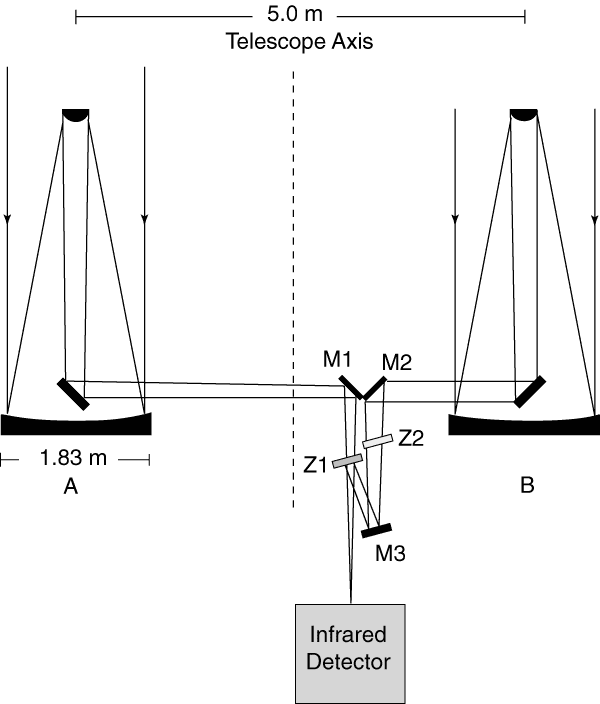
But they all only show light that enters the telescope along the axis. Not the light that would enter with some small angle, let's say from other star in the view. So what is happening in the delay line? The light must be spreading out. You can see my exaggerated situation below, with large angles.
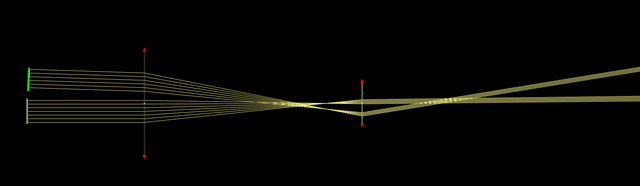
You can see that the light from small angle will go out the eyepiece on some angle, and after some length it would go past the, let's say some mirror that somewhere far to the right. I understand that we are using interferometer because what we want to see is separated by very very small angle, but still... Keck telescope delay line is around 100m long, I would imagine light would spread out over that distance.
Do they have to take care of this by using extra lenses and mirrors, or am I overthinking and light would not spread out that far?
But they all only show light that enters the telescope along the axis. Not the light that would enter with some small angle, let's say from other star in the view. So what is happening in the delay line? The light must be spreading out. You can see my exaggerated situation below, with large angles.
You can see that the light from small angle will go out the eyepiece on some angle, and after some length it would go past the, let's say some mirror that somewhere far to the right. I understand that we are using interferometer because what we want to see is separated by very very small angle, but still... Keck telescope delay line is around 100m long, I would imagine light would spread out over that distance.
Do they have to take care of this by using extra lenses and mirrors, or am I overthinking and light would not spread out that far?