Internal Force Diagram for Rigid Body and Distributed Load

Join the discussion
Ask a follow-up here, or get your own question answered by working scientists, mathematicians and engineers — people, not an autocomplete.
Real named experts · corrections over time · the nuance an AI answer skips
6 replies · 4K views
hdp12
Messages
67
Reaction score
2
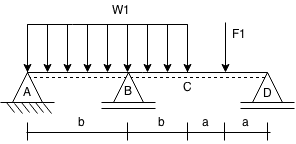
I'm working on a homework problem for Statics and I'm stuck. Could someone please help?Problem: Draw the internal force (N,V,M) diagrams and include all significant figures
HW5-9_Book7-80.png
Here is all of my work:

Resulting F from W1:
W(x) = W1
∴ F2=∫02b W1dx
eq (1) ⇒ F2 = W1⋅2b​
x1 = (F1)-102b W1dx = 1/(W1⋅2b)⋅(W1/2 ⋅ x2) |02b
eq (2) ⇒ x1 = b;​

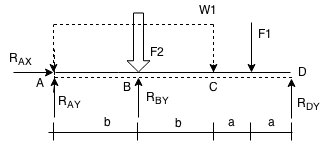
SUPPORT REACTIONS DIAGRAM &FBD:​
DIAGRAM:
FBD.png

FBD:
FBD%2B(1).png


SUPPORT REACTIONS VARIABLE SOLUTION:
[+→]∑Fx = 0 : 0 = RAX
eq (3) ⇒ RAX = 0 ;​
[+∧]∑Fy = 0 : 0 = (RAY + RBY + RDY) - (F1 + F2)
eq (4) ⇒ RAY + RBY + RDY = F1 + W1⋅2b;​
[+CW]∑MA = 0 : 0 = (F2⋅b + F1(2b + a)) - (RBY⋅b + RDY(2b+2a))
→RBY⋅b + RDY(2b+2a) = W1⋅2b⋅b + F1(2b + a)
eq (5) ⇒ RBY⋅b + RDY(2b+2a) = 2⋅W1⋅b2 + F1(2b + a) ;​
[+CW]∑MB = 0 : 0 = (RAY⋅b + F1(b+a)) - RDY(b+2a)
eq (6) ⇒ RDY(b+2a) = RAY⋅b + F1(b+a) ;​
[+CCW]∑MB = 0 : 0 = (F1⋅a + F2(2a+b)) - (RBY(2a+b)+RAY(2b+2a))
eq (7) ⇒ RBY(2a+b)+RAY(2b+2a) = F1⋅a + F2(2a+b) ;​

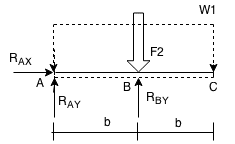
SEPARATE FBDs:
I:
FBD%2B(2).png
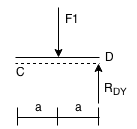
II:
FBD2.png

Separating the system at the hinge (C) will allow us to solve for the support reactions: In Figure 1, we can solve for the support reactions in the separate part, and therefore solve for the support reactions in the whole beam.

[+CW]∑MB = 0 : 0 = RAY⋅b
eq (8) ⇒ RAY = 0 ;​
[+∧]ΣFy = 0 : 0 = RAY + RBY - F2
eq (9) ⇒ RBY = F2

So now, using eq's (8) & (9) in eq (4) we can determine RDY
eq (4) : RAY + RBY + RDY = F1 + W1⋅2b
→F2 + RDY = F1 + W1⋅2b
→ RDY = F1 + W1⋅2b - W1⋅2b
eq (10) ⇒ RDY = F1

(9) > (5) : F2⋅b + RDY(2b+2a) = 2⋅W1⋅b2 + F1(2b + a)
→ RDY(2b+2a) = 2⋅W1⋅b2 + F1(2b + a) - (W1⋅2b)⋅b
→ RDY= 1/(2b+2a)[F1(2b + a) + 2⋅W1⋅b2 - (W1⋅2b)⋅b]
→ RDY= F1(2b + a)/(2b+2a)I'm just super lost, I guess, on where to go and if I'm even starting in the right direction... could someone please help me?
 
Physics news on Phys.org
Are you sure you are intpreting W1 correctly? You are taking it as the weight per unit length. From the info in the OP, it could just as easily be the total weight (your F2).
Your first eqn for x1 has some typos, but it worked out ok.
When you considered the hinged parts separately, you overlooked that there may be a force at C between the two parts. Your eqn 10 is clearly wrong if you consider moments about C.
 
haruspex said:
Are you sure you are intpreting W1 correctly? You are taking it as the weight per unit length. From the info in the OP, it could just as easily be the total weight (your F2).
Your first eqn for x1 has some typos, but it worked out ok.
When you considered the hinged parts separately, you overlooked that there may be a force at C between the two parts. Your eqn 10 is clearly wrong if you consider moments about C.
Yes W1's units are Force/Distance.
what are the typos for x1, just so I know?
and
hdp12 said:
[+CCW]ΣMC = 0 : 0 = (F1⋅a + F2(2a+b)) - (RBY(2a+b)+RAY(2b+2a))
eq (7) ⇒ RBY(2a+b)+RAY(2b+2a) = F1⋅a + F2(2a+b) ;
is supposed to be Sum of Moments at C, so considering, what do I do with this information?
 
hdp12 said:
what are the typos for x1, just so I know?
hdp12 said:
##x_1 = (F_1)^{-1}\int _0^{2b} W_1dx##
Shouldn't that be ##x_1 = (F_2)^{-1}\int _0^{2b} W_1x.dx##?
hdp12 said:
[+CCW]ΣMC = 0 : 0 = (F1⋅a + F2(2a+b)) - (RBY(2a+b)+RAY(2b+2a))
is supposed to be Sum of Moments at C
Looks like moments about D to me.
 
The key to getting the reaction forces in this problem is recognizing that the bending moment at point C is zero. I think that you noted this, but you still got the wrong values for the reaction forces.

If I do a moment balance on the portion of the beam to the right of C by taking moments about the hinge at point C, I get:
$$2aR_D-aF_1 = 0$$
This yields ##R_D=F_1/2##

Now, what do you get if you do the same kind of thing for the portion of the beam to the left of point C?

(I get ##R_A=-F_1/2## and ##R_B=2W_1b+F_1##)

Chet
 
Last edited:
okay so using your logic...
[+CW]ΣMC = 0 : 0 = F1a - 2a⋅RDY
→RDY = (2a)-1(F1a)
⇒ RDY = F1/2
then plugging this solution for RDY into eq (5) I get:
RBY = 1/b (2⋅W1⋅b2 + F1(2b+a)-RDY(2b+2a))
→RBY = (2⋅W1⋅b2)/b + F1⋅(2b+a)/b - F1/2⋅(2b+2a)/b
→RBY = 2⋅W1⋅b + F1⋅(2+a/b) - F1⋅(1+a/b)
⇒RBY = 2⋅W1⋅b + F1

then plugging this solution for RBY into eq (4) I get:
RAY = F1 + 2bW1 - RBY - RDY
→RAY = F1 + 2bW1 - (2bW1 + F1) - (F1/2)
⇒RAY = - F1/2
Now that I have the support reactions, I should be able to determine the Internal Force equations and create a diagram from that information.

What is the best strategy to go about this?