Irradiance from this infrared light source after a diffuser

Click For Summary

Discussion Overview

The discussion revolves around calculating the irradiance from an infrared LED after it passes through a diffuser. Participants explore methods for determining the irradiance at a certain distance from the diffuser, including considerations of the diffuser's transmission and output angle.

Discussion Character

  • Exploratory
  • Technical explanation
  • Mathematical reasoning
  • Debate/contested

Main Points Raised

  • One participant suggests calculating the irradiance at the diffuser and then applying the transmission factor of the diffuser, but expresses uncertainty about how to account for the radiation output angle.
  • Another participant emphasizes the need to characterize the diffuser's output and convolve it with the LED's emission pattern, mentioning that ray tracing programs could assist but require knowledge of the patterns.
  • A participant mentions having datasheets for both the LED and the diffuser, indicating that the necessary information should be available, and inquires about free ray tracing software options.
  • One participant argues that ray tracing may not be suitable due to the lack of a well-characterized transfer matrix for diffusers, suggesting convolution of the LED output with the diffuser profile as a simpler approach.
  • Another participant recommends ImageJ as a free image processing software that could be used for convolutions and FFT of images, noting its utility in handling emission patterns.
  • A participant with a mechanical engineering background seeks clarification on using ImageJ, specifically regarding the need for grayscale images of the emission patterns for convolution.
  • Another participant confirms the use of ImageJ and mentions its user-friendly literature, highlighting a built-in function for applying arbitrary filters to images.

Areas of Agreement / Disagreement

Participants express differing views on the best approach to calculate irradiance, with some advocating for ray tracing and others suggesting convolution methods. There is no consensus on the most effective method, and uncertainty remains regarding the characterization of the diffuser.

Contextual Notes

Participants note limitations related to the characterization of the diffuser and the dependence on specific definitions and data from the LED and diffuser datasheets. The discussion also reflects varying levels of familiarity with the necessary software tools and techniques.

Who May Find This Useful

Individuals interested in photometric and radiometric principles, particularly those working with infrared light sources and diffusers, as well as those seeking software solutions for optical simulations.

Maker21538
Messages
3
Reaction score
0
I need to calculate irradiance in a system shown on the image.
There is an infrared LED on the left and a diffuser in front of it. I need to calculate irradiance at a certain distance after the diffuser.

I think I first have to calculate irradiance at the diffuser. Then multiply it by the transmission of the diffuser to know how much radiation gets through the diffuser. That's where I don't know how to proceed. I don't know how to take into account the effect of radiation output angle from the diffuser.
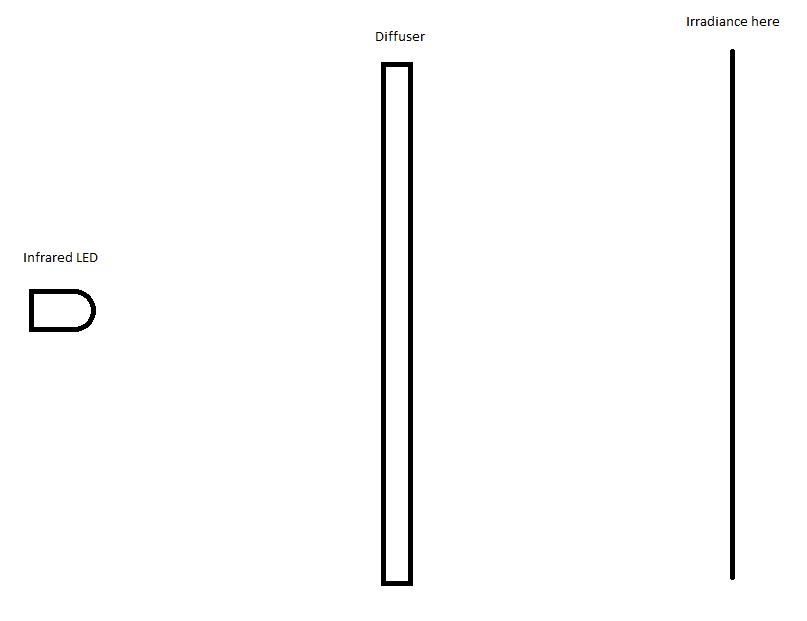
Setup.png
 
Science news on Phys.org
Maker21538 said:
I need to calculate irradiance in a system shown on the image.
There is an infrared LED on the left and a diffuser in front of it. I need to calculate irradiance at a certain distance after the diffuser.

I think I first have to calculate irradiance at the diffuser. Then multiply it by the transmission of the diffuser to know how much radiation gets through the diffuser. That's where I don't know how to proceed. I don't know how to take into account the effect of radiation output angle from the diffuser.
View attachment 241502
You need to characterize the output of the diffuser to a "pencil" of light (experiment? info from supplier?) and convolve it with the emission pattern of the LED. Ray tracing programs will do the arithmetic but you need to know the patterns.
 
hutchphd said:
You need to characterize the output of the diffuser to a "pencil" of light (experiment? info from supplier?) and convolve it with the emission pattern of the LED. Ray tracing programs will do the arithmetic but you need to know the patterns.
I have the datasheets for both the LED and the diffuser so all the info needed should be available.
Are there any good and free ray tracing software out there? All I can find is a few software for lens design.
Could the calculation be done as a stochastic simulation in some mathematics software?
 
Maker21538 said:
I have the datasheets for both the LED and the diffuser so all the info needed should be available.
Are there any good and free ray tracing software out there? All I can find is a few software for lens design.
Could the calculation be done as a stochastic simulation in some mathematics software?

Ray tracing is a bad approach for this problem, since diffusers are not well-characterized in terms of a transfer matrix. I agree with hutchphd, the easiest path is probably to simply convolve the LED output irradiance with the diffuser profile. As far as commercial programs, both FRED and ASAP can handle nonimaging design problems.
 
Maker21538 said:
Are there any good and free ray tracing software out there?
It has been a few years but Image J from NIH used to be good and free. This is image processing software and you can do all kinds of good stuff, including convolutions and FFT of images. Lots of add-ons around.
 
This is a hobby for me, so any kind of commercial software is out of question.
I have a background in mechanical engineering and only know the basic photometric and radiometric principles. Therefore there is much I don’t understand.

To use the ImageJ I should have grayscale images representing the emission patterns of the LED and diffuser and then colvolve them? Am I correct?
 
Yes. You should definitely get to know imageJ then. The software is written with medical/biological applications (diagnostic images, fluorescence) in mind so there is a lot of good but not overpoweringly technical literature available. As I recall there is a built- in function that allows you to define an arbitrary "filter" some pixels in size and apply it (convolve) to any other image. Have fun.
 

Similar threads

  • · Replies 11 ·
Replies
11
Views
4K
  • · Replies 11 ·
Replies
11
Views
2K
  • · Replies 7 ·
Replies
7
Views
3K
  • · Replies 10 ·
Replies
10
Views
8K
  • · Replies 6 ·
Replies
6
Views
2K
  • · Replies 21 ·
Replies
21
Views
7K
  • · Replies 16 ·
Replies
16
Views
4K
  • · Replies 1 ·
Replies
1
Views
2K
  • · Replies 26 ·
Replies
26
Views
5K
  • · Replies 2 ·
Replies
2
Views
2K