Irreversibility of Aristotle's law

Click For Summary
SUMMARY

The forum discussion centers on the irreversibility of Aristotle's law of motion as contrasted with Newtonian mechanics. Participants reference Leonard Susskind's lecture, where he argues that while Newton's laws allow for both past and future predictions, Aristotle's framework fails to provide information about the past due to its reliance on a single initial condition. The discussion highlights the mathematical formulations of motion, particularly the differential equations governing spring behavior, and emphasizes the limitations of predicting past states in Aristotelian physics.

PREREQUISITES
  • Understanding of differential equations, specifically first-order and second-order ODEs.
  • Familiarity with Newton's laws of motion and their implications for predicting future and past states.
  • Knowledge of classical mechanics, particularly the behavior of springs and forces.
  • Basic grasp of time-reversal symmetry in physics.
NEXT STEPS
  • Study the implications of time-reversal symmetry in classical mechanics.
  • Explore the differences between first-order and second-order ordinary differential equations.
  • Investigate the mathematical modeling of spring dynamics using Hooke's Law.
  • Read Leonard Susskind's "The Theoretical Minimum" series for deeper insights into classical physics concepts.
USEFUL FOR

Students of physics, educators in classical mechanics, and anyone interested in the philosophical implications of motion and time in physics will benefit from this discussion.

mark2142
Messages
228
Reaction score
42
"Reversibility means that we never lose information, that at a fundamental level we can always retrodict the past as well as predict the future in the laws of physics".
Susskind in his Theoretical minimum Lecture 2 describes about the laws which are true and which are not. He tells the law of Aristotle is wrong experimentally and if we see it logically. It predicts the future but can't the past. I have some difficulty in it. He writes
$$F(t)=m \dot x$$
$$F(t) \approx \frac{m(x(t+\Delta)-x(t))}{\Delta}$$
So, $$\frac{\Delta}m F(t) +x(t)= x(t+\Delta)$$
To predict the future we just have to know the current position which I assume would be some numerical value of x at time t, ##x(t)##. We can repeat the same thing over and over again to find new positions.

Take an example of spring force ##F(x)=-kx##.
$$x(t)\left[ 1-\frac{k \Delta}{m} \right]=x(t+\Delta)$$
I don't know how the spring here is behaving. He says the way spring behaves according to the law is the position decreases to zero point by a common factor ##\left[ 1-\frac{k \Delta}{m} \right]##. I am not sure how. Is it going to stop immediately after stretching and does not jiggle around?
The solution to the differential eqn ##-kx=m \dot x## is $$x=x(0)e^{-kt/m}$$ I am not sure but here is the position function with respect to time. Can't we now just put in time value and get the position to past and to the future?
Susskind says it sure can predict the future but not the past as we can't tell from where the spring came from since all stretchings end to the same point origin. I don't fully understand how we are unable to predict the past.
 
Last edited:
Physics news on Phys.org
I guess, what he meant is that if you see the point sitting at ##x=0##, you can't say, where it came from, because no matter which initial condition you choose, for ##t \rightarrow \infty## your point always ends at ##x=0##. On the other hand, if ##x(0) \neq 0## you know where it was before ##t=0## and where it will be after ##t=0##.

The supposed "Aristotelian" equation of motion is, of course, not time-translation invariant, because the left-hand side flips sign under time reversal and the right-hand side doesn't.
 
  • Like
Likes   Reactions: topsquark
vanhees71 said:
no matter which initial condition you choose, for your point always ends at .
So that means suppose I choose x(0)=5. That is the relaxed state I suppose. At ##t\rightarrow 0## it will come to x=0 and stop no matter where it was in the past. I suppose the spring doesn't do oscillatory motion. That is a very weird way for spring to behave.
vanhees71 said:
I guess, what he meant is that if you see the point sitting at , you can't say, where it came from,
Can you explain a little bit more? How does Newtons equation tell the past and this doesn't?
 
No at ##t=0## you have by your initial condition ##x=5##. For ##t \rightarrow \infty## you get ##x \rightarrow 0##. You have derived the exponential solution of this equation yourself correctly!
 
vanhees71 said:
No at ##t=0## you have by your initial condition ##x=5##. For ##t \rightarrow \infty## you get ##x \rightarrow 0##. You have derived the exponential solution of this equation yourself correctly!
My mistake. Spring is stretched upto x=5.
 
  • Like
Likes   Reactions: vanhees71
vanhees71 said:
I guess, what he meant is that if you see the point sitting at , you can't say, where it came from, because no matter which initial condition you choose, for your point always ends at . On the other hand, if you know where it was before and where it will be after .
I think what it really means is that in case of Newton the spring never stops. So we know where the start was as it does not loose energy. Contrary to this the aristotle spring stops at x=0 from wherever it was. We can never say where it came from. What was the initial condition. Does that make sense?
 
  • Like
Likes   Reactions: vanhees71
If you have a 1st-order equation of motion of this kind,
$$m \dot{x}=F(x)$$
then you can give only one initial condition, i.e., ##x(t_0)=x_0##. Already this contradicts everyday experience, because I can not only start to move from whatever point in space I like but I can also choose my initial velocity. That's in accordance with Newton's Laws, i.e.,
$$m \ddot{x}=F(x).$$
That's a 2nd-order ODE, and you must give ##x(t_0)=x_0## and ##\dot{x}(t_0)=v_0## as initial conditions to get a unique solution.
 
  • Like
Likes   Reactions: mark2142
vanhees71 said:
No at ##t=0## you have by your initial condition ##x=5##. For ##t \rightarrow \infty## you get ##x \rightarrow 0##. You have derived the exponential solution of this equation yourself correctly!
But wait a minute! We know the position function of time in aristotle version. So don’t we know each and every position from t=0( the initial condition) to t= infinity i.e where the spring came from.Yes?
 
Is Susskind saying that we can never know the past in Aristotle version of spring in the middle of motion whereas in Newtons version the spring is doing cyclic motion so the future and past both are deterministic? I misunderstood the initial condition part. The initial condition during the motion not at the point when the energy is given to the system. Yes?
(I think he is not talking from rest.)
 
  • #10
I think, you cannot so easily argue with Newtonian physics within this supposed version of Aristotelian physics. I think it's pretty obvious that this attempt of describing mechanics doesn't go very far anyway. Is there something in his book or a paper, where this is pursued further?
 
  • #11
vanhees71 said:
I think, you cannot so easily argue with Newtonian physics within this supposed version of Aristotelian physics. I think it's pretty obvious that this attempt of describing mechanics doesn't go very far anyway. Is there something in his book or a paper, where this is pursued further?
I don’t know. I have just started reading and I am stuck on reversible nature of laws. I want to know about predicting the past.
How is spring losing the information of past?
How does the block going down an incline don’t?
How do we check this by inverting the sign of time?

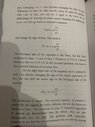
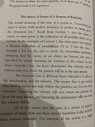
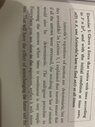
(Here is a page from the book. Maybe this may help.)
 

Attachments

  • image.jpg
    image.jpg
    40.6 KB · Views: 127
  • image.jpg
    image.jpg
    39.7 KB · Views: 144
  • image.jpg
    image.jpg
    50.2 KB · Views: 166
  • #12
vanhees71 said:
If you have a 1st-order equation of motion of this kind,
$$m \dot{x}=F(x)$$
then you can give only one initial condition, i.e., ##x(t_0)=x_0##. Already this contradicts everyday experience, because I can not only start to move from whatever point in space I like but I can also choose my initial velocity. That's in accordance with Newton's Laws, i.e.,
$$m \ddot{x}=F(x).$$
That's a 2nd-order ODE, and you must give ##x(t_0)=x_0## and ##\dot{x}(t_0)=v_0## as initial conditions to get a unique solution.
Do you mean ##\frac {\Delta}{m} F(t)+x(t)=x(t+\Delta)## vs
##\Delta^2\frac Fm+2x(t)-x(t-\Delta)=x(t+\Delta)##.
There is no velocity, only ##x(t)## and ##x(t-\Delta)## in second eqn. Where is initial velocity ?
Are you referring to ##\frac{x(t)-x(t-\Delta)}\Delta## in ##\Delta^2F=(x(t+\Delta)-x(t))-(x(t)-x(t-\Delta))## as initial velocity?
 
Last edited:
  • #13
I don't understand your notation. I thought we discuss the differential equation ##m \dot{x}=F(x)##?
 
  • #14
vanhees71 said:
I don't understand your notation. I thought we discuss the differential equation ##m \dot{x}=F(x)##?
It’s aristotle vs Newton eqn for motion. You can see in video at 06:00 min and at 26:00 minutes.
I want to know how two things are actually required to predict instead of one. And also please look post # 11.
 
  • #15
vanhees71 said:
I don't understand your notation. I thought we discuss the differential equation ##m \dot{x}=F(x)##?
That would be ##m\ddot x = F(x)##.
 
  • #16
But that's Newton! I thought we were discussing this somewhat speculative equation which should somehow mathematically formulate Aristotle's mechanics?
 

Similar threads

  • · Replies 30 ·
2
Replies
30
Views
3K
  • · Replies 17 ·
Replies
17
Views
3K
  • · Replies 45 ·
2
Replies
45
Views
4K
  • · Replies 27 ·
Replies
27
Views
2K
  • · Replies 13 ·
Replies
13
Views
2K
  • · Replies 2 ·
Replies
2
Views
2K
  • · Replies 9 ·
Replies
9
Views
1K
  • · Replies 17 ·
Replies
17
Views
3K
  • · Replies 3 ·
Replies
3
Views
2K
  • · Replies 4 ·
Replies
4
Views
2K