Is it OK to use 220V Solenoid Valve in a 230 V Environment

  • Thread starter Thread starter Green Light
  • Start date Start date
  • Tags Tags
    Solenoid Valve
Click For Summary

Discussion Overview

The discussion centers on the suitability of using a 220V solenoid valve in a 230V environment, exploring the implications of voltage variations, potential impacts on device lifespan, and regional voltage standards.

Discussion Character

  • Technical explanation
  • Debate/contested

Main Points Raised

  • Some participants assert that a 220V solenoid valve will function properly in a 230V environment, citing that domestic supplies can vary by up to 5%.
  • Concerns are raised about the potential for reduced lifespan of the solenoid valve when operated at a higher voltage, as it may run hotter.
  • One participant notes that the actual voltage supplied can often be higher than the nominal 230V, particularly in regions like the UK where historical standards were closer to 240V.
  • Another participant suggests sourcing a solenoid valve rated for 240V/230V to ensure compatibility with local voltage conditions.
  • Discussion includes the idea that global standards for AC supply voltages are being harmonized, with the 230V specification allowing for a range of 218.5V to 241.5V.
  • One participant shares personal experience of measuring a supply voltage that still reads as 240V despite being labeled as 230V.

Areas of Agreement / Disagreement

Participants express differing views on the implications of using a 220V valve in a 230V environment, particularly regarding longevity and the actual voltage supplied in different regions. There is no consensus on the best approach, as some advocate for using the 220V valve while others recommend sourcing a valve rated for 240V/230V.

Contextual Notes

Participants highlight the variability in actual supply voltages and the historical context of voltage standards, which may affect the performance and lifespan of the solenoid valve. There are also mentions of potential resistive line losses that could further influence voltage levels.

Green Light
Messages
4
Reaction score
0
I would like to know whether it is ok to use 220V Solenoid Valve in a 230V Environment.

This is the Valve I am taking about.
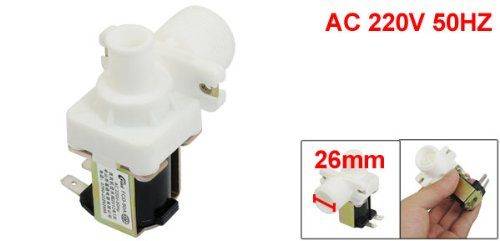
31pv5GvcxjL.jpg


This is the Circuit I am going to make with this.
http://www.electroschematics.com/6161/power-switch-with-infrared-proximity-sensor/

Thanks in Advance :)
 
Engineering news on Phys.org
The simple answer is yes, it will work.
Domestic supplies are designed to vary by up to 5%. If rated at 220V it should work happily at 231V. The problem may be lifetime since it will run slightly hotter at 230V than 220V. Domestic rated solenoid valves like that pictured have a limited lifetime. The solenoid part is designed to be replaced as required.
 
  • Like
Likes   Reactions: 1 person
Baluncore said:
The simple answer is yes, it will work.
Domestic supplies are designed to vary by up to 5%. If rated at 220V it should work happily at 231V. The problem may be lifetime since it will run slightly hotter at 230V than 220V. Domestic rated solenoid valves like that pictured have a limited lifetime. The solenoid part is designed to be replaced as required.

Very Helpful,Thanks a Lot Bro :)
 
Depending on your location the 230v Environment maybe misguided figure. Here in the UK we had a 240v set-up for many years but to conform with EU legislation this was changed to 230v. The power we use is still a majority 240v as the measured average voltage rarely meets the 230v figure in favour of the 240v.

This will as above have a life shortening effect on the coils expected lifespan - you would be better sourcing a 240v/230v coil as this will fall within the tolerances of the solenoid - you could always check with tech' of the manufacturers as most are wise to our actual voltage and theoretical voltage.
 
In your circuit, the S201S02 will switch up to 400V (i.e. 280V AC) according to the data sheet.

The best solution would be to buy the solenoid valve from a supplier in your own country, so you get one that is designed to work with your country's electricity supply.
 
World standards are gradually being harmonised.
AC supply voltages in the range 220V to 240V are moving to the global 230V specification.
Sometime during this process, the voltage actually provided may move closer to 230V.

The 230V specification is +/– 5% with up to 5% more lost due to a customers resistive line loss.
This allows supplies between 218.5V and 241.5V to be called 230V.

I once had 240V. For over three years now the supplier has called it 230V.
But my meters still measure it as 240V.

Anything in the range 220VAC to 240VAC should work OK under the 230VAC specification.
 

Similar threads

  • · Replies 3 ·
Replies
3
Views
3K
Replies
23
Views
5K
Replies
1
Views
3K
  • · Replies 5 ·
Replies
5
Views
6K
  • · Replies 4 ·
Replies
4
Views
2K
  • · Replies 14 ·
Replies
14
Views
2K
  • · Replies 8 ·
Replies
8
Views
11K
  • · Replies 1 ·
Replies
1
Views
2K
  • · Replies 7 ·
Replies
7
Views
6K
  • · Replies 13 ·
Replies
13
Views
4K