Is this Live/Neutral transition true and instant?

  • Context: High School 
  • Thread starter Thread starter Kevin J
  • Start date Start date
  • Tags Tags
    Transition
Click For Summary

Discussion Overview

The discussion revolves around the concept of live and neutral wire transitions in AC circuits, specifically questioning the nature of voltage changes when a wire is earthed and the implications of defining neutral as 0V. Participants explore the theoretical and practical aspects of voltage measurement, earthing, and the behavior of AC voltage in relation to earth potential.

Discussion Character

  • Exploratory
  • Technical explanation
  • Conceptual clarification
  • Debate/contested

Main Points Raised

  • One participant questions how earthing a wire makes it 0V, noting that the wire remains connected to a 240VAC source.
  • Another participant explains that both circuits are equivalent in terms of voltage across terminals, but emphasizes that the neutral wire should be near 0V with respect to Earth for safety.
  • A different participant introduces the idea that voltage definitions are arbitrary, using a 9V battery analogy to illustrate how different terminals can be defined as 0V.
  • There is a discussion about the speed of voltage changes when making an earth connection, with a participant noting that while changes are fast, they are not instantaneous due to capacitance effects.
  • One participant reiterates the question of why neutral is considered 0V, expressing confusion about its relationship to the 240V source.
  • Another participant emphasizes that all voltages are relative and that the circuit's floating nature means either terminal can be connected to earth/0V.

Areas of Agreement / Disagreement

Participants express differing views on the nature of voltage measurement and the implications of earthing, with no consensus reached on the fundamental questions raised regarding the transition of neutral to 0V and the speed of voltage changes.

Contextual Notes

Participants mention various domestic mains supply standards and the complexities involved in earthing practices, indicating that the discussion is influenced by differing regional practices and definitions.

Kevin J
Messages
57
Reaction score
2
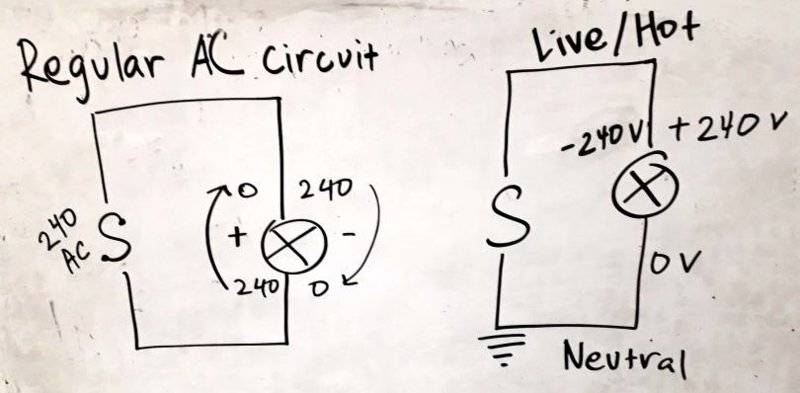
On the right hand side the voltage changes polarity everytime, now, that I 'earth' one of the wire, its now called Neutral, which is 0V(for convenience), and voltage alters in the live wire between +240/-240. My question is this transition true and instant?
*
and if you could help, I don't really understand how does 'earthing' the wire suddenly makes it 0V, isn't the wire still connected to the source which offers 240VAC?
New%20Doc%202018-11-11%2020.31.21_1.jpeg
 

Attachments

  • New%20Doc%202018-11-11%2020.31.21_1.jpeg
    New%20Doc%202018-11-11%2020.31.21_1.jpeg
    33 KB · Views: 540
Physics news on Phys.org
Both circuits are equivalent as far as the device you plug in. There is 240V AC across the terminals in both cases.
The left hand diagram does not define any potentials with respect to Earth (for instance, if you touch part of the circuit you could expect anything. The right hand circuit has its Neutral wire connected to 'an' Earth. The potential of the neutral will therefore be at or near 0V with respect to someone touching that side of the circuit. There are many different domestic mains supply standards around the world and do not pay too much attention to someone who insists that things are the way they describe in detail. The only thing all systems have in common is that the Neutral wire should be near 0V with respect to Earth and safe to touch. (But don't try until you have actually tested it!)

Incidentally, you seem to be assuming that the volts w=swing between + and - 240V. In fact they swing between about peaks of + and - 330V. The 240V figure is the equivalent voltage of a DC generator, supplying the same Power to the Load. Look up RMS mains voltage on Google and find many discussions and explanations.
Edit,: In the US you can often find a Neutral wire with two 120`V wires, in anti phase so that there is 240~V between them
 
You asked how fast the voltages would change when you make the Earth connection. Perhaps make sure you understand how it would work for DC first...

Consider a 9V battery. The two terminals we usually label 0V and 9V. However all voltages are relative so when we say one node is 9V we mean it is at 9V with respect to the other terminal.

However which node we define as 0V is arbitrary. We could easily choose to define the +ve terminal as 0V, in which case the -ve terminal would be at -9V.

We could also define 0V as the voltage on a tent peg hammered into the ground nearby.

So imagine there is now a wire between that peg and one of the battery terminals. The voltages would be either..

0V and 9V
or
-9V and 0V

...depending on which terminal was connected to the tent peg.So your question now amounts to asking how fast the voltages could change between these two cases (assuming the wire can be moved infinitely fast).

The answer is the voltage changes fast but not infinitely fast. The batteries have some capacitance with respect to the world around them and this has to be charged/discharged. The capacitance is small but not zero so it take some small time for the voltages to change when you move the wire from one terminal to the other.

Edit: Here in the UK we have three live wires that are 120 degrees out of phase with each other. Most houses are small and only use one live phase. A few use all three phases. You can't connect any of these to earth. The electric co also provides a Neutral that is usually at a similar voltage to Earth but not always connected to it. Sometimes they do connect them together, sometimes you have to provide your own safety Earth (typically a copper rod hammered into the ground). Whole books can be written on this topic.
 
Last edited:
  • Like
Likes   Reactions: Dale
But why does the neutral becomes 0V, why should it 'choose' the 0v, isn't it still connected to a 240V?
 
All voltages are relative and as Sophiecentaur said...your circuit on the left doesn't define what the 240V AC is measured with respect to.

We are assuming that it's floating (like a 9V battery) so either terminal can be connected to earth/0V.
 

Similar threads

  • · Replies 7 ·
Replies
7
Views
2K
  • · Replies 13 ·
Replies
13
Views
4K
Replies
4
Views
2K
  • · Replies 36 ·
2
Replies
36
Views
7K
  • · Replies 64 ·
3
Replies
64
Views
5K
  • · Replies 2 ·
Replies
2
Views
4K
  • · Replies 28 ·
Replies
28
Views
4K
  • · Replies 83 ·
3
Replies
83
Views
8K
  • · Replies 5 ·
Replies
5
Views
8K
  • · Replies 20 ·
Replies
20
Views
3K