SUMMARY
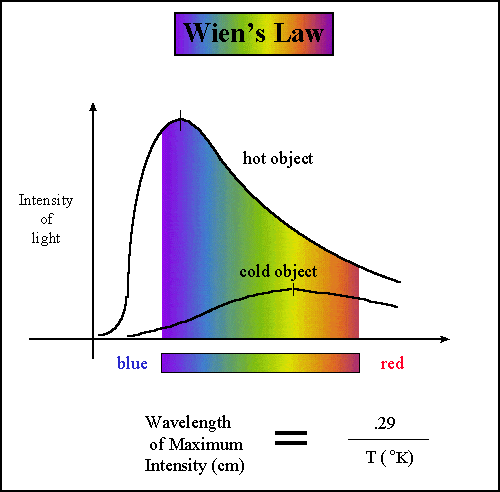
Wien's Law, expressed as λ = b/T, applies universally to all materials above absolute zero (0 Kelvin), indicating that all materials radiate thermal energy. The discussion clarifies that while all materials emit radiation, the peak frequency of this radiation may not always correlate directly with temperature for certain materials. Specifically, colored materials that are heat-resistant can exhibit deviations from the ideal blackbody spectrum, which is a critical consideration in thermal radiation studies.
PREREQUISITES
- Understanding of Wien's Law and its formula λ = b/T
- Knowledge of thermal radiation and blackbody radiation concepts
- Familiarity with materials science, particularly heat-resistant materials
- Basic principles of thermodynamics and temperature scales
NEXT STEPS
- Research the implications of Wien's Law in materials science
- Study the characteristics of blackbody radiation and deviations in real materials
- Explore the properties of heat-resistant colored materials and their thermal behavior
- Investigate advanced topics in thermodynamics related to thermal radiation
USEFUL FOR
Physicists, materials scientists, and engineers interested in thermal radiation, as well as students studying thermodynamics and material properties.