amjad-sh said:
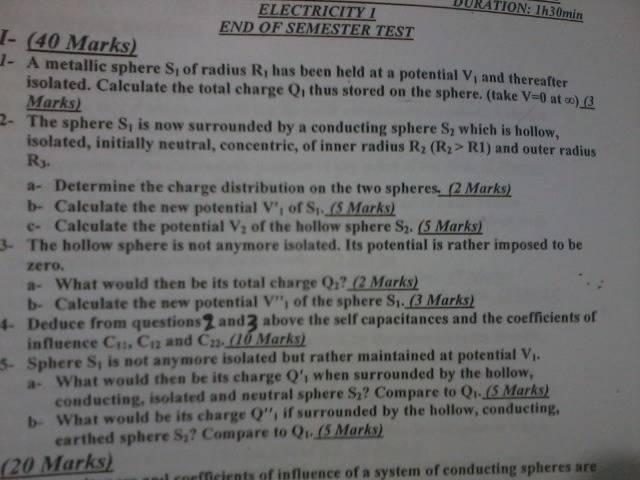
Lets begin from question 1 :
my solution :
1) V∞ -V1=0∫∞ E.dr
what I got is V1=Q1/4∏εR1.
then Q1=4∏εR1*V1
(but since in question 5 he said that s1 is no more isolated rather maintained at potential V1 then I'm not sure about this solution).
That looks about right to me so far.

2) a) from gauss law E*0∫rds=Qin/ε (where r>R2)
then Qin=Q1+Q' and as E must be zero inside the "shell" then Qin=0 and then Q'=-Q1.(Q' is the charge on the inner surface of the shell and I chose spherical gussian surface surrounding sphere of radius R2 consequently charge on the surface of the shell will be +Q1 )
If I understand, yes you are correct. Your previously calculated value of
Q1 is on the outside of the central sphere. -
Q1 exists on the inside of the
S2 shell and +
Q1 exists on the outside of the
S2 shell.
b) V∞-V1'=-R1∫∞E.dr
we get that V1=Q1/4∏εR1.
I think you are missing a few steps here. You need to break the integral up into three parts, since there are three different regions of electric field.
Infinity to
R3
R3 to
R2
and
R2 to
R1
You can then sum the individual results together to find the potential from infinity to
R1.
c) V2-V1'=-R1∫R2E.dr
we get that V2=Q1/4∏εR2.
I interpret the problem as asking you to find the potential between
R2 and infinity, not
R2 and
R1.
Your answer seems correct though. Just realize that that is the potential difference of
S2 from infinity, i.e., it is not
V2 -
V'
1.
(In other words, it's
V2 - 0.)
3) a) if V2=0 then charges on the surface of the shell will be zero then Q2 =0.
That's not right.

But you can fix it easily enough.

What it means to Earth shell
S2 is the electric field from infinity to
R3 must be equal to zero. Given that the sphere
S1 has a
Q1 charge on it, what does Gauss' law say about what the total charge must be on
S2 (where
Q2 is the
net charge on shell
S2)?
Edit: Let me rephrase that for clarity. Shell
S2 is earthed. That means the electric field for all space outside the shell
S2 is zero.
- If so, what does Gauss' law say about the total charge of the S1 and S2 combination.?
- Since you know that S1 has charge on it, what charge must S2 have on it?
b) V"1=R1∫R2E.dr
V"1=(Q1/4∏ε)*(1/R2-1/R1).
Lets skip Question four.
In question 5 I didn't know what to do.
I'm not sure about the solutions I wrote above so if you can help please and thanks btw.
Part a). You don't know what the charge is on
S1, but you do know it's potential (it's potential is
V1). You don't know the value of this charge, but you can still give it a name for now. Let's just call it
q for now (or use whichever name you prefer). Set up the charge distribution on shell
S2 in terms of the variable
q. Now breakup the integral and solve three parts of the integrals. (don't forget about the negative involved [itex]V = - \int_\infty^R \vec E \cdot \vec{d \ell}[/itex].)
You know that the sum of all the individual sections must be
V1. With that, solve for
q.
Part b This time, the shell
S2 is earthed (i.e., grounded, has a potential of 0 Volts). Essentially that means that this time you only need to integrate from
R2 to
R1 instead of from all the way from infinity to
R1.