Kelvin Units: Help Understand Optics of Graphene

Click For Summary

Discussion Overview

The discussion revolves around the transformation of frequency expressed in Kelvin units as presented in an article on the optical properties of graphene. Participants explore the implications of this unit transformation and seek clarification on the underlying principles and calculations involved.

Discussion Character

  • Technical explanation
  • Conceptual clarification
  • Debate/contested

Main Points Raised

  • Some participants suggest that the transformation from frequency to Kelvin is based on the relationship between energy, frequency, and temperature, specifically using the equations E = kbT and E = hv.
  • Others question the validity of "dropping" constants like the Boltzmann constant (kb) and Planck's constant (h) in the transformation process, emphasizing the need to consider units carefully.
  • A participant notes that what is reported as "frequency" may actually be expressed as ##\hbar \omega / k_\mathrm{B}##, indicating a specific relationship in the context of quantum mechanics.
  • There is a discussion about the convenience of expressing quantities in terms of measurable units and the ability to convert between energy and temperature without losing meaning in the context of the same system.

Areas of Agreement / Disagreement

Participants express differing views on the appropriateness of dropping constants in unit transformations, indicating a lack of consensus on the method of conversion between frequency and temperature. Some agree on the conceptual framework, while others remain uncertain about the implications of the transformations.

Contextual Notes

There are unresolved questions regarding the assumptions made in the unit transformation and the dependence on specific definitions of energy and temperature in the context of the discussion.
sukharef
Messages
54
Reaction score
0
Hey!
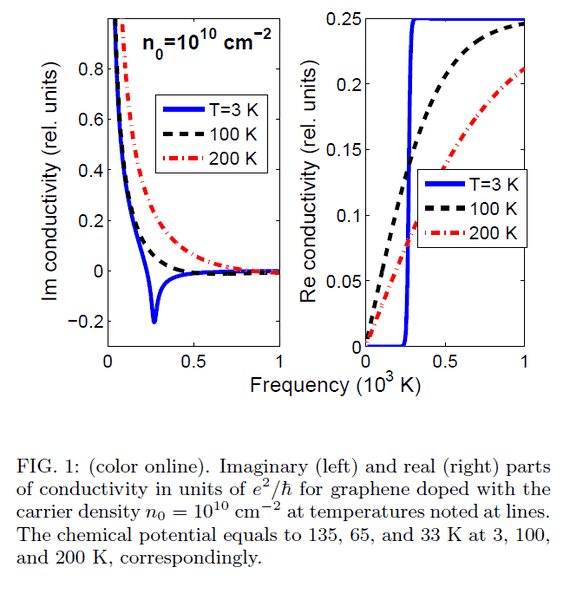
In https://www.researchgate.net/publication/230937856_Optical_properties_of_graphene article (Optical properties of graphene) I found out the frequency is expressed in Kelvins.

f3c892ee81fb.png

Could you help me with it - how did the author do this unit transformation?
Thanks in advance!
 
Last edited by a moderator:
Physics news on Phys.org
There are lots of units of "energy" that look like something else; frequency is a common one. In this case I think the author used E = kbT, where kb is the Boltzmann constant, together with E = hv, then equated the two formulae and dropped the kb and the h. It works in such situations because both frequency and temperature are proportional to energy; and it's convenient to express quantities in terms of things you directly measure.
 
John Park said:
There are lots of units of "energy" that look like something else; frequency is a common one. In this case I think the author used E = kbT, where kb is the Boltzmann constant, together with E = hv, then equated the two formulae and dropped the kb and the h. It works in such situations because both frequency and temperature are proportional to energy; and it's convenient to express quantities in terms of things you directly measure.
Thank you for the answer!
What do you mean by dropping the kb and the h? I mean, we can not just drop them without paying attention to the units that they are expressed in.
What should I do to turn the K-frequency into the sec--frequency in this situation? Still a little bit confused.
 
What is reported as "frequency" is actually ##\hbar \omega / k_\mathrm{B}##.
 
What do you mean by dropping the kb and the h? I mean, we can not just drop them without paying attention to the units that they are expressed in.

Reference https://www.physicsforums.com/threads/frequency-in-k.907539/#post-5722451

Actually you can. As DrClaude says the frequency corresponds to ℏ ω / k.

Maybe think of it this way. We have an energy E that could be the energy of a photon with frequency ν, where hν = E. So we could just agree to talk about the frequency, knowing that if necessary we could always convert back to energies by multiplying by h. In the same way we could say that E =kbT, using the Boltzmann constant to define a corresponding temperature T; and as long as we're talking about the same system we can compare energies, add or subtract them, by comparing, adding or subtracting the corresponding temperatures. We can always convert to real energies at any point, but there's usually no need.

Representing frequencies as temperatures just takes the same process one step further. It's a bit like expressing an amount in dollars as pounds sterling and as euros; you could use the results to express euros in terms of sterling.
 
John Park said:
Actually you can. As DrClaude says the frequency corresponds to ℏ ω / k.

Maybe think of it this way. We have an energy E that could be the energy of a photon with frequency ν, where hν = E. So we could just agree to talk about the frequency, knowing that if necessary we could always convert back to energies by multiplying by h. In the same way we could say that E =kbT, using the Boltzmann constant to define a corresponding temperature T; and as long as we're talking about the same system we can compare energies, add or subtract them, by comparing, adding or subtracting the corresponding temperatures. We can always convert to real energies at any point, but there's usually no need.

Representing frequencies as temperatures just takes the same process one step further. It's a bit like expressing an amount in dollars as pounds sterling and as euros; you could use the results to express euros in terms of sterling.
DrClaude said:
What is reported as "frequency" is actually ##\hbar \omega / k_\mathrm{B}##.
Thank you!
 

Similar threads

  • · Replies 0 ·
Replies
0
Views
2K
  • · Replies 1 ·
Replies
1
Views
2K
  • · Replies 3 ·
Replies
3
Views
2K
  • · Replies 2 ·
Replies
2
Views
4K
  • · Replies 3 ·
Replies
3
Views
3K
  • · Replies 4 ·
Replies
4
Views
4K
Replies
1
Views
2K
  • · Replies 1 ·
Replies
1
Views
2K
  • · Replies 11 ·
Replies
11
Views
2K
  • · Replies 1 ·
Replies
1
Views
4K