Lagrangian function of a double undamped pendulum

Click For Summary
SUMMARY

The discussion focuses on deriving the Lagrangian for a double undamped pendulum, specifically addressing the complexities introduced by the second angle φ2, which is measured from the line connecting the two pivot points. Participants suggest using the kinetic energy equations, T = (1/2) m1(ẋ1² + ẏ1²) + (1/2) m2(ẋ2² + ẏ2²), and emphasize the importance of calculating the velocities of the pendulum masses in terms of their angles. The conversation concludes with a confirmation that the calculations align with the expected results, particularly in simplifying the dot product of the position vectors.

PREREQUISITES
  • Understanding of Lagrangian mechanics
  • Familiarity with kinetic energy equations
  • Knowledge of vector calculus
  • Ability to perform algebraic manipulations involving trigonometric functions
NEXT STEPS
  • Study the derivation of the Lagrangian for multi-body systems
  • Learn about the application of the Euler-Lagrange equation in dynamics
  • Explore the concept of generalized coordinates in Lagrangian mechanics
  • Investigate the effects of damping in pendulum systems
USEFUL FOR

Students and professionals in physics, particularly those specializing in classical mechanics, as well as engineers working on dynamic systems and simulations involving pendulum motions.
PaBlo14101066
Messages
4
Reaction score
1
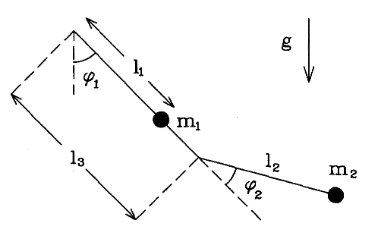
I must find the Lagrangian for an undamped pendulum using the diagram showed below, I've no idea what to do with the second angle φ2 because is measured from the line that joins the two pivot points.
1605973261966.png

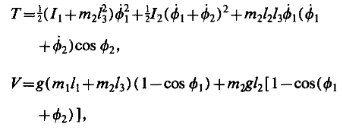
The ecuations I must obtain are as follows
1605973305616.png

I get so many different things but I can't reach the desired result
 
Physics news on Phys.org
PaBlo14101066 said:
I've no idea what to do
If all else fails, you could try $$T = {1\over 2} m_1\Bigl(\dot x_1^2+\dot y_1^2\Bigr) + {1\over 2} m_2\Bigl(\dot x_2^2+\dot y_2^2\Bigr) $$ but of course you already know how the subscript 1 term ends up, so the work is in the ##m_2## term.

Idem ##V##.
 
  • Like
Likes PaBlo14101066
BvU said:
If all else fails, you could try $$T = {1\over 2} m_1\Bigl(\dot x_1^2+\dot y_1^2\Bigr) + {1\over 2} m_2\Bigl(\dot x_2^2+\dot y_2^2\Bigr) $$ but of course you already know how the subscript 1 term ends up, so the work is in the ##m_2## term.

Idem ##V##.
Yes, I know, and also there must be a rotational kinetic energy, I made the algebra considering that φ2 is measured from the vertical and obtained
1605974501155.png

But even though I consider $$\phi_2=\phi_1+\phi'$$ I don't get to the equations of the second image
 
Don't you get, in terms of ##\hat{x}## and ##\hat{y}##,$$\dot{\mathbf{r}}_1 = l_1 \dot{\varphi}_1 \begin{pmatrix} \cos{\varphi_1} \\ \sin{\varphi_1} \end{pmatrix}$$and$$\dot{\mathbf{r}}_2 = l_3 \dot{\varphi}_1 \begin{pmatrix} \cos{\varphi_1} \\ \sin{\varphi_1} \end{pmatrix}

+ l_2 (\dot{\varphi}_1 + \dot{\varphi}_2) \begin{pmatrix} \cos{(\varphi_1 + \varphi_2)} \\ \sin{(\varphi_1 + \varphi_2)} \end{pmatrix}

$$Now you can find ##\dot{\mathbf{r}}_1 \cdot \dot{\mathbf{r}}_1## and ##\dot{\mathbf{r}}_2 \cdot \dot{\mathbf{r}}_2##. Does that work?
 
  • Like
  • Wow
Likes BvU and PaBlo14101066
etotheipi said:
Don't you get, in terms of ##\hat{x}## and ##\hat{y}##,$$\dot{\mathbf{r}}_1 = l_1 \dot{\varphi}_1 \begin{pmatrix} \cos{\varphi_1} \\ \sin{\varphi_1} \end{pmatrix}$$and$$\dot{\mathbf{r}}_2 = l_3 \dot{\varphi}_1 \begin{pmatrix} \cos{\varphi_1} \\ \sin{\varphi_1} \end{pmatrix}

+ l_2 (\dot{\varphi}_1 + \dot{\varphi}_2) \begin{pmatrix} \cos{(\varphi_1 + \varphi_2)} \\ \sin{(\varphi_1 + \varphi_2)} \end{pmatrix}

$$Now you can find ##\dot{\mathbf{r}}_1 \cdot \dot{\mathbf{r}}_1## and ##\dot{\mathbf{r}}_2 \cdot \dot{\mathbf{r}}_2##. Does that work?
I think that's it, I would have to do the algebra, but as far as it looks, looks fine
 
PaBlo14101066 said:
I think that's it, I would have to do the algebra, but as far as it looks, looks fine

Yes, I believe it does indeed get what you're after. The only fiddly part of the calculation is$$
\begin{align*}
\begin{pmatrix} \cos{\varphi_1} \\ \sin{\varphi_1} \end{pmatrix} \cdot \begin{pmatrix} \cos{(\varphi_1 + \varphi_2)} \\ \sin{(\varphi_1 + \varphi_2)} \end{pmatrix} &=

\cos{\varphi_1} \left( \cos{\varphi_1} \cos{\varphi_2} - \sin{\varphi_1} \sin{\varphi_2}\right) + \sin{\varphi_1} \left( \sin{\varphi_1} \cos{\varphi_2} + \cos{\varphi_1} \sin{\varphi_2}\right)

\\
&= \cos{\varphi_2} \left( \cos^2{\varphi_1} + \sin^2{\varphi_1} \right) \\

&= \cos{\varphi_2}

\end{align*}
$$but the rest should fall out okay.
 
  • Like
Likes docnet and PaBlo14101066
etotheipi said:
Yes, I believe it does indeed get what you're after. The only fiddly part of the calculation is$$
\begin{align*}
\begin{pmatrix} \cos{\varphi_1} \\ \sin{\varphi_1} \end{pmatrix} \cdot \begin{pmatrix} \cos{(\varphi_1 + \varphi_2)} \\ \sin{(\varphi_1 + \varphi_2)} \end{pmatrix} &=

\cos{\varphi_1} \left( \cos{\varphi_1} \cos{\varphi_2} - \sin{\varphi_1} \sin{\varphi_2}\right) + \sin{\varphi_1} \left( \sin{\varphi_1} \cos{\varphi_2} + \cos{\varphi_1} \sin{\varphi_2}\right)

\\
&= \cos{\varphi_2} \left( \cos^2{\varphi_1} + \sin^2{\varphi_1} \right) \\

&= \cos{\varphi_2}

\end{align*}
$$but the rest should fall out okay.
Yes, that's it. Thank you very much. You've earned heaven (whatever heaven is to you) :)
 
  • Love
Likes etotheipi

Similar threads

  • · Replies 1 ·
Replies
1
Views
2K
  • · Replies 11 ·
Replies
11
Views
2K
  • · Replies 4 ·
Replies
4
Views
2K
  • · Replies 3 ·
Replies
3
Views
1K
Replies
11
Views
2K
  • · Replies 76 ·
3
Replies
76
Views
7K
Replies
10
Views
5K
Replies
2
Views
2K
  • · Replies 3 ·
Replies
3
Views
3K
  • · Replies 1 ·
Replies
1
Views
2K