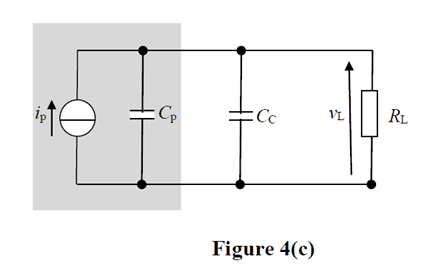
Comp Sci Laplace Transform of the input portion of this circuit

Click For Summary
The discussion focuses on the application of the Laplace Transform in analyzing a circuit's input portion. The original poster has equated T(s) to Z(s) and seeks validation of their approach. Responses indicate that while the results appear correct for phasor form, there are concerns about specific steps in the calculations. It is suggested to utilize conductance, susceptance, and admittance instead of impedance for simplification, especially in circuits with multiple loops and few independent nodes. Overall, the consensus is that the answer is correct, but a shift in perspective towards G, B, and Y could enhance clarity and ease of calculation.
Jason-Li
Messages
119
Reaction score
14
Homework Statement
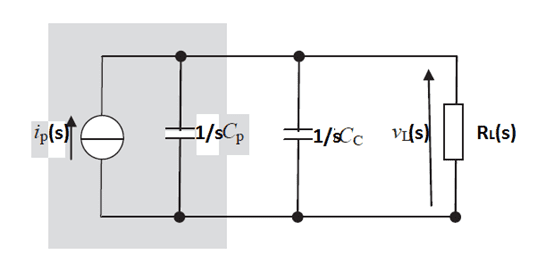
a) Draw the Laplace form of the input portion of the circuit, as
represented in FIGURE 4(c).

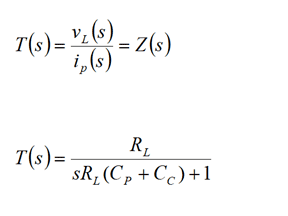
b) Derive an expression for the Laplace transfer function as per figure 4(c).

I have attached the transfer function & figure 4 (c) in my attempt.
Relevant Equations
Standard look up tables for Laplace
So I have completed (a) as this (original on the left):
1581916471329.png
1581916477277.png


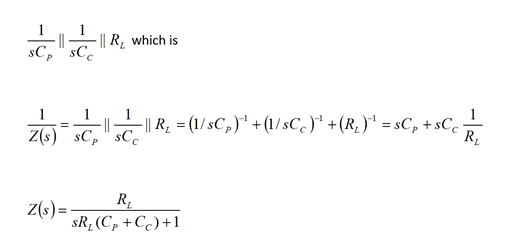
I have then went onto (b) and I have equated T(s)=Z(s) as follows:
1581916464532.png


1581916594584.png

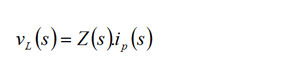
and due to

1581916672162.png

hence
1581916689065.png
Does this look correct to you smarter people?

Thanks in advance! All replies are welcome :)
 

Attachments

  • 1581916409670.png
    1581916409670.png
    1.1 KB · Views: 229
  • 1581916586992.png
    1581916586992.png
    1.3 KB · Views: 205
Last edited by a moderator:
Physics news on Phys.org
Are you trying to solve for the circuit in phasor form?

The results look right to me if it's just phasor form. There's a step where things look a little confusing by my eye. This part below looks concerning to me although it appears less concerning later on the right side.

$${1 \over Z(s)} = {1 \over {sC_p}} \parallel {1 \over {sC_s}} \parallel R_L$$

When I read about Laplace transforms (including standard lookup tables among your relevant equations)... I'm actually expecting a transform from ##s## to ##t## or its converse. The one on the table I'd be looking at is in this form although you'll have to massage the equation (a little bit) on your own if you do require the additional steps.

$$e^{-at} \leftrightarrow {1 \over {s + a}}$$
 
Your transform is ## V_L (s)/(I_p(s). ## You should be using conductance G(s), susceptance B(s) and admittance Y(s) = G + jB(s) rather than impedance Z = R + jX(s). That is suggested by the all-parallel nature of the circuit. You need to think in these terms if the math is thereby greatly simplified. Similarly, use Norton's therem for the input section.

Anyway, your answer is correct. But think G, B and Y whenever a circuit has lots of loops and few independent nodes.
 

Similar threads

  • · Replies 3 ·
Replies
3
Views
2K
  • · Replies 3 ·
Replies
3
Views
2K
  • · Replies 2 ·
Replies
2
Views
2K
  • · Replies 5 ·
Replies
5
Views
3K
  • · Replies 1 ·
Replies
1
Views
2K
  • · Replies 4 ·
Replies
4
Views
4K
  • · Replies 4 ·
Replies
4
Views
5K
  • · Replies 22 ·
Replies
22
Views
3K
  • · Replies 2 ·
Replies
2
Views
3K
  • · Replies 17 ·
Replies
17
Views
3K