Lever Balance Displacement Calculation

Click For Summary
SUMMARY

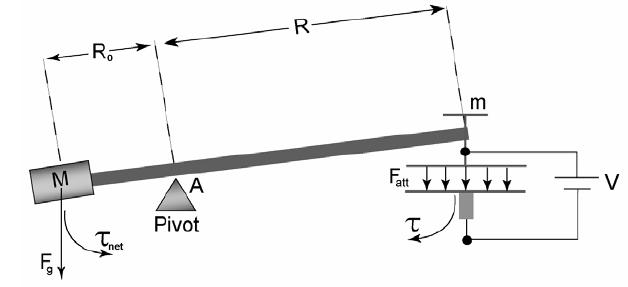
The discussion focuses on calculating the distance displacement of a mass (M) in a force balance lever system when a voltage is applied to a capacitor, creating an attractive force (Fatt). The user seeks a specific equation to determine how the height of mass M varies as the force of attraction increases. The context is likened to traditional weighing scales, emphasizing the equilibrium state maintained by an initial mass (m) on the capacitor plate. The user has already calculated the force of attraction (Faa) and is looking for further insights on displacement calculations.

PREREQUISITES
  • Understanding of force balance systems
  • Knowledge of capacitor physics and voltage effects
  • Familiarity with basic mechanics and displacement equations
  • Experience with equilibrium concepts in physics
NEXT STEPS
  • Research the equation for displacement in force balance systems
  • Study the relationship between voltage and force in capacitors
  • Explore the principles of equilibrium in mechanical systems
  • Learn about the effects of mass variations on lever systems
USEFUL FOR

Engineers, physicists, and students involved in mechanical design, particularly those working with force balance systems and capacitor applications.

jonlg_uk
Messages
141
Reaction score
0
Hello I am trying to design a force balance lever system. Basically the initial state will in a force balance equilibrium. That is, there will be a mass m placed onto of the capacitor plate to keep the lever balanced. I will then ramp the voltage of the capacitor up, causing a force of attraction, Fatt, creating by the plates attracting one another.

I want to know an equation for finding the distance displacement for the other mass M? How much will its height from the floor vary with increasing force of attraction, Fatt?
caplev.jpg


I thank you all in advance

N.B I have already figured out how to calculate the Faa, so there is no need to worry about that.

Jon
 
Last edited:
Physics news on Phys.org
Basically all this is,is a old fashioned weighing scales balance and I want to know how you calculate the displacement
 

Similar threads

  • · Replies 1 ·
Replies
1
Views
2K
  • · Replies 11 ·
Replies
11
Views
3K
  • · Replies 138 ·
5
Replies
138
Views
9K
  • · Replies 9 ·
Replies
9
Views
4K
  • · Replies 12 ·
Replies
12
Views
2K
  • · Replies 6 ·
Replies
6
Views
1K
  • · Replies 1 ·
Replies
1
Views
2K
  • · Replies 131 ·
5
Replies
131
Views
9K
  • · Replies 9 ·
Replies
9
Views
3K
  • · Replies 15 ·
Replies
15
Views
2K