awpbash
Suppose there is a coil around a C-shaped iron core with a dipole magnet in the gap as shown in the dynamo below. As the magnet is spinning, in order to oppose the force, a changing pole is produced in the iron. (Eg. As N-pole approaches the iron core, a north pole is induced to oppose the movement.)
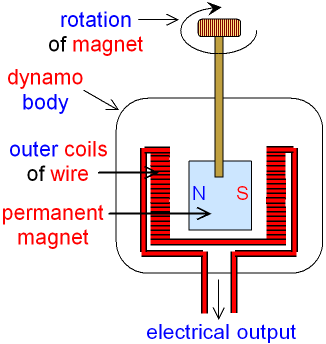
However, if i were to recreate a similar setup with just a C-shaped iron core and a spinning dipole magnet, by magnetic induction, an unlike pole is induced.(Eg. As N-pole approaches the iron core, a S-pole is induced in order to be attracted.) Hence what i do not understand is how a coil is able cause the difference in induction of poles.
However, if i were to recreate a similar setup with just a C-shaped iron core and a spinning dipole magnet, by magnetic induction, an unlike pole is induced.(Eg. As N-pole approaches the iron core, a S-pole is induced in order to be attracted.) Hence what i do not understand is how a coil is able cause the difference in induction of poles.