Discussion Overview
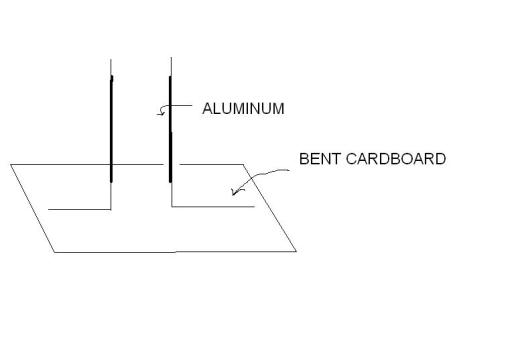
The discussion revolves around the construction of a homemade parallel plate capacitor using aluminum-coated cardboard plates without a dielectric, exploring the feasibility and design considerations for such a capacitor. Participants discuss various aspects including materials, construction methods, and intended applications, with a focus on experimental setups and measurements.
Discussion Character
- Exploratory
- Technical explanation
- Debate/contested
- Experimental/applied
Main Points Raised
- One participant proposes making a parallel plate capacitor using two aluminum-coated cardboard plates, questioning if this setup can work without a dielectric.
- Another participant suggests that the plates should be close together with a large area for measurable capacitance and recommends using nylon screws and nuts as spacers to maintain the gap.
- Clarifications are made regarding the need for a small gap between the plates to avoid shorting, with suggestions for using nylon nuts to achieve this spacing.
- There is a discussion about the suitability of aluminum foil as a conductor and whether it is the optimal choice for this setup.
- Participants express uncertainty about what constitutes a high voltage for their intended use, with one participant mentioning a maximum of 12V.
- One participant points out that air acts as a dielectric, which may lead to confusion regarding the term "free space," and suggests that a solid dielectric could be used instead.
- Concerns are raised about the practicalities of measuring voltage and capacitance, including the effects of discharging and the time constant involved in measurements.
- Another participant discusses the formula for capacitance and suggests that a more complex design, such as a rolled sandwich of aluminum foil and cling film, could yield higher capacitance values.
- There is a mention of the difficulty in measuring capacitance and dielectric constants, with suggestions to look up methods for accurate measurements.
Areas of Agreement / Disagreement
Participants express a range of ideas and suggestions, but there is no clear consensus on the best approach to constructing the capacitor or the optimal materials to use. Disagreements arise regarding the definitions and implications of using air as a dielectric versus solid dielectrics.
Contextual Notes
Participants note limitations in their understanding of voltage readings and measurement techniques, indicating that practical experimentation may yield varying results based on the specific setup and materials used.
Who May Find This Useful
This discussion may be useful for hobbyists, students, or anyone interested in DIY electronics, particularly those exploring capacitor design and measurement techniques in experimental physics or engineering contexts.