Mass flow rate calculation from velocity contour in pipe

Click For Summary
SUMMARY

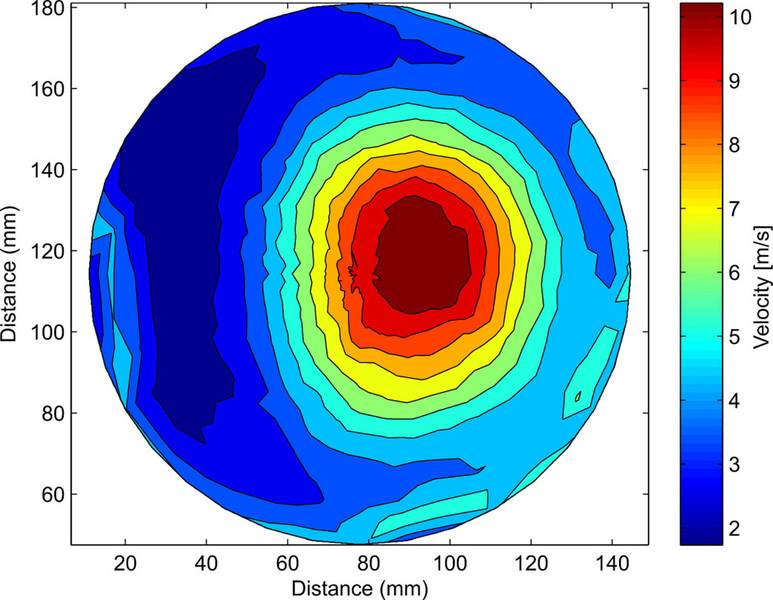
The discussion focuses on calculating mass flow rate from a velocity contour plot in a circular cross-section pipe, particularly when the flow is non-axisymmetric. Participants emphasize the importance of integrating the velocity profile across the area to determine mass flow rate accurately. Key considerations include the behavior of velocity at the pipe walls, where it does not reach zero due to the effects of viscosity and turbulence. Understanding these factors is crucial for accurate flow analysis.

PREREQUISITES
  • Fluid dynamics principles, particularly regarding mass flow rate calculations
  • Knowledge of velocity contour plots and their interpretation
  • Understanding of non-axisymmetric flow characteristics
  • Familiarity with computational fluid dynamics (CFD) tools for flow analysis
NEXT STEPS
  • Research methods for integrating velocity profiles in circular cross-sections
  • Learn about the Navier-Stokes equations and their application in non-axisymmetric flows
  • Explore computational fluid dynamics (CFD) software such as ANSYS Fluent for practical applications
  • Investigate the effects of wall boundary conditions on velocity profiles in pipe flow
USEFUL FOR

Engineers, fluid dynamics researchers, and anyone involved in the analysis of flow behavior in pipes, particularly in non-axisymmetric conditions.

ca2n
Messages
10
Reaction score
0
Hello all,

Looking for ideas on how to calculate mass flow rate from a velocity contour plot. The cross-sectional area is circular. An example of the velocity contour plot is shown in the figure below:
38230090532_0d4a696530_b.jpg


In most of the cases (as exemplified above) the flow is non-axisymmetric. Any suggestions welcomed. Thank you in advance.
 

Attachments

  • 38230090532_0d4a696530_b.jpg
    38230090532_0d4a696530_b.jpg
    59.7 KB · Views: 1,267
Engineering news on Phys.org
Why is it non-symmetric?
 
Chestermiller said:
Why is it non-symmetric?

As a follow-up, why doesn't the velocity go to zero at the walls?
 
  • Like
Likes Chestermiller
I have encountered a vertically oriented hydraulic cylinder that is designed to actuate and slice heavy cabling into sections with a blade. The cylinder is quite small (around 1.5 inches in diameter) and has an equally small stroke. The cylinder is single acting (i.e. it is pressurized from the bottom, and vented to atmosphere with a spring return, roughly 200lbs of force on the spring). The system operates at roughly 2500 psi. Interestingly, the cylinder has a pin that passes through its...

Similar threads

  • · Replies 4 ·
Replies
4
Views
2K
  • · Replies 9 ·
Replies
9
Views
2K
Replies
0
Views
2K
  • · Replies 4 ·
Replies
4
Views
3K
  • · Replies 4 ·
Replies
4
Views
2K
  • · Replies 2 ·
Replies
2
Views
3K
Replies
2
Views
1K
  • · Replies 31 ·
2
Replies
31
Views
4K
  • · Replies 8 ·
Replies
8
Views
3K
  • · Replies 1 ·
Replies
1
Views
3K