Math Help Forum: Find the limit if it exists

  • Thread starter Thread starter calculus123
  • Start date Start date
  • Tags Tags
    Forum Limit
Click For Summary
SUMMARY

This discussion focuses on understanding limits in calculus, specifically how to determine if a limit exists from a graph. The user struggles with interpreting limits as x approaches specific values, particularly -2 and 2, and seeks clarification on the notation used. Key points include the importance of analyzing the graph from the right and left sides of the limit points, with specific limits identified as lim_{x \to -2^+} f(x) and lim_{x \to 2^-} f(x). The user is encouraged to explain their reasoning for better guidance.

PREREQUISITES
  • Understanding of basic calculus concepts, particularly limits
  • Familiarity with graph interpretation in calculus
  • Knowledge of limit notation, including one-sided limits
  • Ability to analyze function behavior near specific points
NEXT STEPS
  • Study the concept of one-sided limits in calculus
  • Learn how to graph functions and identify limits visually
  • Practice problems involving limits approaching from both sides
  • Explore the epsilon-delta definition of limits for deeper understanding
USEFUL FOR

Students studying calculus, particularly those struggling with the concept of limits and graph interpretation. This discussion is beneficial for anyone looking to improve their understanding of limit behavior in mathematical functions.

calculus123
Messages
4
Reaction score
0
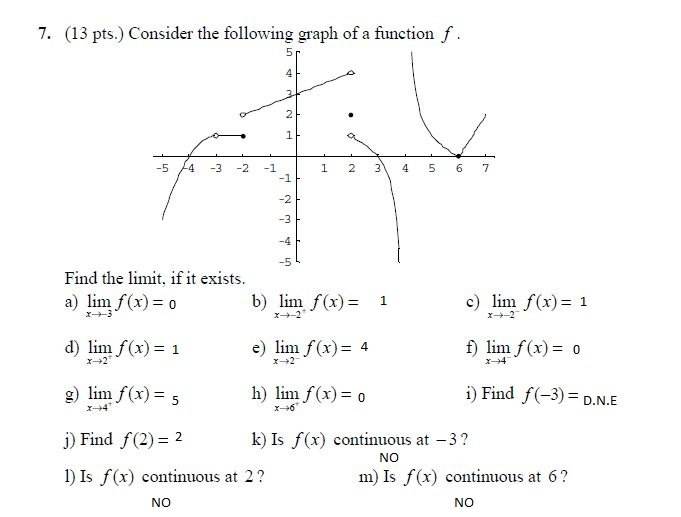
I'm having a really difficult time understanding limits from the graph. I don't completely understand how to find if the limit exists or not. I tried to do these for my homework but I don't know if they are right. Could someone please help me understand limits?
152hn36.jpg
 
Physics news on Phys.org
I'm having trouble reading the little + and - symbols in your limits. Is there any way you can display this at a higher resolution?

[edit] just noticed that in b and c, the limits are as x approaches -2, whereas in d and e, x approaches 2.

The first one that looks wrong is b. Is that the limit as x approaches -2 from the positive side? If so, the answer is not 1. To answer this question, ignore everything to the left of x = -2, and ignore what happens at x = -2 itself. Focus only on what the graph is doing as x approaches -2 from the right side. What number is the graph approaching?
 
B and C are -2, whereas D and E are +2. Going blind looking at it.
 
The limits appear to be:
\begin{align*}
\lim_{x \to -3} f(x) \\
\lim_{x \to -2^+} f(x) \\
\lim_{x \to -2^-} f(x) \\
\lim_{x \to 2^+} f(x) \\
\lim_{x \to 2^-} f(x) \\
\lim_{x \to 4^-} f(x) \\
\lim_{x \to 4^+} f(x) \\
\lim_{x \to 6^+} f(x)
\end{align*}
 
calculus123 said:
I'm having a really difficult time understanding limits from the graph. I don't completely understand how to find if the limit exists or not. I tried to do these for my homework but I don't know if they are right. Could someone please help me understand limits?
Explain how you arrived at your answers, so we can see where you're going wrong.
 

Similar threads

  • · Replies 10 ·
Replies
10
Views
2K
  • · Replies 7 ·
Replies
7
Views
1K
  • · Replies 16 ·
Replies
16
Views
3K
  • · Replies 8 ·
Replies
8
Views
2K
  • · Replies 7 ·
Replies
7
Views
2K
  • · Replies 9 ·
Replies
9
Views
3K
  • · Replies 5 ·
Replies
5
Views
2K
Replies
5
Views
2K
Replies
11
Views
2K
  • · Replies 4 ·
Replies
4
Views
1K