Mesh Current: Cannot see my mistake in my approach?

Click For Summary

Discussion Overview

The discussion revolves around the application of Mesh Current Analysis to solve a circuit problem involving multiple meshes and a dependent current source. Participants are attempting to find the currents I1, I2, and I3, while addressing errors in their initial approaches and equations.

Discussion Character

  • Homework-related, Exploratory, Technical explanation, Debate/contested

Main Points Raised

  • One participant presents initial mesh equations but struggles to reconcile results from different methods, expressing confusion over potential errors.
  • Another participant identifies that a term in the equations was misinterpreted as a voltage source instead of a current source, prompting a reevaluation of the equations.
  • A later reply acknowledges the realization that I2 is a forced mesh current and does not require its own equation, indicating a shift in understanding.
  • Subsequent attempts to solve the problem still yield incorrect results, leading to further questioning of algebraic steps and assumptions made in the equations.
  • Participants discuss the implications of Ohm's law and the correct treatment of dependent sources in their equations, with one participant admitting to a misunderstanding of the relationships between current and voltage.
  • In later posts, another participant describes a new mesh current problem, expressing uncertainty about how to incorporate a voltage source into their equations and seeking clarification on the correct approach.
  • Feedback from others includes suggestions to check the polarity of voltage terms and to reconsider the inclusion of certain sources in their equations.

Areas of Agreement / Disagreement

Participants do not reach a consensus on the correct approach initially, as multiple misunderstandings and errors are identified. However, there is a collaborative effort to refine the equations and clarify concepts, with some participants acknowledging corrections and improvements in their understanding.

Contextual Notes

Participants express uncertainty regarding the treatment of dependent sources and the application of KVL in their equations. There are indications of missing assumptions and potential algebraic errors that remain unresolved.

Who May Find This Useful

Students and practitioners working on circuit analysis, particularly those using Mesh Current Analysis and dealing with dependent sources in electrical engineering contexts.

teh_dude
Messages
11
Reaction score
0
Mesh Current: Cannot see my mistake in my approach?

Homework Statement


Find currents I1, I2, and I3 using Mesh Current Analysis in this circuit:
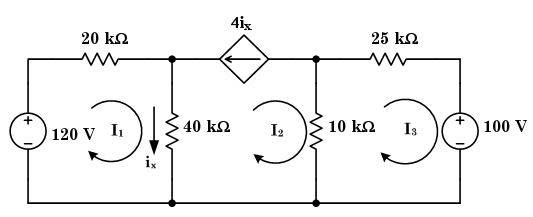
MeshCurHelp.jpg


Homework Equations


KVL

The Attempt at a Solution


Initial equations:
Mesh 1: -120 + 20k(I1) + 40k(I1 - I2) = 0
Mesh 2: 40k(I2 - I1) - 4ix + 10k(I2 - I3) = 0
Mesh 3: 10k(I3 - I2) + 25k(I3) + 100 = 0


As seen in the circuit, ix = 40k(I1 - I2), so the equation for Mesh 2 can be rewritten as:

New Mesh 2: 40k(I2 - I1) - 160k(I1 - I2) + 10k(I2 - I3) = 0

After rearranging and consolidating, I come up with this system ready to put in an augmented matrix:

60k(I1) - 40k(I2) + 0(I3) = 120
-200k(I1) + 210k(I2) - 10k(I3) = 0
0(I1) - 10k(I2) + 35k(I3) = -100


The answer must be submitted online (yay for unlimited attempts!), and in this instance, must be in mA.

I get the following using the "rref()" function in my TI-84:

I1 = 5.3548387 mA

I2 = 5.0322581 mA

I3 = -1.4193548 mA


I get the following different answers by hand:

I1 = .003168316832 mA

I2 = 2.3762376 mA

I3 = 21.7821782 mA


All of these are incorrect according to the website, but I don't see an error in my equations (although my attempt by hand probably has errors).

FYI, this is an extra credit problem that I am doing solely for extra practice before the test. Generally I'm pretty proficient at this, but this one just isn't making any sense to me--either that or maybe I'm right and the site's wrong? lol...
 
Physics news on Phys.org


4ix is a current source, not a voltage source.


...and therefore I2 = -4ix, and my set of equations must reflect that accordingly, right? ah HA! Thanks!

EDIT: ...aaaaand I2 therefore is a forced mesh that needs no equation of its own! derpa herp derp...lol. Whoops. Again, thanks.


By George, I think he's got it :smile:


Nope. Perhaps I'm taking the right approach now, but I'm still getting it wrong. I think before I post my new attempts, I'm going to go eat supper, go to my night class, and come back with a (hopefully) fresher mind that isn't low on blood sugar.


Okay, well, still no dice, and I still don't see what I'm doing wrong, especially with taking what should be the correct approach with the dependent source. The original problem is above, so I'm going to type out my latest attempt. There were two versions of it, because an approximation was easier, and should be close enough, but I'll post the exact numbers here:

Mesh 1: -120 + 20000I1 + 40000(I1 + 4ix) = 0
Mesh 2: I2 = -4ix
Mesh 3: 10000(I3 + 4ix) + 25000I3 + 100 = 0

ix = 40000(I1 + 4ix)


And now, the work, in detail:

ix = 40000I1 + 160000ix
-40000I1 = 159999ix
ix = (-40000/159999)I1

-120 + 20000I1 + 40000I1 + 160000ix = 0
-120 + 60000I1 + 160000(-40000/159999)I1 = 0
60000I1 - 40000.25I1 = 120
19999.75I1 = 120
I1 = 0.006000075 A = 6.000075 mA

10000I3 + 40000ix + 25000I3 + 100 = 0
35000I3 + 40000(-40000/159999)I1 + 100 = 0
35000I3 - 10000.0625I1 = -100
35000I3 - 60.00112501 = -100
35000I3 = -39.99887499
I3 = -0.001142825 A = -1.142825 mA

-4ix = -4(-40000/159999)I1 = -4(-40000/159999)(.006000075) = I2 = .0060001125 A = 6.0001125 mA

These answers for I1, I2, and I3 are all wrong according to the website. What am I doing wrong? Is there just some glaring algebraic fallacy that I'm blind to?


Your equation ix = 40000(I1 + 4ix) is not correct (you're equating a current to a voltage). Drop the 40000 Ohm resistance from it and it'll be fine.


I now see. I was trying to say that I = I*R, which is, for all intents and purposes, bull. lol...*sigh* I'll post back with the result either way. Thanks again..


*ahem*...it worked this time. Thank you for being the invaluable second mind and second set of eyes.

After I realized what you were saying, that I was trying to break Ohm's law, I realized I was doing the same thing in another problem. OOPS. So glad these are just extra credit/practice. lol. Thank you very much.
 
  • #10


:smile: Glad it all worked out. Cheers.
 
  • #11


GAAAAHHH! Now I've got another one--that other one that I mentioned--except I'm not sure that I have the right approach for part of it. It's another one listed as a mesh current problem.

Circuit:
TheOtherMesh.jpg


Problem: Find iy, io, and vx.

General approach:

Clockwise supermesh around the top two meshes because of the 3A current source in between them.

The bottom mesh, well, there's a dependent current source there, so I figured the current in that bottom mesh was equal to 4iy, and I'm for sure not treating current sources like voltage sources this time lol, but this approach isn't working for me. I believe it probably has something to do with the fact that I'm not including the 120 V source in my equations. Thing is, I don't know how. Here's what I've tried that failed:

Supermesh equation: -230 + 3*I1 + 2*I2 + 2*vx + 3(I1 - 4iy) = 0

Others:

3A = I2 - I1 ---> I2 = 3 + I1

iy = I1

io = -I2 = -3 - I1

vx = 3(I1 - 4iy) = 3*I1 - 12iy = 3*I1 - 12*I1

I got some answers, but they're wrong.

I understand that I cannot directly determine the current at an independent voltage source, nor the voltage at a current source. So how does the 120 V source apply??

I was going to write KVL for the bottom mesh, but I don't see how it's possible.
 
  • #12


Check the polarity indicated for Vx and then the equation you wrote for it.
 
  • #13


Yeeeeeep that did it. lol. The overwhelming majority of my tutoring problems lately have been someone else going "fix this <fill in overly simple tiny mistake that derails the whole damn problem> and you're good". Thanks again. So I don't have to include the 120V source in the equations, and I'm not sure why, but maybe if I attacked it with superposition then I'd see the proof. Buuuuut I'm too tired right now for that. Sleepy time. Thanks again so much, kind sir.
 

Similar threads

  • · Replies 7 ·
Replies
7
Views
2K
  • · Replies 7 ·
Replies
7
Views
3K
  • · Replies 7 ·
Replies
7
Views
2K
Replies
9
Views
2K
  • · Replies 4 ·
Replies
4
Views
3K
  • · Replies 7 ·
Replies
7
Views
2K
  • · Replies 187 ·
7
Replies
187
Views
59K
Replies
18
Views
2K
  • · Replies 6 ·
Replies
6
Views
3K
  • · Replies 14 ·
Replies
14
Views
3K