Model an Inductor: Flux Through Core & Air Around It

Click For Summary

Discussion Overview

The discussion revolves around the modeling of inductors, specifically the representation of leakage inductance in relation to the ideal core. Participants explore whether leakage inductance should be modeled in series or parallel with the core, considering the implications for magnetic flux through the core and surrounding air.

Discussion Character

  • Debate/contested
  • Technical explanation

Main Points Raised

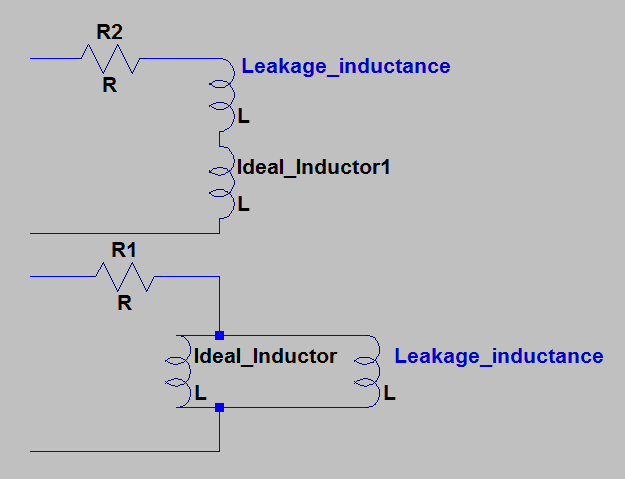
  • One participant questions why leakage inductance is modeled in series with the ideal core instead of in parallel, suggesting that flux travels in two parallel directions: through the core and through the air.
  • Another participant asserts that since the same current generates both magnetizing and leakage fluxes, leakage inductance (Lk) and magnetizing inductance (Lm) should be modeled as series-connected elements.
  • A later reply agrees with the previous point about series connection but introduces the idea that leakage flux is more relevant in the context of transformers rather than isolated inductors.
  • One participant emphasizes that while leakage inductance is typically modeled in series with the primary in practical applications, it may not apply to isolated inductors in the same way.
  • Another participant notes that while accurate modeling may be limited, it could be useful to lump leakage inductance and magnetizing inductance together in certain cases.

Areas of Agreement / Disagreement

Participants express differing views on the applicability of leakage inductance to isolated inductors versus transformers, indicating that multiple competing perspectives remain unresolved.

Contextual Notes

Participants do not fully resolve the implications of modeling choices, and there are assumptions about the behavior of inductors and transformers that are not explicitly stated.

tim9000
Messages
866
Reaction score
17
Hi, I'm just curious why we model the ideal inductor as having the leakage inductance as being in series with the ideal core, rather than in parallel to it? Because it would seem to me that the flux goes in two parallel directions, one through the core, and one through the air around the core. Please observe my illustration of what I mean:
snip.PNG
 
Engineering news on Phys.org
The same current creates both the magnetizing and leakage fluxes. That means you need to model Lk and Lm as series-connected elements.
 
berkeman said:
The same current creates both the magnetizing and leakage fluxes. That means you need to model Lk and Lm as series-connected elements.
Good point!
 
tim9000 said:
Good point!
Leakage flux seems to apply to the case of a transformer, where part of the primary flux does not link to the secondary. I don't think it applies to an isolated inductor. If a perfect transformer has a resistor across the secondary, the primary looks like a resistor. But in practice, there is still a leakage inductance in series with the primary.
 
tech99 said:
Leakage flux seems to apply to the case of a transformer, where part of the primary flux does not link to the secondary. I don't think it applies to an isolated inductor. If a perfect transformer has a resistor across the secondary, the primary looks like a resistor. But in practice, there is still a leakage inductance in series with the primary.
As you say, it would be of limited use, accurate modeling, but just as useful to lump them together in that case.
 

Similar threads

  • · Replies 6 ·
Replies
6
Views
1K
Replies
10
Views
3K
  • · Replies 8 ·
Replies
8
Views
3K
Replies
1
Views
3K
  • · Replies 6 ·
Replies
6
Views
4K
  • · Replies 4 ·
Replies
4
Views
2K
  • · Replies 47 ·
2
Replies
47
Views
9K
  • · Replies 26 ·
Replies
26
Views
7K
Replies
22
Views
4K
Replies
11
Views
3K