Need help about the magnetic field near an infinite current sheet

Join the discussion
Ask a follow-up here, or get your own question answered by working scientists, mathematicians and engineers — people, not an autocomplete.
Real named experts · corrections over time · the nuance an AI answer skips
13 replies · 3K views
e0ne199
Messages
56
Reaction score
5
Homework Statement
hello everyone, i have a question about magnetic field from infinite current sheet...
Relevant Equations
the equation will be related with the application of Ampere's Law on current sheet
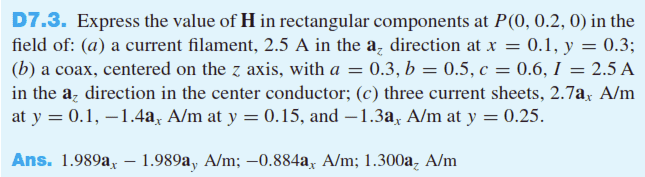
here is the question, don't mind about point (a) and (b) because i have solved them already...the main problem is the question on point (c) :
1614333324457.png


so far, what i have done is : H = 2.7*0.1-(1.4*0.15+1.3*0.25) = -0.265 az A/m which is the wrong answer compared to the solution provided from the question...any help is really appreciated, thanks before
 
on Phys.org
Use Ampere's law ##\oint \vec H d \vec l = I## twice. Use a rectangular path (which have to be in the plane perpendicular to the current direction). The first one would have to include pieces of all three current planes; this would give you the field on both sides of the stack of planes. The second one would have to go through your test point P.
 
Henryk said:
Use Ampere's law ##\oint \vec H d \vec l = I## twice. Use a rectangular path (which have to be in the plane perpendicular to the current direction). The first one would have to include pieces of all three current planes; this would give you the field on both sides of the stack of planes. The second one would have to go through your test point P.

sorry for the late response, but do you know how to apply your solution to my problem? probably i still have a little understanding for this kind of question...please help
 
BvU said:
I don't see the y-coordinate of ##P## in your version ?
could you please point out which is wrong on my current answer?
 
e0ne199 said:
could you please point out which is wrong on my current answer?
Did you read the replies ?
e0ne199 said:
hallo, anyone?
Instant service required after two weeks of silence? Still nice to hear back from you :wink:
e0ne199 said:
the equation will be related with the application of Ampere's Law

what i have done is : H = 2.7*0.1-(1.4*0.15+1.3*0.25) = -0.265 az A/m
Yes, Ampere's law. As @Henryk wrote. It involves a path (maybe even several paths). Where is your path ? Is P on that path ?
 
BvU said:
Did you read the replies ?
Instant service required after two weeks of silence? Still nice to hear back from you :wink:
Yes, Ampere's law. As @Henryk wrote. It involves a path (maybe even several paths). Where is your path ? Is P on that path ?
i am sorry, i really don't understand about your clue...i did try to find another example for a whole week after posting that question here... the possible way i could think of is like this :

(2.7-1.4) X ay = 1.3 az A/m but i am not sure if the way i get the answer is right or not...
 
e0ne199 said:
really don't understand about your clue
But do you understand what I am asking ? Ampere <--> path . Where is your path ?

e0ne199 said:
(2.7-1.4) X ay = 1.3 az A/m
What is X ? What are you doing here and how is it related to Ampere's law ?
 
BvU said:
But do you understand what I am asking ? Ampere <--> path . Where is your path ?

What is X ? What are you doing here and how is it related to Ampere's law ?
Screenshot_20210309-060736_LectureNotes.jpg


ok, here is the path, P is the green one, and pink line is the path.

about this
(2.7-1.4) X ay = 1.3 az A/m

i was doing a calculation with cross product, but i am not sure if this is the right way to do, since

H=K X an

so please tell me if i am doing it wrong or not
 

Attachments

  • Screenshot_20210309-060736_LectureNotes.jpg
    Screenshot_20210309-060736_LectureNotes.jpg
    74.7 KB · Views: 194
oops, sorry, I have a symbol missing in Ampere's law, it should be ##\oint \vec H \cdot \vec l = I##, i.e. dot product, not cross product and I is the total current enclosed by the loop with the direction given by the right hand rule.
Now, you notice that you can move vertical vectors left or right (i.e. changing the length of the horizontal vectors, portions of the path) and as long as they don't cross current planes, the enclosed current remains the same. This tells you ##H_y = 0##. Similarily, the loop can be moved up or down and, since the current density is constant, the ##H_z = const##
Now, consider the two loops, ABCD and FBCE and you should get the correct answer.
 

Attachments

  • planes.png
    planes.png
    8.5 KB · Views: 197
  • Like
Likes   Reactions: BvU
Henryk said:
oops, sorry, I have a symbol missing in Ampere's law, it should be ##\oint \vec H \cdot \vec l = I##, i.e. dot product, not cross product and I is the total current enclosed by the loop with the direction given by the right hand rule.
Now, you notice that you can move vertical vectors left or right (i.e. changing the length of the horizontal vectors, portions of the path) and as long as they don't cross current planes, the enclosed current remains the same. This tells you ##H_y = 0##. Similarily, the loop can be moved up or down and, since the current density is constant, the ##H_z = const##
Now, consider the two loops, ABCD and FBCE and you should get the correct answer.
based on the diagram, the result is like this :

##H_z * l = K * l##
##H_z =##(loop ABCD)+(loop FBCE) = (2.7-1.4-1.3) + (-1.3) = -1.3 ##a_z## A/m

is that result correct?