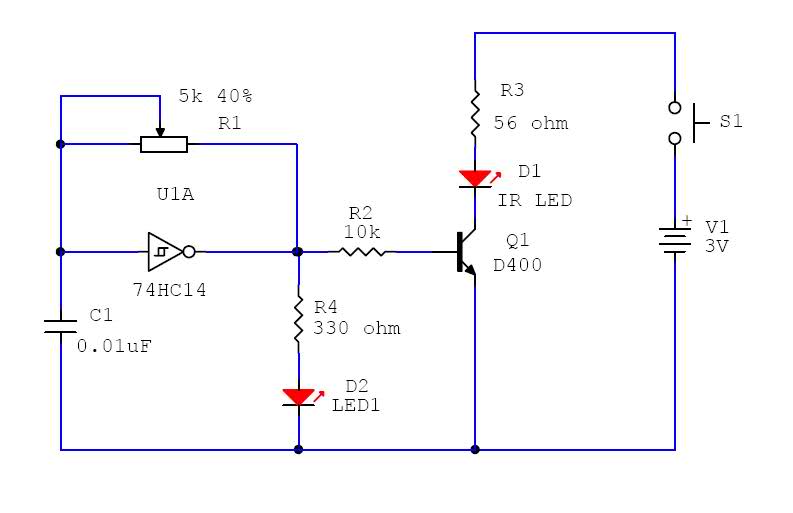
I'm a bit surprised that you're not getting some kind of range out of this. Even though there are places it can be improved a bit.
Putting 9 volts across the 74HC14 isn't going to work - It won't like anything over 6. But if you choose to go over 6, you might try the CD40106. It's basically the same type of part, though the output drive has about 100-200 series equivalent output impedance.
In the mean time, every other remote uses 3 volts. That's handy, because AA cells give you a great energy density / $.
I'd start by increasing the LED drive. Most any LED can take 25ma average, and the large ones used for remote controls can usually take 100ma. Even for a 25ma part, you can apply 50ma for a rapid 50% duty cycle, so I'd design to that.
I don't know the voltage drop of youre LED, but as a guess, 1.8 volts is typical for an IR type. You'll also have a voltage drop across the transistor. Say .2 volts if it were well driven to sturation (which it's not, but we'll return to this).
So, you have 3V - 1.8V - .2V = 1V across your resistor.
For 50ma, R = V / I => R=20 ohms.
Now, your transistor is sinking about 50 ma, so it needs adequate base drive. I'm not sure what a D400 is (a 2SD400?), so I'm going to guess it has an hfe on the low side, say 40. To saturate the transistor, drive it with about twice as much as it will ever need in the linear range.
Ib = 2 x (Ic / hfe) => Ib = 2x ( 50ma / 40) => 2.5ma
(Vhi - Vbe) / Rb = ib => Rb = (Vhi - Vbe)/ib => Rb = (3 - .65)/.0025 = 940
Vhi will be lower than 3V because of the internal on resistance of the 74HC14's PFET, but the HC series has pretty low output impedance, so it's not likely to be 50 ohms or less. I'd stick with a 910 ohm resistor for Rb.
I guess the only other thing I can think of is that you got a really poor output LED. That happens as the efficeiny of the things varies 100's to one. If you can scrap one from a remote, those are great.
Best Luck,
- Mike