New theory, our solar system formation, "space bubble"

Click For Summary

Discussion Overview

The discussion revolves around a new hypothesis regarding the formation of the solar system, suggesting it originated within a massive space bubble created by a Wolf-Rayet star. Participants explore the implications of this model, its components, and the challenges in understanding the associated visual representations.

Discussion Character

  • Exploratory
  • Technical explanation
  • Debate/contested
  • Conceptual clarification

Main Points Raised

  • Some participants note that various theories exist about solar system formation, with no consensus on a single model that accounts for all observations.
  • There is a discussion about the size of the hypothesized Wolf-Rayet star, with some suggesting it may not be as large as initially thought, possibly only reaching the orbit of Mercury.
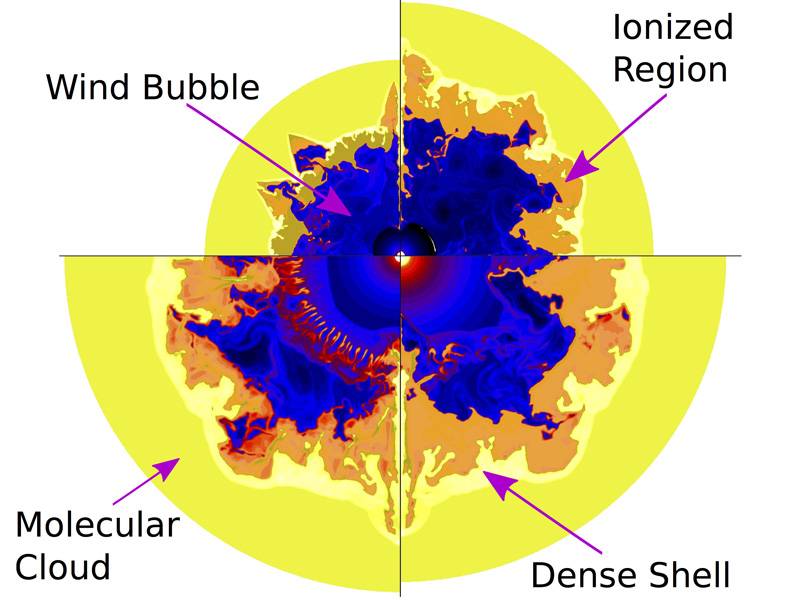
  • Participants express confusion regarding the visual representation of the model, particularly the meaning of the "blue fluid" and the components of the molecular cloud depicted in the graphics.
  • One participant explains that the blue area likely represents stellar wind, while others seek clarification on the star's representation in the diagram.
  • A detailed explanation is provided regarding the simulation of the molecular cloud's behavior under the influence of stellar winds, including the implications for star formation and the distribution of elements like aluminum and iron in the solar system.
  • Some participants express skepticism about the clarity of the graphics and the overall presentation of the model.
  • There is a request for information on how the new model might be confirmed or supported by future observations, indicating a desire for further validation of the hypothesis.
  • One participant questions whether the remnant of the original star that formed the solar system has been located.

Areas of Agreement / Disagreement

Participants generally agree that the new model presents an interesting hypothesis but express uncertainty and confusion regarding its details and implications. Multiple competing views remain about the specifics of the model and its visual representation.

Contextual Notes

Participants highlight limitations in understanding the graphics and the need for clearer labeling and explanations. There is also mention of the lack of access to the original research article, which may contain methods for confirming the proposed model.

Spinnor
Gold Member
Messages
2,231
Reaction score
419
"There are various theories about how the solar system formed, but scientists haven't been able to agree on a single model that explains all the quirks of our corner of space as it exists today. Now, scientists at the University of Chicago have https://news.uchicago.edu/article/2017/12/22/scientists-describe-how-solar-system-could-have-formed-bubble-around-giant-star017-12/uoc-sdh122117.php that explains an enduring mystery about the early solar system. They hypothesize that our solar system formed inside a massive space bubble, which was produced by a star 40 to 50 times the size of our sun. The research was published today in Astrophysical Journal."
bubble.jpg


giphy.gif


From https://www.engadget.com/2017/12/23/solar-system-formation-wolf-rayet-star/
 

Attachments

  • bubble.jpg
    bubble.jpg
    50.2 KB · Views: 1,178
  • Like
Likes   Reactions: Ralph Rotten and Delta2
Astronomy news on Phys.org
How big exactly was the mother star (Wolf Rayet type star)? IF (I know this is not the case I just say if) its center was the same as the center of our sun would it reach up to where Earth is now?

EDIT: Ok I guess not that big, maybe up to where mercury is...
 
Last edited:
Delta² said:
EDIT: Ok I guess not that big, maybe up to where mercury is...

They can have radius less than the sun. For example WR142, or WR2
 
  • Like
Likes   Reactions: Delta2
stefan r said:
They can have radius less than the sun. For example WR142, or WR2

Ok thanks, when I first read the article, I read 50 times bigger than Sun I thought that was referring to the radius of the stars, but I guess it was referring to the total mass of the stars.

Can you help me understand the picture a bit. It says the bubble is in what I identify as the "blue fluid". What the blue fluid is exactly? Also if you can explain briefly what the other components in the picture are, e.g the molecular cloud...
 
Delta² said:
Ok thanks, when I first read the article, I read 50 times bigger than Sun I thought that was referring to the radius of the stars, but I guess it was referring to the total mass of the stars.

Can you help me understand the picture a bit. It says the bubble is in what I identify as the "blue fluid". What the blue fluid is exactly? Also if you can explain briefly what the other components in the picture are, e.g the molecular cloud...

molecular cloud. there are books on this topic.

I think the blue part is just a stellar wind. The graph looks strange on my computer. The colors should be labeled better IMO.
 
  • Like
Likes   Reactions: Delta2
stefan r said:
molecular cloud. there are books on this topic.

I think the blue part is just a stellar wind. The graph looks strange on my computer. The colors should be labeled better IMO.
Ok the link for stellar wind says that it is ejected by the upper atmosphere of a star. Let me see If I get the basics of this picture right, the star is represented by the bright little sphere in the center of the picture? Or the star is the whole picture (including the molecular cloud)??
 
Delta² said:
Ok the link for stellar wind says that it is ejected by the upper atmosphere of a star. Let me see If I get the basics of this picture right, the star is represented by the bright little sphere in the center of the picture? Or the star is the whole picture (including the molecular cloud)??
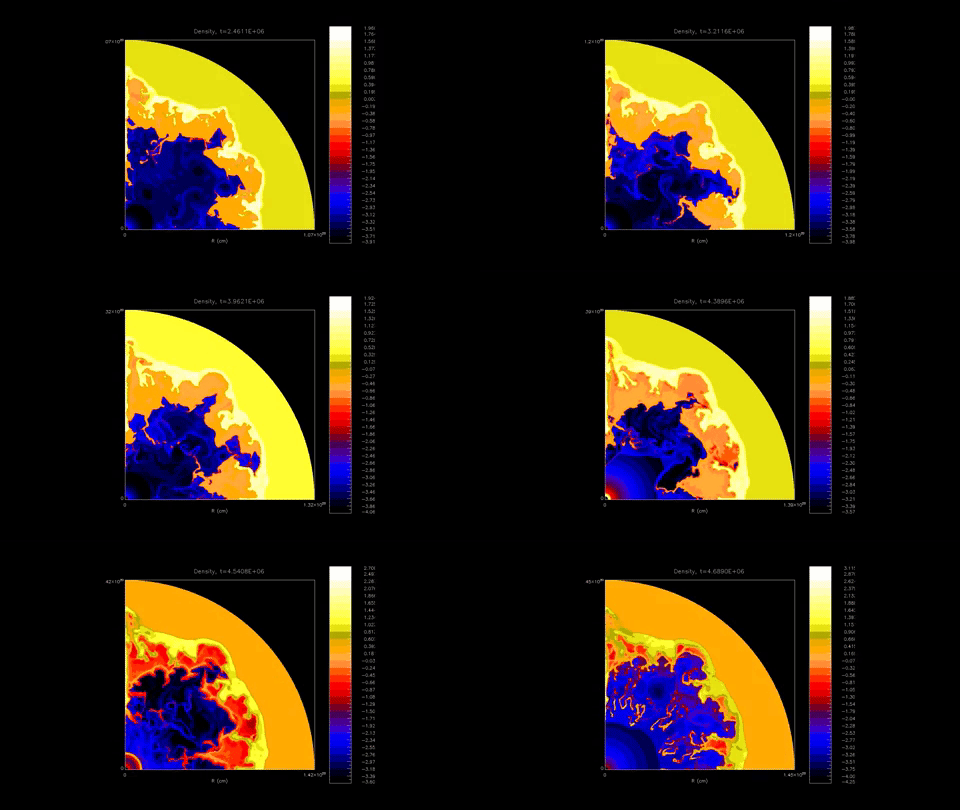
The x and y-axis are labeled R(cm). The video changes the length scale between frames. It it is really 1020 then radius is the image is supposed to be around 100 light years. The top line says "Density, t= ...E6" t is rolling forward so I assume time in years. So density must be the colors. The numbers by the color scale change and they change to fast to make sense of them. But they are sequential.

Over 4 million years the star goes from type O to red supergiant and ends and wolf-rayet.

I am a bit skeptical. There is something strange happening at x=0.
 
  • Like
Likes   Reactions: jim mcnamara
I agree with @stefan r - The graphics are confusing, a priori, ...trying to find some clarification.
 
Here you can see the same simulation running over a longer period of time with some explanations:
http://astro.uchicago.edu/~vikram/Media/bub40.mov
It looks like one of simulations of behaviour of molecular cloud medium under shockwaves from dying stars, like e.g. those seen here:
https://arxiv.org/abs/1111.0012

Here's my best attempt at reading the study:
The graph shows the effects of the stellar wind from a star, in the latter stages of its life, on a molecular cloud in which it is embedded.
The star is too small to show on the scale of the graph.
The extended video above has the bubble expand from approx 20 lyr radius at the end of main sequence, to ~100 lyr by the end of the W-R phase.
The star blows away material in a bubble around itself. This results in a low-density region (in blue) in its immediate vicinity, and a compressed shell (bright yellow) of molecular cloud material (darker yellow). Whenever you see brighter colours (towards the top of the scale), it means there's more material there, and vice versa.
Over time, and as stellar emissions go up, the bubble expands.
Due to various ratios of mass loss and velocity, the flow of material ejected from the star penetrates the shell to varying degrees.
The high-mass loss, high-velocity Wolf-Rayet flows allow the material abundant in the ejecta at this stage of stellar life (specifically, isotopes of aluminium) to penetrate the shell, and the additional compression gives rise to overdense regions in the cloud which will later nucleate new stars. The W-R stage is the last 0.2 million years of the simulation - it's the final, strongest blow seen in the animation.
The ejecta of the subsequent supernova (not shown), which include isotopes of iron, don't penetrate the shell as well, which would explain the relative overabundance of aluminium vs iron we have in our solar system - and this is what the study aims to show.
 
Last edited:
  • Like
Likes   Reactions: Ken G, Ralph Rotten and Delta2
  • #10
big thanks @Bandersnatch this answers a lot of questions that had been gathered in my mind.
 
  • #11
So have they been able to locate the remnant of the star that created Sol? Sounds like there should be a smoking hole out there somewhere nearby.
 
  • #12
Hi everyone:

I am unable to make a guess about what I should think about the engadget article. I am guessing that the article is NOT in an authoritative peer-reviewed journal. It did say, "The research was published today in Astrophysical Journal."

My impression from the engadget article is that the authors have made a hypothetical proposal for a new model which aims at explaining flaws/weaknesses in previous models dealing with the formation of the solar system. However, there was no discussion there about how the new model might be confirmed or supported by future observations.

If a reader has access to Astrophysical Journal (I do not), and it presents proposals for methods of confirmation, I would much appreciate seeing a summary of such proposed confirmation methods.

Regards,
Buzz
 
  • #13
Bandersnatch said:
The ejecta of the subsequent supernova (not shown), which include isotopes of iron, don't penetrate the shell as well, which would explain the relative overabundance of aluminium vs iron we have in our solar system - and this is what the study aims to show.
That would seem to be the key idea. It has been expected for a long time that our Sun formed in a giant molecular cloud, with massive stars evolving first and going supernova, compressing and shredding the molecular cloud, ultimately leading to lots of smaller stars like our Sun. The point of this particular model must be to explain why, if you have supernovae popping off, you end up with lots of aluminum but little iron-60. So that seems to say "Wolf-Rayet stellar wind" rather than just "supernova."
 
  • #14
Hi @Spinnor:

I looked at the list of articles in current The Astrophysical Journal (AJ)
I am unable to identify the article referred to in engadget. Since the engadget article did not name any authors of the AJ article, I was unable to search among the listed AJ articles for a name. Can you help me identify the correct article?

Regards,
Buzz
 
  • #15
*cough* the thread is almost 2 years old *cough*
 
  • #16
Bandersnatch said:
*cough* the thread is almost 2 years old *cough*
Hi Bandersnatch:

Thank you for pointing out my carelessness to me. (One more senior moment.) I would still like to find the AJ article. Can you help me?

Regards,
Buzz
 

Similar threads

  • · Replies 52 ·
2
Replies
52
Views
7K
  • · Replies 2 ·
Replies
2
Views
3K
  • · Replies 8 ·
Replies
8
Views
3K
  • · Replies 2 ·
Replies
2
Views
2K
  • · Replies 6 ·
Replies
6
Views
2K
  • · Replies 11 ·
Replies
11
Views
4K
  • · Replies 1 ·
Replies
1
Views
2K
  • · Replies 6 ·
Replies
6
Views
3K
  • · Replies 0 ·
Replies
0
Views
2K
  • · Replies 10 ·
Replies
10
Views
9K