On the invariant speed of light being the upper speed limit

Click For Summary

Discussion Overview

The discussion revolves around the nature of the invariant speed of light in the context of Special Relativity, specifically examining how the Minkowskian metric and the spacetime interval lead to the conclusion that the speed of light is both invariant for all observers and serves as an upper speed limit. Participants explore theoretical implications, mathematical derivations, and the foundational assumptions of Special Relativity.

Discussion Character

  • Exploratory
  • Technical explanation
  • Debate/contested
  • Mathematical reasoning

Main Points Raised

  • Some participants question how the Minkowskian metric or spacetime interval can lead to the conclusion of the speed of light being invariant and the existence of an upper speed limit.
  • Others argue that a massive particle cannot exceed the speed of light due to the increase in mass requiring infinite energy as it approaches light speed.
  • A few participants introduce the concept of tachyons, suggesting that if they exist, they would not be bound by the same speed limit, but this requires additional postulates to rule them out.
  • Some contributions highlight that the derivation of the symmetry group of transformations preserving the Minkowski metric leads to the velocity addition formula, which supports the upper speed limit.
  • One participant notes that the Minkowskian metric inherently assumes the invariance of the speed of light, raising questions about the foundational assumptions needed to derive this conclusion.
  • There is mention of the concept of "relativistic mass" being outdated and that modern discussions should focus on invariant mass and total energy instead.

Areas of Agreement / Disagreement

Participants express a range of views, with no clear consensus on how to derive the invariance of the speed of light solely from the Minkowskian metric or spacetime interval. Disagreements exist regarding the interpretation of mass and the implications of tachyons.

Contextual Notes

Some participants point out that the discussion may depend on specific definitions and assumptions about mass and speed, and that the mathematical steps leading to conclusions about speed limits are not universally agreed upon.

Joker93
Messages
502
Reaction score
37
Hello! I have a question that has been bothering me since I first started learning about Special Relativity:
Given only the Minskowskian metric and/OR the spacetime interval, how can one reach the conclusion that the speed of light is invariant for every observer and how can one conclude that it is also the upper speed limit? Or, more generally, how can one conclude that there exists an upper speed limit?
Thanks!
 
Physics news on Phys.org
It is a speed limit in the sense that a particle with mass, whose velocity is initially less than the speed of light in an inertial frame (strictly - has a timelike velocity), cannot be accelerated to have a velocity that exceeds the speed of light in that frame (has a spacelike velocity). The reason is that, because the object's mass in that frame increases without limit as its velocity in the frame nears c, it takes infinite energy to make its speed reach c.

To my knowledge, there is no prohibition on particles having spacelike velocities for their entire existence. Such hypothetical particles are called tachyons. If we want to rule out their existence we need to introduce a postulate that explicitly does that. The prohibition cannot be deduced from the other postulates.
 
andrewkirk said:
It is a speed limit in the sense that a particle with mass, whose velocity is initially less than the speed of light in an inertial frame (strictly - has a timelike velocity), cannot be accelerated to have a velocity that exceeds the speed of light in that frame (has a spacelike velocity). The reason is that, because the object's mass in that frame increases without limit as its velocity in the frame nears c, it takes infinite energy to make its speed reach c.

To my knowledge, there is no prohibition on particles having spacelike velocities for their entire existence. Such hypothetical particles are called tachyons. If we want to rule out their existence we need to introduce a postulate that explicitly does that. The prohibition cannot be deduced from the other postulates.
So, in reality, we study special relativity postulating that everything follows timelike trajectories? If so, the question remains: what part of the math involved in special relativity shows this property? Is it the Minkowskian metric that implies an upper speed limit? Is it the spacetime interval? On a second thought, we obtain the spacetime iterval through the Minkowskian metric, so the strictly timelike trajectories(or lightlike if we are talking about things that travel with c) must be implied by the metric.
But I can't see this though.
 
It is Newton's third law: Force = Mass times acceleration. Since mass approaches infinity, an infinite force is needed to accelerate a massive particle to the speed of light, which in turn will require an infinite amount of energy.
 
andrewkirk said:
It is Newton's third law: Force = Mass times acceleration. Since mass approaches infinity, an infinite force is needed to accelerate a massive particle to the speed of light, which in turn will require an infinite amount of energy.
But since all special relativity can be derived from the metric(or so I read), shouldn't what you are saying be explained with the metric?
 
Joker93 said:
what part of the math involved in special relativity shows this property?
It's from the derivation of the symmetry group of transformations which preserves the Minkowski metric; -- more specifically, the subgroup corresponding to velocity boosts in a given direction. After crunching through the math, one finds the (now well-known) velocity addition formula: $$ v'' ~=~ \frac{v + v'}{1 + (vv'/c^2)} ~,$$ governing the composition of 2 Lorentz boosts where the respective relative speeds are ##v, v'## respectively. Provided both ##v## and ##v'## are ##\le c##, the result ##v''## can never exceed ##c##.

This is explained in every textbook on special relativity.
 
Joker93 said:
Given only the Minskowskian metric and/OR the spacetime interval, how can one reach the conclusion that the speed of light is invariant for every observer
This part at least is easy. Since ##ds^2=-c^2 dt^2 + dx^2 + dy^2 + dz^2## is invariant and when ##ds=0## the equation is a sphere expanding at the speed of light, that means that anything which is a sphere expanding at c in one frame is also a sphere expanding at c in all other frames.
 
  • Like
Likes   Reactions: Joker93
Joker93 said:
Given only the Minskowskian metric and/OR the spacetime interval, how can one reach the conclusion that the speed of light is invariant for every observer
Find the eigenvectors of the boost transformations that preserve the Minkowskian metric. (Do the (1+1)-dimensional case for simplicity.)
(Bonus: what are the corresponding eigenvalues?)
 
Joker93 said:
Given only the Minskowskian metric and/OR the spacetime interval, how can one reach the conclusion that the speed of light is invariant for every observer and how can one conclude that it is also the upper speed limit?

By noting that these are already contained in the Minkowski metric. In other words, by assuming the Minkowski metric, you are assuming the conclusion you want to draw.

A better question would be, what is the minimum you can assume in order to get to the conclusion you describe? AFAIK the principle of relativity plus the assumption that the laws of physics are invariant under space and time translations and ordinary rotations is sufficient to narrow down the possibilities to two: (1) no invariant speed and no upper limit (Newtonian physics, Galilean invariance), or (2) a single invariant speed which is also an upper limit (SR, Lorentz invariance). I don't have links handy to papers where this is shown, I'll see if I can find some references.
 
  • Like
Likes   Reactions: vanhees71, Joker93 and SiennaTheGr8
  • #10
andrewkirk said:
The reason is that, because the object's mass in that frame increases without limit as its velocity in the frame nears c, it takes infinite energy to make its speed reach c.
I would here interject that "relativistic mass" is a largely obsolete concept that is prone to misunderstanding. I and many others have spent a considerable amount of time in pulling the concept out of people who come here with these. In modern relativity, "mass" only refers to the invariant mass and all actual uses of relativistic mass for a particle can be exchanged for total energy. In this case, the explanation would be: "The classical mechanics expression for total energy is changed in relativity, in relativity the total energy approaches infinity as v goes to c."
 
  • Like
Likes   Reactions: vanhees71 and strangerep
  • #11
Joker93 said:
Hello! I have a question that has been bothering me since I first started learning about Special Relativity:
Given only the Minskowskian metric and/OR the spacetime interval, how can one reach the conclusion that the speed of light is invariant for every observer and how can one conclude that it is also the upper speed limit? Or, more generally, how can one conclude that there exists an upper speed limit?
Thanks!
The Minskowskian metric is built entirely around the notion that the speed of light is invariant.

As for your second question, try applying the Minskowskian metric to a tachyon's frame of reference.

In this paper, they end up with imaginary transverse (y & z) space. which is entirely incomprehensible.
http://dinamico2.unibg.it/recami/erasmo%20docs/SomeOld/RevisitingSLTsLNC1982.pdf
 
  • Like
Likes   Reactions: nitsuj
  • #12
PeterDonis said:
By noting that these are already contained in the Minkowski metric. In other words, by assuming the Minkowski metric, you are assuming the conclusion you want to draw.

greswd said:
The Minskowskian metric is built entirely around the notion that the speed of light is invariant.

Theoretically, yes.
But suppose that one is somehow handed the metric (in some form) without the full theory behind it, the question seems to be how to then obtain the other features.

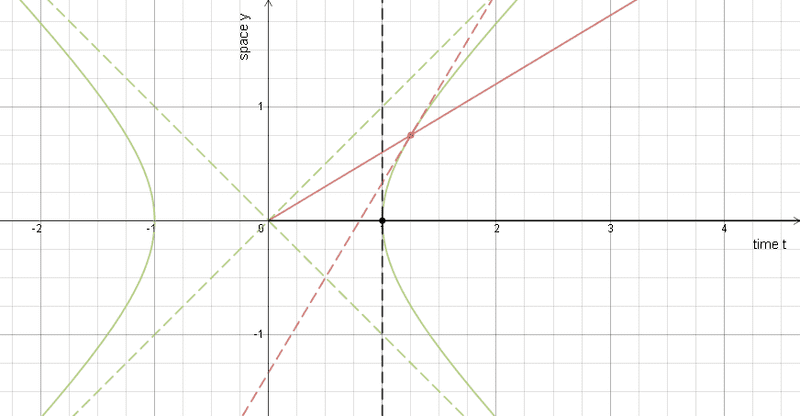
For example, one could conduct an experiment where folks with wristwatches start at a event and, after traveling with various velocities, stop [or somehow mark] when their wristwatches reach (say) 10 seconds. [Suppose muons [with a finite mean lifetime in its rest frame] could be produced with various velocities in the lab frame... we somehow measure the observed lifetime in the lab frame as a function of their velocity in the lab frame.] The locus of those stop-events would trace out a hyperbola on a position-vs-time graph, providing the metric by an experiment. From that, what can one deduce?
 
  • Like
Likes   Reactions: Joker93
  • #13
robphy said:
The locus of those stop-events would trace out a hyperbola on a position-vs-time graph, providing the metric by an experiment. From that, what can one deduce?
That the speed asymptotically reaches but never hits c?

I wish you could get your light clock spinning again too.
 
  • #14
greswd said:
That the speed asymptotically reaches but never hits c?

I wish you could get your light clock spinning again too.

Right... one would deduce that [or at least suspect it]. Some extrapolation/curve fitting on the experimental data would probably suggest a hyperbola analytically.
But then go further and uncover the rest of special relativity from that. (Maybe one should do the same experiments in the lab moving with different velocities, etc...)

If you click on my username to see my profile, you'll see my light clock avatar animated there. For some reason, it doesn't seem to work in the threads.
 
  • #15
robphy said:
The locus of those stop-events would trace out a hyperbola on a position-vs-time graph, providing the metric by an experiment.

Providing a portion of the metric. But not all of it; to do that you would need to do experiments involving null and spacelike intervals as well as timelike intervals. In other words, you would have to, for example, do experiments with light clocks moving at various speeds, do experiments with lightning strikes hitting both ends of trains, etc. All of those experiments together (plus, for example, experiments confirming Maxwell's Equations and their prediction that electromagnetic waves always travel at the same speed in vacuum relative to all observers) would give you the full Minkowski metric, including the properties the OP asked about.
 
  • #16
PeterDonis said:
Providing a portion of the metric. But not all of it; to do that you would need to do experiments involving null and spacelike intervals as well as timelike intervals. In other words, you would have to, for example, do experiments with light clocks moving at various speeds, do experiments with lightning strikes hitting both ends of trains, etc. All of those experiments together (plus, for example, experiments confirming Maxwell's Equations and their prediction that electromagnetic waves always travel at the same speed in vacuum relative to all observers) would give you the full Minkowski metric, including the properties the OP asked about.
Have all of these experiments (or similar experiments) been conducted before? For example the lightning train one.
 
  • #17
PeterDonis said:
Providing a portion of the metric. But not all of it; to do that you would need to do experiments involving null and spacelike intervals as well as timelike intervals. In other words, you would have to, for example, do experiments with light clocks moving at various speeds, do experiments with lightning strikes hitting both ends of trains, etc. All of those experiments together (plus, for example, experiments confirming Maxwell's Equations and their prediction that electromagnetic waves always travel at the same speed in vacuum relative to all observers) would give you the full Minkowski metric, including the properties the OP asked about.

Certainly, one would have to do a variety of experiments to be exhaustive and to check predictions made as the theory is built up ...
However, if I have the unit circle [the unit hyperbola], that gives me the unit timelike vectors...
as well a definition of orthogonality... the tangent to the "circle" is "orthogonal" to the [radial] unit timelike vector.
(This works in Euclidean space and in the Galilean spacetime [a PHY 101 position-vs-time-graph].)
By comparing diagrams from labs on inertially moving ships doing the same experiment, I can deduce that this orthogonality condition is preserved,
as well as uncover invariant directions [associated with the null eigenvectors] in the diagram. (In the Galilean case, the null eigenvector is along the spatial direction.)
By deducing the transformations that preserve this, I can get the Minkowskian signature.
[Of course, we're making the usual assumptions of isotropy and homogeneity, etc...]
 
  • Like
Likes   Reactions: greswd
  • #18
greswd said:
Have all of these experiments (or similar experiments) been conducted before? For example the lightning train one.

Einstein did that one in his head. :wink:

I don't know that the exact experiments I described have been done in the exact form I described them; but we certainly have mountains of experimental evidence for the Minkowski metric.
 
  • #19
robphy said:
By comparing diagrams from labs on inertially moving ships doing the same experiment, I can deduce that this orthogonality condition is preserved,
as well as uncover invariant directions [associated with the null eigenvectors] in the diagram. (In the Galilean case, the null eigenvector is along the spatial direction.)

Given only this data, how would you distinguish the Galilean from the Minkowskian case?
 
  • #20
PeterDonis said:
Given only this data, how would you distinguish the Galilean from the Minkowskian case?

The story I tell is that [figuratively] Galileo did this wristwatch experiment with observers spanning the range of velocities available by the technology of his day... say the upper speed was the speed of a racehorse. From the collected data, Galileo would extrapolate from the small segment on his position-vs-time diagram to a vertical line ranging to all velocities.

With the range of velocities was large enough to approach the speed of light or with high-precision timepieces, Minkowski [figuratively] could repeat the experiment and distinguish his circle from Galileo's circle. In addition, whereas Galileo would have found that the tangent-lines to his unit circle are parallel [implying absolute simultaneity], Minkowski would see that the tangent-lines associated with different unit radii are in fact not parallel... simultaneity is relative. (If one formulated the corresponding transformation laws ["rotations"], one would find that their eigenvectors are different... a little more analysis would uncover additivity of angles [arc lengths on the unit circles] and the non-additivity of slopes in Special Relativity, as one has in Euclidean geometry.)

Here is my desmos diagram again (from physicsforums.com/threads/general-questions-about-special-relativity.878810/page-5#post-5538694 )
https://www.desmos.com/calculator/ti58l2sair [time is along the horizontal axis]
You can tune "E" to go between Minkowski, Galilean, and Euclidean.
proxy.php?image=https%3A%2F%2Fs3.amazonaws.com%2Fgrapher%2Fexports%2Fti58l2sair.png


If you want to see an animation of the "stop when your wristwatch reads 1 sec experiment",
visit items 1. and 2. of my GeoGebra files [time is along the vertical axis]
https://www.geogebra.org/m/HYD7hB9v#
 
  • #21
PeterDonis said:
A better question would be, what is the minimum you can assume in order to get to the conclusion you describe? AFAIK the principle of relativity plus the assumption that the laws of physics are invariant under space and time translations and ordinary rotations is sufficient to narrow down the possibilities to two: (1) no invariant speed and no upper limit (Newtonian physics, Galilean invariance), or (2) a single invariant speed which is also an upper limit (SR, Lorentz invariance). I don't have links handy to papers where this is shown, I'll see if I can find some references.
Probably mentioned this once or twice before, but I think this article is not a bad place to start.
 
  • Like
Likes   Reactions: Boing3000
  • #22
Guys, upon reading your replies, I must state that, although the information about how one could discover the metric from experiments are more than helpful, I was really interested in the mathematics behind it. Let me be more clear. I am now learning about GR and SR for the first time. Our professor just gave us the spacetime interval saying that it's a quantity which was found to be invariant under Lorentz transformations and then we calculated some interesting things. But, without knowing anything else except from the metric or the invariant interval could one deduce mathematically that there is a speed limit in the universe and that it is that of the speed of light? Or, put differently, how is the upper limit speed information encoded into the metric and the spacetime interval?
 
  • #23
Joker93 said:
Or, put differently, how is the upper limit speed information encoded into the metric and the spacetime interval?

That's the better way to ask the question, I think. It's the upper speed limit that comes first. Everything else follows from that.

Are you familiar with the light-clock thought experiment? It shows how the invariance of the speed of light implies the invariance of the spacetime interval. The math is simple. See here: https://books.google.com/books?id=PDA8YcvMc_QC&pg=PA67

Same for the Lorentz transformation, which differs from the Galilean transformation precisely because it accounts for the existence of a universal speed limit. The math is simple here, too: http://www.princeton.edu/~kdiab/relativity.pdf (PDF)

I don't know enough GR to speak to the metric.
 
  • Like
Likes   Reactions: Joker93
  • #24
Mathematically, the answer is in @strangerep 's reply.
From a more spacetime-viewpoint,...
Take any future unit-timelike vector (representing the 4-velocity of an observer).
Apply a nontrivial Lorentz boost transformation (i.e. not the identity).
The result is another unit-timelike vector.
Use the same boost on this result... and keep going.
The resulting unit-timelike vector approaches (but never reaches) the lightcone.
The sequence of boosts can be combined into a single boost (essentially, the composition of velocities).
The velocity-parameter v labeling the boosts approaches the speed of light.
Alternatively, the [additive] rapidity-angle parameter approaches infinity.

[Why the Lorentz transformation?... because that is the transformation that preserves the metric [preserves the dot-product].)
 
  • #25
robphy said:
Mathematically, the answer is in @strangerep 's reply.
From a more spacetime-viewpoint,...
Take any future unit-timelike vector (representing the 4-velocity of an observer).
Apply a nontrivial Lorentz boost transformation (i.e. not the identity).
The result is another unit-timelike vector.
Use the same boost on this result... and keep going.
The resulting unit-timelike vector approaches (but never reaches) the lightcone.
The sequence of boosts can be combined into a single boost (essentially, the composition of velocities).
The velocity-parameter v labeling the boosts approaches the speed of light.
Alternatively, the [additive] rapidity-angle parameter approaches infinity.

[Why the Lorentz transformation?... because that is the transformation that preserves the metric [preserves the dot-product].)
But, in your answer and also strangerep's answer, you are assuming that we know what the Lorentz transformations are, right?
 
  • #26
Joker93 said:
But, in your answer and also strangerep's answer, you are assuming that we know what the Lorentz transformations are, right?
So, the prerequisite problem is this:
Given a metric (a dot-product), find the group of transformations that preserve that metric.
(This is Felix Klein's view... geometry is encoded in the group of transformations...)

Edit: we do this because we are effectively requiring that there is a symmetry among inertial observers [the principle of relativity]. That there are no timelike-eigenvectors of the transformations says that no inertial observer is preferred over any other inertial observer.

Edit: is there some theorem from linear algebra that says something to the effect that ##B^n\vec v ## approaches an eigenvector (the dominant eigenvector) of B?
 
Last edited:
  • Like
Likes   Reactions: Dale
  • #27
robphy said:
So, the prerequisite problem is this:
Given a metric (a dot-product), find the group of transformations that preserve that metric.
(This is Felix Klein's view... geometry is encoded in the group of transformations...)
So, in reality, given just the metric, someone can find the transformations that preserve it and then everything just comes out of knowing the metric and the transformations, right? Well, this seems just about right, but then how can one find those transformations?

Also,consider the other way around. Given the transformations, how can you find the metric(the invariant interval follows from this)?

Please, forgive me if I am asking elementary questions, it's just that I am just now learning SR and GR(at the same time; it's a long story).
 
  • #28
Joker93 said:
So, in reality, given just the metric, someone can find the transformations that preserve it and then everything just comes out of knowing the metric and the transformations, right? Well, this seems just about right, but then how can one find those transformations?
Please, forgive me if I am asking elementary questions, it's just that I am just now learning SR and GR(at the same time; it's a long story).

For the (1+1)-case, setup an arbitrary 2-by-2 matrix with entries ##\left(\begin{array}{cc} a&b\\c&d \end{array}\right)##.
Then there are certain group properties that have to satisfied. This puts constraints on the entries... until you are led to the boost transformation.
(You can try this for a rotation in Euclidean space... as a warmup.)
 
  • #29
Joker93 said:
But, in your answer and also strangerep's answer, you are assuming that we know what the Lorentz transformations are, right?
It's easy enough to show that the (flat) metric is preserved under the Lorentz transformations and only the Lorentz transformations, so the form of the metric does logically imply the Lorentz transformations - you do not need to assume their truth separately and without proof.

It is true that it's a lot easier to find the Lorentz transformations in the metric if you already know what you're looking for, but that's true of most derivations of non-trivial results.
 
  • #30
As a followup to my earlier post...
look at this section for an example
https://en.wikipedia.org/wiki/Deriv...rmations#Galilean_and_Einstein.27s_relativity

In the more abstract case, when you don't necessarily know what to expect,
you are led to a differential equation for one of the last matrix elements
[the rest of the elements have already been constrained by the group properties].
Depending on the dot product, your matrix entry will be a hyperbolic trig function for Special Relativity
and a circular trig function to Eucldean space.
 

Similar threads

  • · Replies 6 ·
Replies
6
Views
2K
  • · Replies 57 ·
2
Replies
57
Views
6K
  • · Replies 22 ·
Replies
22
Views
2K
  • · Replies 33 ·
2
Replies
33
Views
4K
  • · Replies 16 ·
Replies
16
Views
2K
  • · Replies 25 ·
Replies
25
Views
2K
  • · Replies 40 ·
2
Replies
40
Views
3K
  • · Replies 9 ·
Replies
9
Views
2K
  • · Replies 7 ·
Replies
7
Views
3K
  • · Replies 141 ·
5
Replies
141
Views
10K