(Probably) simple question: Asymptotes of a Hyperbola

  • Thread starter Thread starter sltungle
  • Start date Start date
  • Tags Tags
    Hyperbola
Click For Summary

Homework Help Overview

The discussion revolves around finding the asymptotes of a hyperbola defined by the equation 2x²/3 - y²/2 = 1. The subject area is analytic geometry, specifically focusing on hyperbolas and their properties.

Discussion Character

  • Exploratory, Conceptual clarification, Mathematical reasoning

Approaches and Questions Raised

  • The original poster attempts to find the asymptotes using the standard form of a hyperbola and expresses confusion over a discrepancy between their calculated result and the answer provided in a textbook. Some participants discuss the reasoning behind setting the hyperbola equation to zero to derive the asymptotes.

Discussion Status

Participants have provided insights into the reasoning behind the asymptote calculation, with one suggesting that the original poster's answer may be correct and the textbook's answer incorrect. There is an exchange of clarifications regarding the approach to finding asymptotes.

Contextual Notes

There is mention of a potential misunderstanding regarding the treatment of the constant in the hyperbola equation, as well as the original poster's concern about the simplicity of their question.

sltungle
Messages
26
Reaction score
0
Okay, before I start: I'm sorry for what is probably going to be an absurdly easy question and I'm probably going to seem like a complete moron to everyone here, however the way I see it the only way I'll learn is by asking questions (and that's just what I've did ever since I could speak)... so... help would be appreciated.

Find the asymptotes for the hyperbola: 2x^2/3 - y^2/2 = 1


Equations: Hyperbola: (x-h)^2/a^2 - (y-k)^2/b^2 = 1, Asymptote: ±b/a (x-h) + k


Attempt:
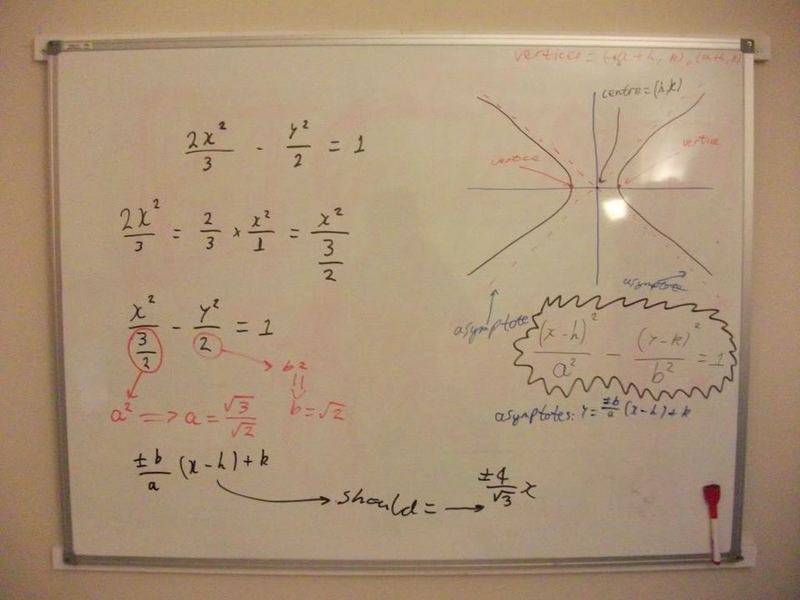
DSCF9170.jpg


I keep arriving at the answer ±2/√3 yet the answer in the back of the book is ±4/√3. What am I doing wrong?
 
Physics news on Phys.org
Here's the easy way to think about "asymptotes". The whole point of asymptotes is that the hyperbola gets closer and closer to them as x and y get larger and larger. Now if x is extremely large, x^2 will be even larger and so will x^2/a^2 for constant a. Similarly, y^2/b^2 will be an extemely large number. Comparatively, the "1" on the right side of the equation is very small and negligible. If we drop it from the equation of the hyperbola, we get
\frac{x^2}{a^}- \frac{y^2}{b^2}= 0
\left(\frac{x}{a}- \frac{y}{b}\right)\left(\frac{x}{a}+ \frac{y}{b}\right)= 0

From that, x/a= y/b and x/a= -y/b are the two asymptotes.

Here, 2x^2/3= x^2/(3/2) so a= \sqrt{3/2} and b= \sqrt{2}.

The asymptotes are given by x/(\sqrt{3/2}= y/\sqrt{2} so that y= \sqrt{2}x/\sqrt{3/2}x= (2/\sqrt{3})x and x/\sqrt{3/2}= -y/\sqrt{2} so that y= -(2/\sqrt{3})x.

You are right and the book is wrong!
 
Ahh. Thank you very much :) I was a bit worried I was missing something obvious. Glad to know I'm not.

Thanks again.
 
Dear HallsofIvy,

Thanks for your easy-to-follow explanation of why you replace the 1 with a zero to find the asymptotes. I had gotten that tidbit from another website, but they didn't explain why you set the original equation to 0 instead of 1.
 
As a side note, I want your whiteboard.
 

Similar threads

Replies
4
Views
4K
  • · Replies 29 ·
Replies
29
Views
4K
  • · Replies 3 ·
Replies
3
Views
2K
  • · Replies 6 ·
Replies
6
Views
2K
  • · Replies 5 ·
Replies
5
Views
10K
  • · Replies 12 ·
Replies
12
Views
4K
  • · Replies 20 ·
Replies
20
Views
3K
  • · Replies 9 ·
Replies
9
Views
4K
Replies
5
Views
3K
Replies
2
Views
3K