Problem related to the Ideal Gas equation -- Nitrogen under pressure

Click For Summary
SUMMARY

The discussion revolves around the application of the Ideal Gas Law to calculate the mass of nitrogen under varying pressure and temperature conditions. The user consistently arrives at a mass of 1.55 kg, despite using different equations derived from the Ideal Gas Law (PV = m/M x R x T). The correct approach involves understanding the relationship between initial and final states of nitrogen in the tank, specifically at pressures of 6 MPa and 8.333 MPa at temperatures of 270K and 300K, respectively. The user also introduces the concept of moles to express changes in nitrogen mass, indicating a need for clarity in deriving the textbook equation.

PREREQUISITES
  • Understanding of the Ideal Gas Law (PV = nRT)
  • Knowledge of pressure and temperature conversions in gas calculations
  • Familiarity with mole calculations and molar mass concepts
  • Basic algebra for manipulating equations
NEXT STEPS
  • Study the derivation of the Ideal Gas Law and its applications in real-world scenarios
  • Learn about the relationship between pressure, volume, and temperature in gas laws
  • Explore the concept of molar mass and its significance in gas calculations
  • Investigate advanced gas law applications, such as the Van der Waals equation for real gases
USEFUL FOR

Students in chemistry or physics, engineers working with gas systems, and anyone involved in thermodynamics or fluid mechanics will benefit from this discussion.

PhysicsDuki
Messages
1
Reaction score
0
Homework Statement
A bottle filled with nitrogen under a pressure of 1.5x10^7 Pa at a temperature of 27 ° C has a mass of 97 kg. Part of the nitrogen is consumed, so the pressure in the bottle, at a temperature of -3 ° C, is 6x10^6 Pa, and the weight of the bottle is 93.5 kg. How much mass of nitrogen is left in the bottle?
Relevant Equations
pxV = m/M x R x T
(R = 8.314 J/K x Mol and M= Molar mass of N2 ( 28 g/mol) )
Solution from the textbook:
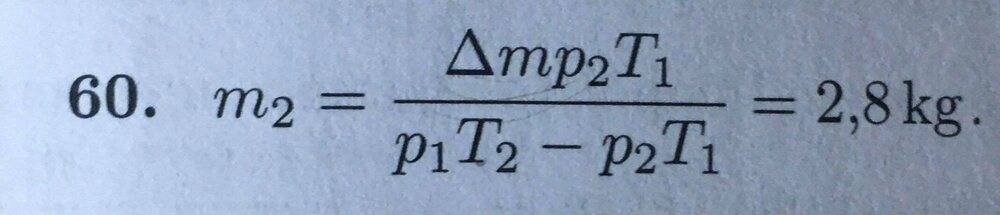
solution.jpg
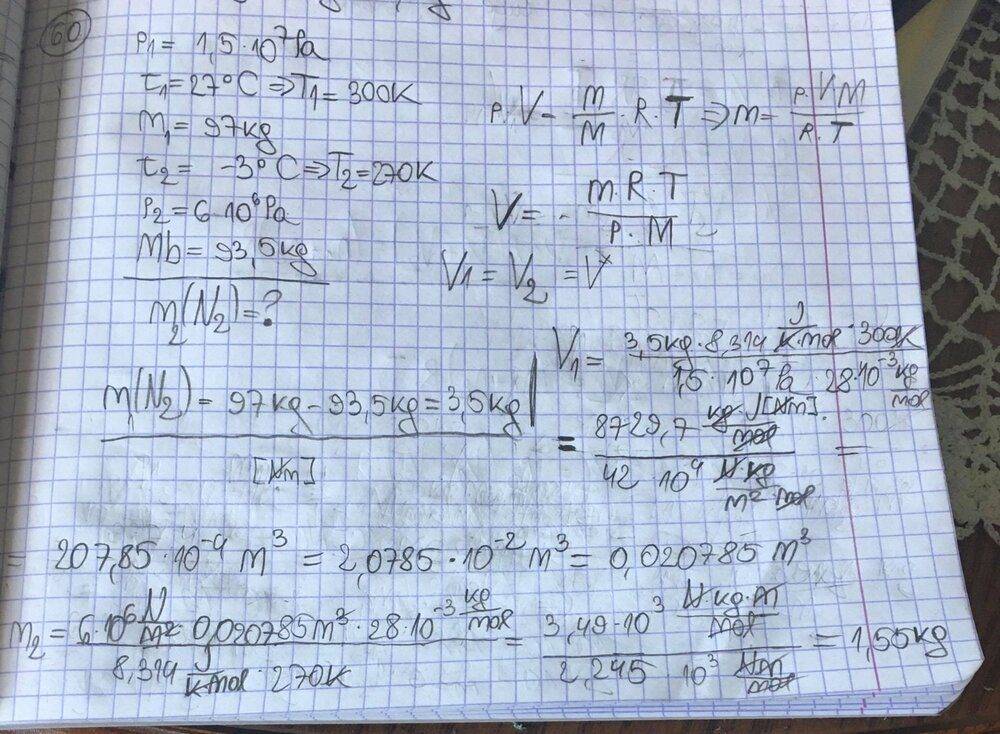
My work:
rad.jpg


I constantly get 1.55kg. I also tried dividing the first and the second equation (pxV=m/M x R x T with different values). How did they come up with the equation in the solution? Also, I am sorry if I posted it in the wrong place and didn't follow the rules of the forum, but I am new member. Thanks in advance!
 
Physics news on Phys.org
You seem (as far as I can tell) to be calculating the volume of nitrogen that has been consumed, and equating it to the volume of nitrogen remaining, which makes no sense.

I haven't tried deriving the textbook equation, but did it like this:
The 6 MPa remaining at 270K corresponds to a pressure of 6.667 MPa at 300K.
This means that 8.333 MPa (at 300K) has been consumed, which has a mass of 3.5 kg.
6.667/8.333 = m2/3.5
 
Let ##n_1## represent the number of moles of N2 in the tank initially and let ##n_2=n_1-\frac{3500}{M}## represent the number of moles of N2 in the tank finally. Let V represent the volume of the tank. In terms of ##n_1## and V, write down the ideal gas relationship for the initial and final states.
 

Similar threads

  • · Replies 3 ·
Replies
3
Views
10K
  • · Replies 2 ·
Replies
2
Views
2K
  • · Replies 17 ·
Replies
17
Views
7K
  • · Replies 7 ·
Replies
7
Views
1K
  • · Replies 2 ·
Replies
2
Views
3K
  • · Replies 2 ·
Replies
2
Views
2K
Replies
10
Views
2K
Replies
5
Views
1K
  • · Replies 1 ·
Replies
1
Views
2K
  • · Replies 3 ·
Replies
3
Views
1K