Problem when solving example with differential forms

Click For Summary

Discussion Overview

The discussion revolves around a problem encountered while solving an example related to differential forms, specifically focusing on discrepancies in results derived from two different sources. Participants explore the implications of factors such as ##1/p!## and the treatment of anti-symmetry in the context of forms and vectors.

Discussion Character

  • Debate/contested
  • Technical explanation
  • Conceptual clarification

Main Points Raised

  • One participant notes a divergence in results when applying the definition of a p-form from one source compared to another, leading to confusion about the correct answer.
  • Another participant identifies that the discrepancy arises from the presence of a factor of ##1/p!## in one pdf but not in the other, resulting in an answer that is off by a factor of ##1/2##.
  • There is a suggestion that the need for a factor of ##1/2## may depend on whether one is considering the anti-symmetric part of the expression or a different formulation involving two forms.
  • A later reply indicates that the original poster may have overlooked summing over all components, which contributed to their incorrect result.
  • One participant expresses frustration regarding the clarity of the original poster's questions and suggests a lack of foundational understanding in the subject matter.

Areas of Agreement / Disagreement

Participants do not reach a consensus on the correct approach or resolution to the problem. There are multiple competing views regarding the necessity of the factor of ##1/2## and the handling of anti-symmetry in the calculations.

Contextual Notes

Limitations include potential missing assumptions regarding the definitions of forms and the treatment of anti-symmetry, as well as unresolved mathematical steps in the calculations presented by the original poster.

davidge
Messages
553
Reaction score
21
Hi was reading about differential forms, when I tried to solve the example
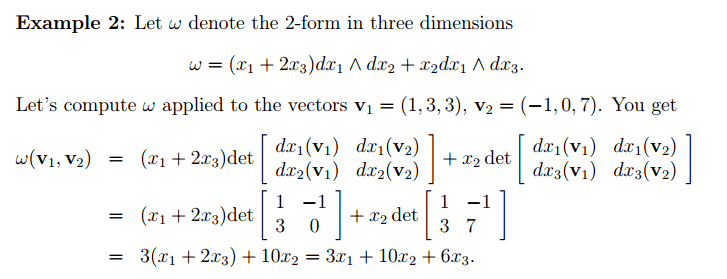
EPOnpJe.png
given in this pdf https://www.rose-hulman.edu/~bryan/lottamath/difform.pdf. According to it, the answer is that on the image above. But when I tried to solve this same example by following the expression for ##w## given in this pdf http://www.bose.res.in/~amitabha/diffgeom/chap13.pdf, namely that a p-form ##w## can be written as $$\frac{1}{p!}w_{\mu_1 ... \mu_p}dx^{\mu_1} \wedge \ ... \ \wedge dx^{\mu_p}$$ and that ##w##, in this case, applied to two vectors ##v_{(1)}## and ##v_{(2)}## is ##w_{i j}v_{(1)}^i v_{(2)}^j##, the answer that I'm getting diverges from that given in the other pdf. What is wrong?
 
Physics news on Phys.org
I noticed that the only problem is that in one pdf they introduce a factor ##1 / p!## while in the other they don't. My answer is off by a factor of ##1/2## in this case. So what is the correct?

I guess if one were going to consider only the anti-symmetric part of ##A(u)B(v)## then a factor of ##1/2## would be needed. But if one were considering ##A(u)B(v) - A(v)B(u)## it is not clear whether a factor of ##1/2## is needed. (##A, B## are one-forms and ##v, u## are vectors)
 
You ask us what's wrong with your calculation we do not get to see?
 
haushofer said:
You ask us what's wrong with your calculation we do not get to see?
After this thread, I noticed that I have forgotten to summing over all components and that was the cause of not getting the right result.
Thanks
 
Look, if you want people to invest time to help you, you shouldn't expect them to have paranormal abilities.

I've read a couple of your questions now and they seem highly confused, giving me the impression that you're studying stuff without the right background.
 

Similar threads

  • · Replies 29 ·
Replies
29
Views
5K
  • · Replies 6 ·
Replies
6
Views
3K
  • · Replies 13 ·
Replies
13
Views
4K
  • · Replies 3 ·
Replies
3
Views
3K
  • · Replies 4 ·
Replies
4
Views
3K
  • · Replies 5 ·
Replies
5
Views
4K
  • · Replies 2 ·
Replies
2
Views
3K
  • · Replies 73 ·
3
Replies
73
Views
9K
  • · Replies 24 ·
Replies
24
Views
4K
  • · Replies 3 ·
Replies
3
Views
3K