Problem with a directional derivative calculation

Click For Summary
The discussion revolves around the calculation of directional derivatives using two methods: the limit definition and the dot product of the gradient and direction vector. Participants noted that different results were obtained from these approaches due to the lack of continuity in the partial derivatives at the point (0,0). It was clarified that the dot product method is valid only for differentiable functions, which require continuous partial derivatives. Since the function in question is not differentiable at (0,0), the limit method should be used instead. Understanding these concepts is crucial for accurate directional derivative calculations.
Amaelle
Messages
309
Reaction score
54
Homework Statement
calculate the directional derivative
Relevant Equations
directional derivative
Good day

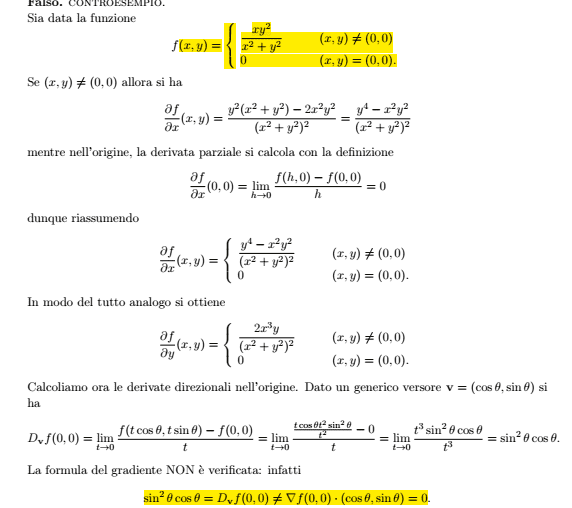
I have a problem regarding the directional derivative (look at the example below)
1605103234654.png


in this example, we try to find the directional derivatives according to the two approaches ( the definition with the limit and the dot product of the vector gradient and the vector direction)
in this example, we got totally different results?

why?

many thanks in advance!
 
Physics news on Phys.org
The partial deivatives are not continuous: for x= 0 and y \neq 0 you have \frac{\partial f}{\partial x} = \frac{y^4}{y^4} = 1 which does not tend to 0 as y \to 0.
 
  • Like
Likes PeroK and Amaelle
Thanks a lot for your prompt answer
so If I understand well, the dot product method works only if the function is differentiable? otherwise, we should only use the limit method?
 
Amaelle said:
in this example, we try to find the directional derivatives according to the two approaches ( the definition with the limit and the dot product of the vector gradient and the vector direction)
in this example, we got totally different results?

why?

many thanks in advance!

What your book is doing is calculating the derivative along a parameterised curve through ##(0,0)##:$$g(t) = f(t\cos \theta, t\sin \theta) = t\cos \theta \ \sin^2 \theta$$ Which is well-defined. And, trivially: $$g'(t) = \cos \theta \ \sin^2 \theta$$
 
Last edited:
  • Informative
Likes Amaelle
yes thank you, understanding things takes times :) but thank you for easing the pain
 
  • Like
Likes Delta2
Amaelle said:
Thanks a lot for your prompt answer
so If I understand well, the dot product method works only if the function is differentiable? otherwise, we should only use the limit method?
Yes. A function of many variables is differentiable if and only if all the partial derivatives exist and are continuous . But in this case as post #2 shows the partial derivatives are not continuous at (0,0) hence the function is not differentiable at (0,0) hence you can't apply the gradient approach for calculating the directional derivative.
 
  • Love
Likes Amaelle
thanks a million!
 
  • Like
Likes Delta2

Similar threads

  • · Replies 13 ·
Replies
13
Views
2K
  • · Replies 7 ·
Replies
7
Views
2K
  • · Replies 11 ·
Replies
11
Views
2K
  • · Replies 8 ·
Replies
8
Views
5K
  • · Replies 8 ·
Replies
8
Views
1K
Replies
12
Views
9K
Replies
10
Views
2K
  • · Replies 1 ·
Replies
1
Views
2K
  • · Replies 1 ·
Replies
1
Views
2K
  • · Replies 2 ·
Replies
2
Views
1K