Projectile Motion Problem of a ship

Click For Summary

Homework Help Overview

The discussion revolves around a projectile motion problem involving an enemy ship that can fire projectiles at a mountain peak. The problem requires determining the safe distances from the western shore where the ship can avoid bombardment, given the height of the mountain and the initial speed of the projectiles.

Discussion Character

  • Exploratory, Mathematical reasoning, Problem interpretation

Approaches and Questions Raised

  • The original poster attempts to find the angles necessary for the projectile to clear the mountain peak and is uncertain about the equations needed to do so. Some participants suggest writing the equations for the projectile's motion in terms of time and the firing angle, and eliminating time to find the relationship between height and distance.

Discussion Status

Participants are exploring the equations of motion for the projectile and discussing how to derive the necessary conditions for the projectile to clear the mountain peak. There is an ongoing examination of the relationships between the variables involved, but no consensus has been reached on a specific method or solution.

Contextual Notes

The original poster expresses frustration with a lack of guidance from their teacher, indicating that they are working through the problem independently. There is also a mention of a rough hand sketch that may not provide complete clarity on the setup.

kdf8
Messages
2
Reaction score
0
Okay, I'm in a rut. We got a pack of physics problems from our teacher and no one knows how to go about doing them and he refuses to help us. This is the first one I've ran into major trouble with.

Here's the problem:

An enemy ship is on the east side of a mountainous island, as shown in the figure below. The enemy ship can maneuver to within 2500 m of the 1800 m high mountain peak and can shoot projectiles with an initial speed of 250 m/s. If the western shoreline is horizontally 300 m from the peak, what are the distances from the western shore at which a ship can be safe from the bombardment of the enemy ship?
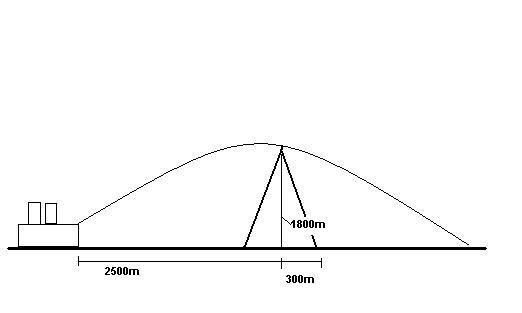
physics.jpg


Sorry for such a rough hand sketch, I don't have a scanner.

I've tried working out this problem from doing my own research on projectile motion and basically I know I need to find the smallest and largest angles that will clear the mountain peak and find where those angles will cause the projectile to land, but I have no idea how to do that, equation wise. ANY help will be greatly appreciated.
 
Physics news on Phys.org
Write the equations for x(t) and y(t) for the projectile in terms of the firing angle. Eliminate time from the equations to find y(x). This will be the equation of the path of the shell. It will still depend on the firing angle. What conditions must this equation satisfy for the shell to clear the mountain peak? Satisfying these conditions will determine the limiting values for the firing angle. Once you have those, calculate the range of the projectile.
 
So would x(t) = 1800(t) + 250*1/2*g*t^2? And then solve out for t and use your t in y(t) = 250sin(theta)t - 1/2*g*t^2 and solve out for theta?
 
kdf8 said:
So would x(t) = 1800(t) + 250*1/2*g*t^2? And then solve out for t and use your t in y(t) = 250sin(theta)t - 1/2*g*t^2 and solve out for theta?

x(t) has an initial velocity term that depends on the angle, and no acceleration. Solve the simpler x(t) equation for time in terms of x and use that expression for time in y(t) to get the equation for y(x).
 

Similar threads

  • · Replies 2 ·
Replies
2
Views
5K
  • · Replies 11 ·
Replies
11
Views
2K
  • · Replies 9 ·
Replies
9
Views
5K
Replies
5
Views
4K
  • · Replies 3 ·
Replies
3
Views
2K
Replies
2
Views
10K
  • · Replies 23 ·
Replies
23
Views
4K
  • · Replies 22 ·
Replies
22
Views
5K
  • · Replies 3 ·
Replies
3
Views
3K
  • · Replies 4 ·
Replies
4
Views
5K