Prove: angular momentum is preserved

Click For Summary

Homework Help Overview

The discussion revolves around proving the conservation of angular momentum, specifically in the z-axis, using Hamiltonian equations. The original poster seeks to establish this proof based on prior equations related to angular momentum.

Discussion Character

  • Exploratory, Mathematical reasoning, Assumption checking

Approaches and Questions Raised

  • Participants discuss the significance of the equation ##\dot{P_{\phi}} = 0## as it relates to conservation laws. There is an inquiry into whether this equation can be equated to the expression for angular momentum ##L_z##. Additionally, there are questions regarding the definitions and relationships between variables involved in the equations.

Discussion Status

The discussion is ongoing, with participants exploring the relationships between various equations and variables. Some guidance has been offered regarding the connection between ##P_{\phi}## and ##L_z##, but no consensus has been reached on the proof itself.

Contextual Notes

Participants are working within the framework of Hamiltonian mechanics and are referencing specific equations and variables that may not be fully defined in the thread. There is an emphasis on ensuring that the mathematical relationships are correctly interpreted.

Gbox
Messages
54
Reaction score
0
Homework Statement
A particle of mass ##m## is moving in a central field with potential ##V(r)## the lagrangian in Spherical coordinate is ##l=\frac{1}{2}m(\dot{r}^2+r^2\dot{\theta}^2+r^2sin^2\theta\dot{\phi}^2)-V(r)##
Relevant Equations
##P_i=\frac{\partial }{(\partial \dot{p}_i )}##

##H(p,q)=\sum_(i=1)^n(p_i\cdot \dot{r}_i)-L##

##\dot{q}=\frac{\partial H}{(\partial p_i )}##

##\dot{p}_i=\frac{-\partial H}{(\partial q_i }##
3. Find the hamilton equations
4. using 3. prove the the angular momentum in the z axis ##L_z=m(x\dot y-xy\dot)## is preserved.

I got in ##3##:
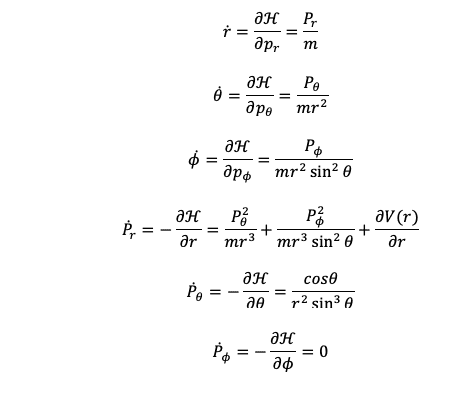
245209


How can I prove 4?
 
Physics news on Phys.org
The key equation is ##\dot{P_{\phi}} = 0## as that represents a conservation law.

You also have an equation for ##P_{\phi}## there. Can you show that is equal to ##L_z##?
 
  • Like
Likes   Reactions: Gbox
PeroK said:
The key equation is ##\dot{P_{\phi}} = 0## as that represents a conservation law.

You also have an equation for ##P_{\phi}## there. Can you show that is equal to ##L_z##?
Do you mean
##-\frac{\partial H}{\partial \phi}=m(x\dot{y}-y\dot{x})##

Where ##x=rsin\theta cos\phi, y=rsin\theta sin\phi##?
 
Gbox said:
Do you mean
##-\frac{\partial H}{\partial \phi}=m(x\dot{y}-y\dot{x})##

Where ##x=rsin\theta cos\phi, y=rsin\theta sin\phi##?

I mean your third equation below.

Gbox said:
 

Similar threads

Replies
4
Views
2K
  • · Replies 0 ·
Replies
0
Views
2K
Replies
4
Views
2K
  • · Replies 3 ·
Replies
3
Views
3K
Replies
1
Views
2K
  • · Replies 4 ·
Replies
4
Views
2K
Replies
6
Views
4K
  • · Replies 1 ·
Replies
1
Views
6K
Replies
6
Views
1K
  • · Replies 21 ·
Replies
21
Views
2K