Quartz Clocks (Battery Operated)

  • Context: Electrical 
  • Thread starter Thread starter John1397
  • Start date Start date
  • Tags Tags
    Clocks Quartz
Join the discussion
Ask a follow-up here, or get your own question answered by working scientists, mathematicians and engineers — people, not an autocomplete.
Real named experts · corrections over time · the nuance an AI answer skips
9 replies · 5K views
John1397
Messages
189
Reaction score
18
I never had quartz clock I see you need to use carbon battery, I am thinking start with 1000 ohm resistor and see if clock runs with alkaline battery if not just keep lowering resistance.

 
Physics news on Phys.org
John1397 said:
I never had quartz clock I see you need to use carbon battery, I am thinking start with 1000 ohm resistor and see if clock runs with alkaline battery if not just keep lowering resistance.
I run all my clocks with alkaline batteries. Where did you read that carbon batteries are required?
 
Last edited:
  • Like
Likes   Reactions: berkeman
John1397 said:
I never had quartz clock I see you need to use carbon battery
I'm with @anorlunda -- I don't understand your question. Do you have a datasheet for the clock you are asking about?

Or perhaps are you asking about how to build a crystal oscillator circuit? There are some requirements on the oscillator circuit (like using an unbuffered inverter for some configurations), but you would need to tell us more in order for us to help you.

crystal-oscillator.png

https://www.gadgetronicx.com/square-wave-generator-crystal-oscillator/
 
  • Like
Likes   Reactions: russ_watters
John1397 said:
I never had quartz clock I see you need to use carbon battery, I am thinking start with 1000 ohm resistor and see if clock runs with alkaline battery if not just keep lowering resistance.
A crystal regulated wall clock will run on any battery voltage from about 1.1 volts to 2.0 volts. I use rechargeable Ni-Mh cells at about 1.2 volt.

Do NOT use a resistor. The crystal oscillator runs continuously, but once each second the clock takes a short pulse of charge from the battery to advance the clock mechanism. A resistor will drop too much voltage during the pulse, which will then upset the oscillator.
 
  • Like
Likes   Reactions: berkeman
anorlunda said:
I run all my clocks with alkaline batteries. Where did you read that carbon batteries are required?
The manufacturer in China says not to use rechargeable or alkaline batteries even Seikos website says no alkaline batteries, seems to me on DC you only have volts and amps.
 
See what a seller on Ebay writes about batteries.
 

Attachments

  • Screenshot_20230110-050621.png
    Screenshot_20230110-050621.png
    40.9 KB · Views: 187
All battery-operated equipment must run off a range of voltages, since batteries vary over their useful life. Both Zn-C and alkaline batteries are nominally 1.5 V and spend most of their life between about 1.5 - 1.3 V

NiCd and NiMH have a lower voltage, starting around 1.3 V and spending most of their life around 1.2 - 1.1 V, so I can see why they might not work. And I certainly have equipment which does not work with rechargeables (on a one to one replacement basis) or works only briefly with a freshly charged battery.

Alkaline batteries are preferred for higher current loads and because they may(!) be less likely to leak if left in past their useful life.
Zn-C I've seen specifically recommended for low-drain applications like clocks.
Clocks are also less likely to leak as they are not usually on stand-by: they operate all the time and you notice quickly if the battery reaches the end of its useful life.

If the current demand of the short pulses is significant, I'd have thought designers would include a bit of capacitance to support the transient load.
 
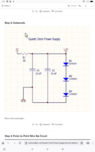
Somebody thinks this will work three diodes in row cuts voltage from 5 to 1.5.
 

Attachments

  • Screenshot_20230106-053758.png
    Screenshot_20230106-053758.png
    23.2 KB · Views: 212
John1397 said:
Somebody thinks this will work three diodes in row cuts voltage from 5 to 1.5.
"Somebody" is not a valid reference at PF. I checked the datasheet for those diodes and this schematic is obviously in error. Lordy.

Thread is closed temporarily for Moderation...
 
  • Like
Likes   Reactions: Wrichik Basu