tomul
- 9
- 1
- Homework Statement
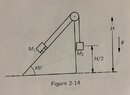
- There is a mass-pulley system as shown in the attachment. I am asked to find the acceleration of M2 with M2 > M1.
- Relevant Equations
- acceleration of free fall : g
sinθ = O / H
My attempt was to calculate the acceleration of M2 as the acceleration of M2 if it were the only mass in the system, minus the component of M1's acceleration along the slope. And then I would divide the whole thing by 2 to get the acceleration for just one of the two masses@
a = 1/2 ( g - [acceleration of M1 along slope] )
Based on what I've seen online, this approach seems to be correct, however I think I'm resolving the acceleration incorrectly. The angle in the triangle is 45 degrees, so taking the sine of this will give sin 45 = O / H. The opposite should be the acceleration downwards due to gravity and since weight acts downwards, I figured this should just be free fall acceleration, g. So to get the component along the slope I would need to rearrange for H. sin45 = g / H becomes g / sin45 = H. So:
a = 1/2 (g - g/sin45)
a = g/2 (1-1/sin45)
But it seems the actual answer is:
a = g/2 (1 - sin45)
I can only think that I must have resolved the acceleration incorrectly...
a = 1/2 ( g - [acceleration of M1 along slope] )
Based on what I've seen online, this approach seems to be correct, however I think I'm resolving the acceleration incorrectly. The angle in the triangle is 45 degrees, so taking the sine of this will give sin 45 = O / H. The opposite should be the acceleration downwards due to gravity and since weight acts downwards, I figured this should just be free fall acceleration, g. So to get the component along the slope I would need to rearrange for H. sin45 = g / H becomes g / sin45 = H. So:
a = 1/2 (g - g/sin45)
a = g/2 (1-1/sin45)
But it seems the actual answer is:
a = g/2 (1 - sin45)
I can only think that I must have resolved the acceleration incorrectly...
Attachments
Last edited: