Reduction of Order Problem for Differential Equations Class

1 reply · 2K views · last reply
M87TJC
Messages
2
Reaction score
0
Homework Statement
Find second solution for differential equation using reduction of order (see first image)
Relevant Equations
equation labeled (5) in first image in addition to equation 1
Problem statement:
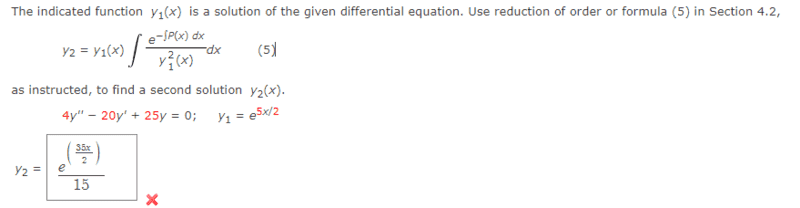
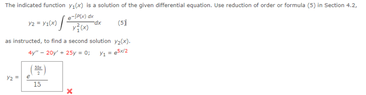
Screenshot of a textbook problem on reduction of order: y1 = e^(5x/2) solves 4y'' - 20y' + 25y = 0, with formula y2 = y1 times the integral of e^(-∫P dx) over y1 squared, and a student's wrong answer y2 = e^(35x/2) over 15.

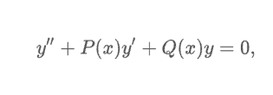
Second order linear differential equation in standard from
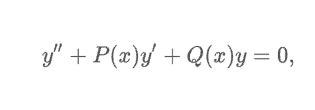
Standard form of a second-order linear homogeneous differential equation: y'' + P(x)y' + Q(x)y = 0, where P and Q are functions of x.

Reasoning:
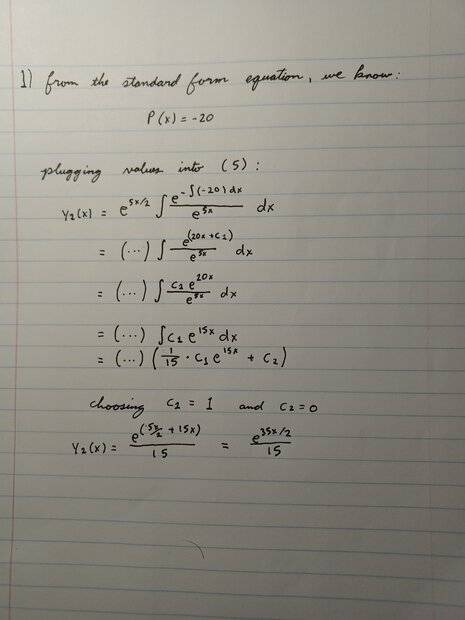
Handwritten reduction of order derivation: P(x) = -20, then Y2(x) = e^(5x/2) times the integral of e^(-∫(-20)dx) over e^(5x) dx, simplified step by step to e^(15x) and then Y2(x) = e^(35x/2)/15 with c2 = 1 and c2 = 0.
 
Attachments
  • Screenshot of a textbook problem on reduction of order: y2 = y1(x) times the integral of e^(-∫P(x)dx) over y1 squared, formula (5), to find a second solution to 4y'' - 20y' + 25y = 0 with y1 = e^(5x/2). Student's answer shown as y2 = e^(35x/2) over 15, marked wrong.
    1633375118018.png
    9 KB · Views: 240
  • Second order linear homogeneous differential equation in standard form: y'' + P(x)y' + Q(x)y = 0, where y'' and y' are second and first derivatives of y with respect to x.
    1633375502266.png
    1.5 KB · Views: 185
I just looked back at the original problem, and I realized that I did not put the equation into standard form. If I divide the equation by 4 and repeat the same process I get the correct answer.