Related: Center of Mass, Torque, and Tension on a String. Find θ, m1, and m2.

Click For Summary

Homework Help Overview

The discussion revolves around a physics problem involving a horizontal beam supported by a hinge and a cable, with a package placed on the beam. The participants are tasked with evaluating the angle θ, the mass of the beam (mb), and the mass of the package (mp) based on the given conditions and equations related to torque and center of mass.

Discussion Character

  • Exploratory, Conceptual clarification, Mathematical reasoning, Problem interpretation, Assumption checking

Approaches and Questions Raised

  • Participants discuss calculating the total torque around the hinge and equating it to zero. There are attempts to clarify the center of mass of the beam and the combined system of the beam and package. Questions arise about the correct application of torque equations and the implications of including certain forces in the calculations.

Discussion Status

Some participants have provided guidance on the correct approach to calculating the center of mass and torque. There is an ongoing exploration of how to equate the torques and the role of different forces in the system. Multiple interpretations of the problem setup and equations are being discussed, indicating a productive exchange of ideas.

Contextual Notes

Participants are working within the constraints of the problem as posed, with specific values and relationships given in the diagrams. There is an acknowledgment of potential confusion regarding the inclusion of certain forces in the torque calculations.

DavidAp
Messages
44
Reaction score
0
Figure 12-52a shows a horizontal uniform beam of mass mb and length L that is supported on the left by a hinge attached to a wall and on the right by a cable at angle θ with the horizontal. A package of mass mp is positioned on the beam at a distance x from the left end. The total mass is mb + mp = 59.8 kg. Figure 12-52b gives the tension T in the cable as a function of the package's position given as a fraction x/L of the beam length. The scale of the T axis is set by Ta 500 N and Tb 700 N. Evaluate (a) angle θ, (b) mass mb, and (c) mass mp.

The answers are displayed at the bottom of the diagrams.
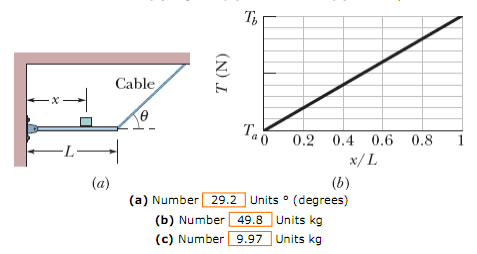
2kfp6d.png


Related Equation:
T = r*Fτ

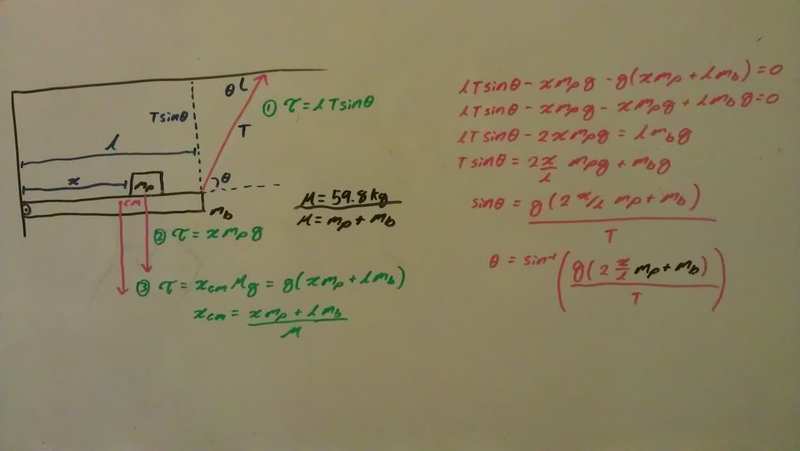
My attempt at this problem can be seen in the image below. I decided to write it on my board to make it easier to follow and less strenuous on the eyes; however, if my handwriting is illegible please do not hesitate to tell me for I will retype it for you as a response. Although my work below doesn't show it I have been tackling this problem for over an hour on various sheets of paper and have been able to get no where so any help is much appreciated.

I feel as if I am suppose to isolate mp+mb so that I may replace it with M but in my final equation I am unable to due so because 2x/l is being multiplied to mp. As for x/l and T, if I am able to isolate mp+mb, I was just planning on picking a random point on the chart above to place into my equation. Is this what I'm suppose to do?
2n9vldt.jpg


Thank You for taking the time to review my question.

(note) I'm sorry if the size of my image creates any inconveniences.
(edit) Small grammar mistakes.
 
Last edited:
Physics news on Phys.org
You've got the right idea by calculating the total torque around the hinge and equating it to zero. But You haven't calculated it right.

l \ T \ sin(\theta)=g(m_p+m_b)x_{cm}
This is what you should be trying to get, so you need to calculate the value of x_{cm} correctly.

So first, you need to think what is the centre of mass of the beam, and use that to find the centre of mass of the two objects combined.

I'm guessing you already know it, but just in case, this is the equation for the centre of mass of a collection of masses:
x_{cm} = \frac{\Sigma m_i \ x_i}{\Sigma m_i} = \frac{\int \ \mu_{(x)} x \ dx}{\int \ \mu_{(x)} \ dx}

Which is the representation in the non-continuous and continuous cases. (\mu is the linear density - ie mass per length).
 
Last edited:
BruceW said:
You've got the right idea by calculating the total torque around the hinge and equating it to zero. But You haven't calculated it right.

l \ T \ sin(\theta)=g(m_p+m_b)x_{cm}
This is what you should be trying to get, so you need to calculate the value of x_{cm} correctly.

So first, you need to think what is the centre of mass of the beam, and use that to find the centre of mass of the two objects combined.

I'm guessing you already know it, but just in case, this is the equation for the centre of mass of a collection of masses:
x_{cm} = \frac{\Sigma m_i \ x_i}{\Sigma m_i} = \frac{\int \ \mu_{(x)} x \ dx}{\int \ \mu_{(x)} \ dx}

Which is the representation in the non-continuous and continuous cases. (\mu is the linear density - ie mass per length).
So the centre of mass of the beam, disregarding the package on top, should be the center of the beam. I did some quick integration and it was right.
Xcm = ∫(0,l) xρdx / ∫(0,l) ρdx = ρ(X^2 / 2)(0, l) / ρ(X)(0,l) = (l^2 / 2)/(l) = l/2

Once I have that do I use a series to calculate the center of mass of the two body system?
Xcm = (l/2 mb + xmp)/M?

If so I'm not quite sure how this helps assuming that my two previous equations for torque where right.
1) Torque = lTsinθ
2) Torque = xgmp >>> I'm starting to think that I shouldn't have this but this is a force in the system to I'm hesitant to remove it. However, even if I did remove it...
3) Torque = g(l/2 mb + xmp) >>> I'm not sure how this would help.

What should I do?
 
DavidAp said:
So the centre of mass of the beam, disregarding the package on top, should be the center of the beam. I did some quick integration and it was right.
Xcm = ∫(0,l) xρdx / ∫(0,l) ρdx = ρ(X^2 / 2)(0, l) / ρ(X)(0,l) = (l^2 / 2)/(l) = l/2

Once I have that do I use a series to calculate the center of mass of the two body system?
Xcm = (l/2 mb + xmp)/M?
This is exactly right.

DavidAp said:
2) Torque = xgmp >>> I'm starting to think that I shouldn't have this but this is a force in the system to I'm hesitant to remove it. However, even if I did remove it...
Yes, you need to remove this, because it is already accounted for when you combined the two bodies to get their centre of mass.

DavidAp said:
1) Torque = lTsinθ ... 3) Torque = g(l/2 mb + xmp)
Now you equate these two torques (since they must cancel). And if you imagine T as y and x/L as x, you've got a straight line of y against x. The graph gives you this, so you get two pieces of information - the intercept and the gradient. You need to use both of these to find the answer.
 

Similar threads

Replies
7
Views
2K
Replies
1
Views
4K
Replies
13
Views
2K
  • · Replies 10 ·
Replies
10
Views
6K
  • · Replies 9 ·
Replies
9
Views
7K
Replies
10
Views
3K
  • · Replies 5 ·
Replies
5
Views
2K
  • · Replies 4 ·
Replies
4
Views
4K
  • · Replies 18 ·
Replies
18
Views
2K
  • · Replies 30 ·
2
Replies
30
Views
4K